


For decades, Testosterone Replacement Therapy (TRT) was viewed through a narrow, often stigmatized lens. It was seen either as a medical life raft for the elderly or a “secret sauce” for competitive bodybuilders. That era is over. In 2026, hormone optimization is widely recognized as a cornerstone of preventative health, mental resilience, and longevity medicine. TRT benefits for men
The modern man is not searching for this treatment just because he wants to get huge. He is searching because he is tired. He is asking, “Why do I feel anxious, brain fogged, and lethargic at 35?”
The answer often lies in the data. We are currently facing a silent epidemic of hypogonadism. Studies confirm that testosterone levels in men have been dropping steadily for decades. A man born in 1995 has significantly less testosterone than his grandfather did at the same age, likely due to a combination of microplastics, environmental estrogens, sedentary lifestyles, and chronic stress.
This guide is your roadmap. It covers TRT benefits, Testosterone replacement therapy cost, how to get TRT, low testosterone symptoms, TRT timeline, bioidentical testosterone, online TRT clinic reviews, TRT side effects the real world numbers, the exact costs, the delivery methods, and the optimization protocols that separate successful therapy from a medical nightmare.
The Symptoms: It Is Not Just About Libido
When people think of “low T,” they usually think of erectile dysfunction. While that is a major symptom, it is often the last one to show up. The early warning signs are much more subtle and often misdiagnosed as depression or “just getting old.”
If you are experiencing three or more of the following, your hormones may be the root cause:
- Mental: Chronic brain fog, lack of motivation, social anxiety, and a feeling of “numbness” toward life.
- Physical: Difficulty building muscle despite training hard, accumulation of visceral fat around the belly, and persistent joint pain.
- Sleep: Insomnia or waking up feeling unrefreshed (poor sleep efficiency).
- Recovery: Soreness that lasts for days after a standard workout.
The Numbers: Reference Range vs. Optimized Range
One of the most confusing and frustrating aspects of TRT is the blood work. You can walk into a standard doctor’s office with the testosterone levels of an 80 year old man, and they will tell you that you are “normal.”
Technically, they are right. You are in the reference range. But in the world of Fit Science, “normal” does not mean healthy. It definitely does not mean optimized. The reference range is an average of the entire population, including sick, sedentary, and aging men. It is not a benchmark for peak performance.
Data Chart: The Optimization Gap
This table illustrates the massive difference between what insurance companies consider acceptable and what optimization clinics aim for.
| Parameter | Standard Medical “Normal” Range | Optimization / Sport “Ideal” Range | What It Actually Does |
| Total Testosterone | 264 – 916 ng/dL | 800 – 1100 ng/dL | The total amount of hormone in your blood. The “gas in the tank.” |
| Free Testosterone | 8.7 – 25.1 pg/mL | 20 – 30 pg/mL | The amount actually available for your body to use. This matters more than Total T. |
| Estradiol (E2) | 7.6 – 42.6 pg/mL | 20 – 40 pg/mL | Estrogen. You need this for joint health and libido, but too high causes side effects. |
| SHBG | 16.5 – 55.9 nmol/L | 20 – 40 nmol/L | Sex Hormone Binding Globulin. It acts like a sponge that soaks up your testosterone. |
The Takeaway: A level of 350 ng/dL might be “normal” for a geriatric patient, but for a 35 year old man, it is a state of deficiency that contributes to depression, cardiac risk, and metabolic disease. Optimization therapy aims to restore levels to the upper quartile of a healthy young man, typically the 800 to 1000 ng/dL range.
Real World Results: The TRT Timeline
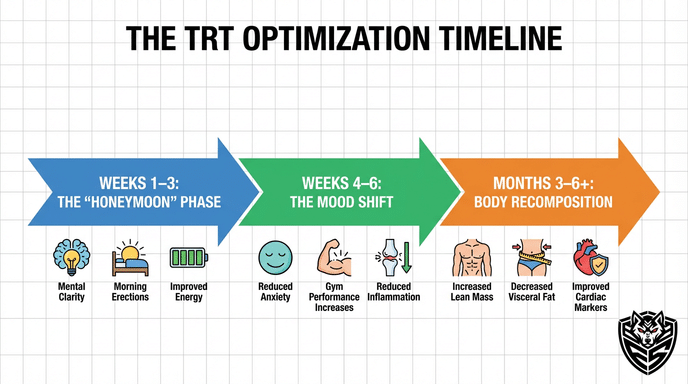
TRT is not a magic pill. You do not inject it and wake up looking like a fitness model the next day. It is a biological process that takes time to saturate androgen receptors and change gene expression. Based on clinical data and thousands of patient logs, here is the realistic timeline of what happens when you start.
Weeks 1 to 3: The Placebo Phase and Libido
Most physical changes have not started yet, but many men report a “honeymoon phase.”
- Mental: A sudden lift in brain fog. You might find yourself completing tasks at work that you have been putting off for months.
- Sexual: Morning erections often return within the first 10 days, followed by a noticeable increase in libido.
- Physical: No visible muscle changes yet, but sleep quality often improves, specifically the duration of deep wave sleep.
Weeks 4 to 6: The Mood Shift
This is where the antidepressant effects kick in.
- Mental: Reductions in anxiety and irritability. Men often describe this as feeling “calm under pressure.” The small things that used to make you angry simply stop bothering you.
- Physical: Gym pumps become more noticeable. Inflammation and chronic joint pain may start to decrease as fluid retention shifts.
Months 3 to 6: The Body Composition Change
This is the “Fit Science” sweet spot. If your nutrition and training are dialed in, this is when the visual transformation occurs.
- Physical: Increased lean muscle mass and decreased body fat. The fat loss is specifically “visceral fat,” the dangerous fat around your organs.
- Health: Your red blood cell count (hematocrit) may rise, requiring monitoring. Lipid profiles often shift, with Total Cholesterol usually dropping, though HDL (good cholesterol) needs to be watched.
Delivery Methods: Gels vs. Injections vs. Pellets
Not all testosterone is created equal. The method of delivery dictates how stable your blood levels are, which in turn dictates how you feel.
1. Injections (The Gold Standard)
This is the most effective and reliable method. Using Testosterone Cypionate or Enanthate, you inject the oil into the muscle or subcutaneous fat.
- Pros: 100% absorption, precise dosing, and easy to adjust. It allows you to maintain stable levels 24/7.
- Cons: You have to be comfortable with needles.
2. Transdermal Gels and Creams
You rub these on your shoulders or scrotum daily.
- Pros: No needles. Mimics a daily natural rhythm.
- Cons: Absorption is terrible for many men. It can transfer to women and children by touch (which is dangerous). It is often much more expensive than injectable testosterone.
3. Pellets
A doctor surgically implants pellets under the skin of your glute every 3 to 6 months.
- Pros: “Set it and forget it.”
- Cons: You cannot adjust the dose once it is inside you. If your levels get too high or you have a bad reaction, you literally have to cut them out. Infection rates are higher than injections.
The Verdict: For 95% of men, injectable testosterone is the superior choice for control, cost, and results.
The Protocols: Modern Dosing Strategies
Gone are the days of receiving one massive 200mg injection every two weeks at a doctor’s office. That antiquated protocol causes massive roller coaster spikes in hormones. You feel like Superman for three days, then you crash and feel terrible for a week.
Modern TRT relies on micro dosing for stable blood levels.
The Standard Optimized Protocol
- Dosage: 100 mg to 150 mg per week total.
- Frequency: Split into at least two doses (e.g., 50 mg Monday morning, 50 mg Thursday evening).
- Why split the dose? Injecting more frequently keeps the peak testosterone lower (less estrogen conversion) and the trough higher (no crash before the next shot). This mimics natural production more closely and reduces side effects like acne.
HCG (Human Chorionic Gonadotropin)
Many clinics prescribe HCG alongside testosterone. This peptide mimics LH (Luteinizing Hormone) and keeps the testicles functioning.
- Why use it? Without HCG, TRT will cause testicular atrophy (shrinkage) and shut down fertility. If you want to have children in the future, or if testicular size is important to you, HCG is non negotiable.
The Cost of TRT in 2025
Search interest for “testosterone replacement therapy cost” is high because prices vary wildly depending on which route you take.
Route A: The Insurance Path (Urologist)
- Cost: $10 to $50 copay per month.
- Pros: Cheapest option.
- Cons: Extremely difficult to qualify. You often need two blood tests under 250 ng/dL (which is remarkably low). Doctors are often not trained in optimization and may refuse to treat symptoms if your numbers are technically “in range.”
Route B: Online Telemedicine Clinics
- Cost: $150 to $250 per month.
- Pros: This is the “optimization” route. These clinics understand that the goal is performance and health, not just sick care. The price usually includes the medication, needles, shipping, and doctor consultations.
- Cons: Usually out of pocket (no insurance accepted).
Route C: Local Men’s Health Centers
- Cost: $300 to $500 per month.
- Pros: In person monitoring. Some offer additional therapies like B12 shots, peptides, or “executive physicals.
- Cons: Often the most expensive option and can sometimes be salesy.
Side Effects and Risk Management
TRT is a medical intervention, not a supplement. It carries specific risks that must be managed through quarterly blood work.
Hematocrit (Thick Blood)
Testosterone stimulates red blood cell production. If it gets too high (Hematocrit > 52%), the blood becomes viscous, increasing the risk of stroke or heart attack.
- Management: Staying hydrated is key. If levels remain high, therapeutic phlebotomy (donating blood) acts as an oil change, instantly lowering the viscosity.
Estradiol Management (The AI Debate)
Some testosterone converts to estrogen. High estrogen causes nipple sensitivity (gynecomastia), water retention, and emotional volatility.
- Management: Old school doctors prescribe Anastrozole (an Aromatase Inhibitor) automatically. Modern experts advise against this. Estrogen is neuroprotective and cardio protective. The preferred method to control estrogen is simply lowering the testosterone dose or increasing injection frequency, rather than blocking estrogen chemically.
Infertility
Exogenous testosterone signals your brain to stop producing LH and FSH, the hormones that tell your testes to make sperm.
- Management: As mentioned, HCG is used to maintain fertility. However, if you are actively trying to conceive right now, you may need to come off TRT entirely and switch to a pure fertility protocol (like Enclomiphene).
Conclusion: Is Optimization Worth It?
For men suffering from true hypogonadism, TRT is not just life changing; it is life saving. The data clearly shows that men with low testosterone have higher all cause mortality rates, higher rates of diabetes, and higher rates of cardiovascular disease than men with normal levels.
However, it is a lifelong commitment. You cannot cycle TRT like a pre workout powder. Once you start, your natural production shuts down, and coming off can be a difficult hormonal transition. The decision requires a serious cost benefit analysis of your current quality of life versus the commitment to weekly injections and health monitoring.
For the Fit Science audience, TRT represents the ultimate baseline. No amount of creatine, protein powder, or perfect training can overcome a hormonal environment that is fighting against you. Fixing the foundation is the first step to building the house.
Scientific References and Further Reading
- Travison TG, et al. (2007). A population-level decline in serum testosterone levels in American men. Journal of Clinical Endocrinology & Metabolism, 92(1), 196-202.The definitive study proving the generational decline in male testosterone levels.
- Morgentaler A. (2009). Testosterone therapy and prostate cancer: the myth and the reality. Urology, 73(4), 738-742.Dr. Morgentaler’s work debunking the old belief that TRT causes prostate cancer.
- Corona G, et al. (2011). Testosterone replacement therapy and cardiovascular risk: A meta-analysis. Expert Opinion on Drug Safety, 10(6), 899-917.Meta-analysis showing that restoring testosterone levels is generally cardio protective.
- Bhasin S, et al. (2018). Testosterone Therapy in Men with Hypogonadism: An Endocrine Society Clinical Practice Guideline. The Journal of Clinical Endocrinology & Metabolism, 103(5), 1715-1744.The gold standard clinical guidelines for diagnosis and treatment.
- Finkelstein JS, et al. (2013). Gonadal steroids and body composition, strength, and sexual function in men. New England Journal of Medicine, 369(11), 1011-1022.Breakdown of how testosterone vs. estrogen affects libido and fat accumulation.
- Snyder PJ, et al. (2016). Effects of Testosterone Treatment in Older Men. New England Journal of Medicine, 374, 611-624.The “T Trials” – a major set of studies confirming benefits in sexual function, mood, and walking distance.
- Hackett G, et al. (2017). The British Society for Sexual Medicine Guidelines on Adult Testosterone Deficiency, with Statements for UK Practice. The Journal of Sexual Medicine, 14(12), 1504-1523.Provides the “optimization” ranges and symptom based diagnosis criteria.
- Kovac JR, et al. (2014). Men with Low Testosterone Levels Have a Higher Risk of Death. Journal of Sexual Medicine, 11(7), 1723-1725.Highlights the mortality risk of untreated hypogonadism.
- Rastrelli G, et al. (2018). Testosterone and sexual function in men. Maturitas, 112, 46-52.Deep dive into the timeline of sexual benefits.
- Bachman E, et al. (2014). Testosterone induces erythrocytosis via increased erythropoietin and suppressed hepcidin: evidence for a new erythropoietin/hemoglobin set point. Journals of Gerontology Series A, 69(6), 725-735.Explains the mechanism behind high hematocrit (thick blood) on TRT.