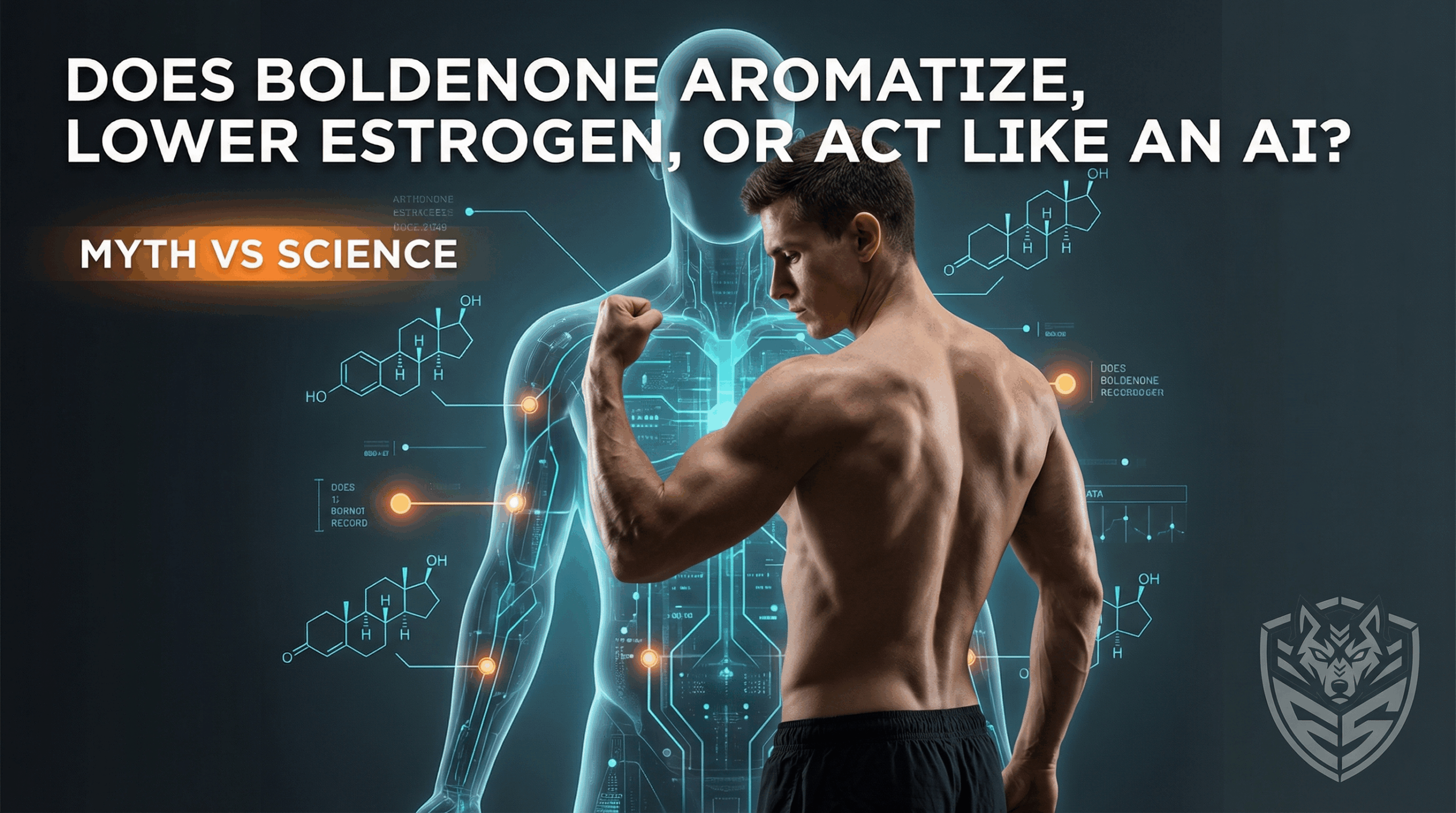
Boldenone, most people know it by the name Equipoise or EQ, sits right in the middle of one of the biggest misunderstandings in bodybuilding. Ask around long enough and you will hear that EQ barely aromatizes, that it aromatizes at half the rate of testosterone, or that it somehow acts like a built in aromatase inhibitor that controls estrogen on its own. These ideas have been repeated so often that they feel true simply by repetition. But once you look deeper, you realize they are shortcuts, distortions, or partial truths that grew into myths.
If EQ really did build lean muscle steadily, increase appetite, create vascularity, and control estrogen automatically, it would be the most praised drug in the enhanced world. Yet the real world is full of people who ran EQ and experienced strange bloodwork, anxiety, libido swings, sky-high hematocrit, headaches, or lingering side effects. That gap between promise and reality exists because EQ is more complicated than most people bother to understand.
Boldenone is nothing mystical. It is a modified testosterone molecule with a structural tweak and a long undecylenate ester. That ester is slow and stubborn. EQ builds up gradually and clears even more slowly. Many lifters underestimate how long it remains active inside the body. On paper, EQ is anabolic, moderately androgenic, and aromatizable. In practice, people often like it because appetite rises, gains come on gradually rather than explosively, and the visual look tends to be dry and athletic instead of swollen.
The dryness is where misconceptions are born.
Aromatase is an enzyme that converts androgens into estrogens. Testosterone becomes estradiol. Androstenedione becomes estrone. Estradiol is powerful. It affects libido, mood, confidence, joint integrity, bone strength, cardiovascular resilience, cognition, motivation, and recovery. Estrone is weaker but still relevant and under certain conditions can convert back into estradiol. So asking “does EQ aromatize” is not the right question. The right questions are whether EQ aromatizes, how much it aromatizes, and what it aromatizes into.
Old literature commonly claimed that EQ aromatizes at about half the rate of testosterone. That number took on a life of its own. The problem is that it was never really grounded in solid modern human data. There are not controlled trials of bodybuilders running matched anabolic loads of testosterone and EQ with full estrogen profiling. What is more realistic is that EQ tends to produce fewer obvious estradiol-driven symptoms. Less water retention. Less visible bloat. Less nipple irritation in many people. From there, people assumed “less estrogen” when the truth is closer to “different estrogen.”
That assumption evolved into something bigger when bloodwork entered the picture. Guys running testosterone alone saw estradiol rise. Guys running testosterone plus EQ sometimes saw estradiol drop or normalize. Then they heard about lab molecules that looked similar to boldenone and showed some aromatase inhibition in test tubes. They also heard anti-doping discussions where boldenone metabolites and AI metabolites had to be differentiated. Without context, all of this started sounding like boldenone had anti-estrogen properties.
It doesn’t.
Aromatase uses boldenone as a substrate. EQ is something aromatase can act on. EQ does not behave like a real aromatase inhibitor. AIs are designed to bind aromatase and reduce estrogen formation in a predictable way. EQ appears to shift the estrogen environment instead of blocking it. There tends to be less estradiol and proportionally more estrone and other estrogenic derivatives. Less estradiol typically means less visible estrogenic water retention, but the body is not in an estrogen-free state. It is in an altered estrogen balance.
This is where regular estradiol testing becomes misleading.
Most estradiol blood tests are designed for normal hormonal patients, not enhanced athletes. They struggle with unusual metabolites and sometimes misread or fail to read what is actually present. A user might run EQ, see estradiol drop on paper, feel tighter, and conclude estrogen has been crushed. Meanwhile estrogenic signaling is still active, just expressed differently and harder to measure.
EQ also interacts strongly with appetite and nutrient partitioning. For many lifters, EQ makes food easier to eat in large amounts without constant digestive discomfort. That matters. Getting enough calories in while staying lean can be harder than training. EQ can make this easier. But more appetite plus altered estrogen plus increased blood thickness becomes a combination that requires attention, not carelessness.
The ester deserves respect too. That undecylenate ester stays active long after injections stop. People finish cycles thinking they are “off” when in reality EQ is still influencing blood viscosity, hormones, lipids, and recovery. Post-cycle timing, blood donation timing, and expectations about returning to baseline all get complicated by the slow clearance of EQ.
Bloodwork, when done correctly, reveals EQ’s true fingerprints. The markers that matter most are often not the ones beginners obsess over. Important things to watch include
• hematocrit and hemoglobin, because blood thickening is one of EQ’s most persistent effects
• HDL cholesterol, because EQ commonly pushes it down
• kidney function, since thicker blood forces kidneys to work harder
• estradiol and estrone together, when possible, to see the pattern not just the number
• resting blood pressure, since viscosity plus water shifts can quietly elevate it
Focusing only on estradiol is how users blind themselves.
It also helps to compare EQ to other familiar compounds. Testosterone aromatizes strongly. Its estrogen profile is straightforward. Nandrolone has a totally different interaction with progesterone receptors and neurochemistry, which is why its side effects feel unique. EQ sits somewhere else entirely. It shifts estrogen sideways, not up or down in the traditional sense. That sideways shift is why EQ sometimes causes unusual mood patterns. Some report calm focus, others report creeping anxiety or irritability. Hormones shape the brain as much as the body, and different estrogens do not “feel” the same.
Dose culture is another problem. The bodybuilding world is full of dosing folklore. EQ especially gets abused because it feels subtle. People tell themselves that because EQ does not explode them with water, they can run more. Instead of respecting it, they stretch cycles longer and longer because EQ supposedly “needs time.” Meanwhile hematocrit keeps rising, blood gets thicker, the heart works harder, kidneys are overburdened, lipids drift downward, and recovery post-cycle becomes harder than expected.
Contest prep complicates things further. Some competitors add EQ thinking it will make them dry. In early phases, it may help appetite and support lean gain. But as prep progresses and estrogen levels drop from diet, stress, and other drugs, that EQ-driven estradiol shift can make joints hurt, libido tank, mood flatten, and physique look oddly flat if things go too far. Dry is good up to a point. Beyond that point, dry becomes fragile.
EQ is especially misleading for men on TRT. Someone on TRT adds EQ and suddenly feels leaner, stronger, and their estradiol number drops. They assume EQ fixed an “estrogen problem.” What actually happened is that EQ shifted the equation, altered testing, and quietly increased hematocrit and cardiovascular stress. Months or years later, problems show up. The person is confused, because on paper they believed they were doing everything right.
Coming off EQ also takes longer than people expect. Because EQ clears slowly, natural hormone recovery is delayed. HPTA suppression lingers. Some people feel “off” for months without understanding why. They assume PCT failed instead of realizing the compound itself was still present.
A lot of discussion around estrogen management with EQ is also misguided. People expect AI dosing “templates” that work regardless of context. EQ breaks templates. If someone reflexively piles AI on top of EQ, they often end up with estradiol too low and estrone dominating. The result feels terrible. Dry joints, flat training sessions, low libido, emotional instability. The problem is not EQ alone. The problem is EQ misunderstood and managed aggressively with drugs that did not belong there.
On top of everything hormonal, EQ carries cardiovascular concerns that deserve serious respect. Boldenone has a pronounced ability to increase red blood cell production. Thick blood is not a cosmetic issue. It is a mechanical stress on the heart and vessels. Combined with weight training, heavy loads, stimulants, possibly high calories, and sometimes dehydration, the situation grows risky quickly. Some lifters attempt to fix this with frequent blood donation without understanding that aggressively lowering blood iron can create its own problems, fatigue, and performance crashes if done thoughtlessly.
There are also situations where EQ is simply the wrong choice. It is a poor option for someone already dealing with high hematocrit or hypertension. It makes little sense for someone who has difficulty recovering naturally. It is not ideal for people with anxiety tendencies given how estrogen shifts can affect the brain. And it is not some safe alternative for new users who think they are “avoiding estrogenic drugs.”
So here is the clean, honest picture.
Boldenone aromatizes, but it does not do so in a typical testosterone-like way. It does not act as an aromatase inhibitor. It shifts the estrogen pattern, often increasing estrone relative to estradiol. It can make bloodwork confusing, especially if low quality testing is used. It can make someone look leaner while quietly increasing hematocrit, altering cholesterol, stressing the cardiovascular system, and complicating recovery. It can feel incredible for some phases and absolutely terrible if mishandled or misunderstood.
This does not mean EQ has no place. It explains why EQ is misunderstood. Appetite support, steady development, cosmetic hardness, and performance benefits make sense. But those upsides exist alongside consequences that need to be managed honestly. Not wished away. Not ignored because “it doesn’t bloat me.”
The athletes who do best long term are not the ones who chase every compound that seems magical on paper. They are the ones who understand how each compound truly behaves, who respect the tradeoffs, and who stop believing in shortcuts that chemistry never promised.
EQ is not a built-in estrogen solution. It is not a “milder” testosterone. It is not automatically safer. It is a powerful hormone tool with unique behavior, and if someone chooses to use it, the smartest thing they can do is treat it with respect, track the right markers, avoid reflexive AI abuse, and realize that what they feel today is only part of the long story.