

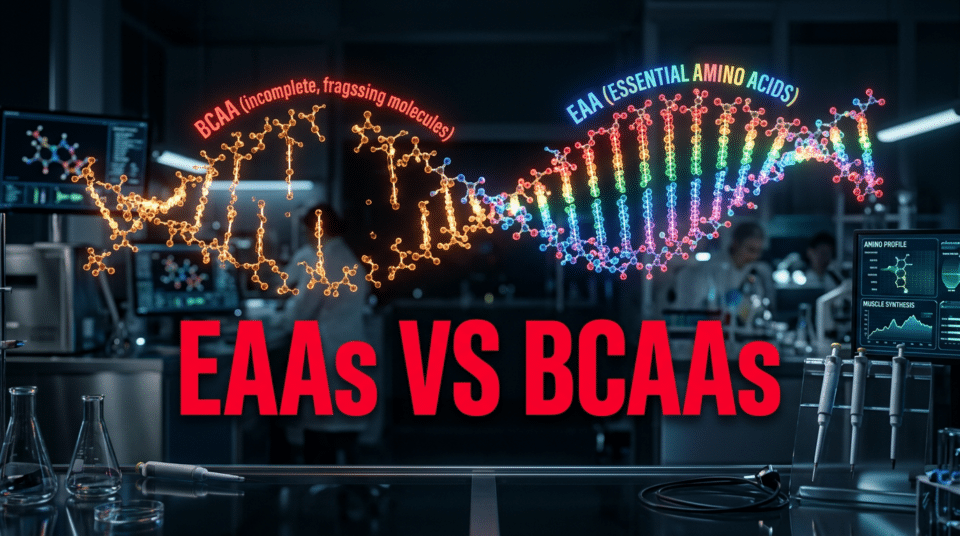
Everyone wants to know about EAAs vs BCAAs. The question “Are EAAs better than BCAAs for muscle protein synthesis?” has a definitive scientific answer: Yes. While BCAAs (Branched-Chain Amino Acids) have long been the industry standard, modern exercise physiology in 2026 has confirmed that they are an incomplete solution. To build muscle, the human body requires a “full deck” of all 9 essential amino acids. Relying on BCAAs alone is the biological equivalent of starting a construction project with a foreman but no building materials.
The Direct Answer: EAAs vs BCAAs Why EAAs Win for Protein Synthesis
Muscle Protein Synthesis (MPS) is a complex process that requires all 9 Essential Amino Acids (EAAs) to be present in the blood simultaneously. While BCAAs only provide 3 of these (Leucine, Isoleucine, and Valine), EAAs provide the full spectrum. Recent clinical data shows that while BCAAs can “signal” the body to start growth, the actual rate of synthesis is roughly 50% lower than when a complete EAA profile is used. In fact, taking BCAAs in isolation can actually trigger muscle catabolism as the body is forced to harvest the missing 6 amino acids from its own tissue to satisfy the signal sent by the BCAAs.
The Science of Muscle Protein Synthesis (MPS)
To understand the EAAs vs BCAAs debate, you must understand how your body builds tissue at the cellular level. Muscle Protein Synthesis is regulated primarily by the mTORC1 pathway, a nutrient-sensing complex that acts as the master switch for hypertrophy.
Leucine: The Starter Pistol
Leucine, the primary Branched-Chain Amino Acid, is the most potent activator of mTORC1. It acts as the “starter pistol” for a race. When Leucine levels rise in the blood, the body receives a signal that it is time to build muscle. This is the primary reason BCAAs became popular—they are high in Leucine and relatively cheap to manufacture.
The Limiting Amino Acid Theory
The “Limiting Amino Acid” theory states that protein synthesis will only occur at the rate of the lowest available essential amino acid. Imagine a car assembly line. If you have 500 engines (Leucine) but only 10 steering wheels (the other 6 EAAs), you can only build 10 cars. The excess engines are essentially wasted for the purpose of building cars.
When the body receives the signal to build muscle but lacks the other 6 essential amino acids, it enters a state of metabolic stress. It will actually break down existing muscle tissue (the “bricks” it already has) to harvest the missing amino acids required to satisfy the growth signal sent by the BCAAs. This is why, for hypertrophy and recovery, EAAs are significantly better than BCAAs.
EAAs vs BCAAs: A Detailed Comparison
BCAAs (Branched-Chain Amino Acids)
- Component Count: 3 (Leucine, Isoleucine, Valine)
- mTOR Signaling: High (Trigger only)
- Muscle Growth: Incomplete/Limited
- Digestion: Instant Absorption
- Best Use: Reducing mental fatigue during training
EAAs (Essential Amino Acids)
- Component Count: 9 (The Full Spectrum)
- mTOR Signaling: High (Trigger + Supply)
- Muscle Growth: Optimal/Complete
- Digestion: Instant Absorption
- Best Use: Muscle protein synthesis and recovery
The Metabolic Advantage of EAAs
For athletes on a calorie-restricted “cutting” phase, the EAAs vs BCAAs choice is even more critical. During a deficit, the body is highly catabolic. Supplemental EAAs provide a “free-form” source of aminos that hit the bloodstream within minutes without requiring the digestive energy of a whole-food protein source.
Because EAAs contain Tryptophan and Methionine—which are absent in BCAAs—they support neurotransmitter production and metabolic health that BCAAs simply cannot touch. This leads to better focus during training and more efficient fat oxidation. Furthermore, the inclusion of Lysine and Threonine in EAA blends supports collagen synthesis and immune function, both of which are compromised during intense training cycles.
The Leucine Threshold Strategy
The key to a god-tier EAA supplement is hitting the Leucine Threshold. Science suggests you need approximately 3 grams of Leucine to maximally stimulate the mTOR pathway. When you check your EAA label, ensure that the total profile provides all 9 aminos while maintaining a high concentration of Leucine. If an EAA supplement is “fairy-dusted” with only milligrams of the other 6 amino acids, it is effectively just a BCAA supplement with better marketing.
Dosing Protocol for Maximum Hypertrophy
To optimize your results from the latest EAAs vs BCAAs data, follow this 2026 protocol:
Intra-Workout Dosing
Mix 10 to 15 grams of EAAs with 500ml of water. Sip this throughout your session to provide a constant drip of building blocks while blood flow to the muscles is at its peak. This “perfusion” of amino acids directly into the working tissue is the most effective way to prevent mid-workout muscle breakdown.
Post-Workout Window
If you cannot eat a whole food meal within 30 minutes of training, a 10 gram dose of EAAs will bridge the gap. Unlike whey protein, which must be broken down into peptides, free-form EAAs are available to the muscle cells almost instantly, halting the catabolic processes initiated by heavy lifting.
Fasted Training Preservation
If training before your first meal, 10 grams of EAAs will protect muscle tissue from breakdown without causing the heavy insulin spike associated with whey protein. This allows you to stay in a “fat-burning” state while ensuring your biceps aren’t being used as a fuel source.
Common Myths in the Amino Acid Market
Myth 1: BCAAs are enough if my protein intake is high.
While whole food protein contains all EAAs, free-form EAAs bypass the liver and require zero digestion. This makes them specifically valuable during the workout when blood flow is diverted away from the gut and toward the muscles.
Myth 2: EAAs will break my fast.
In a clinical sense, yes, because they contain calories. However, for the purposes of fat loss and muscle preservation, the 40 to 60 calories in a scoop of EAAs are negligible and will not stop your body from oxidizing fat.
Myth 3: BCAAs are better for weight loss.
There is zero evidence to support this. In fact, because EAAs support more muscle mass through superior protein synthesis, they indirectly support a higher metabolic rate, making them the superior choice for long-term body recomposition.
FAQ: Frequently Asked Questions
Do EAAs work better than whey protein?
EAAs and whey protein both provide all 9 essential amino acids. However, EAAs are “free-form” and require no digestion. This makes them better for intra-workout use, while whey protein is better as a meal replacement because it digests more slowly and provides a longer-lasting “anabolic drip.
Can I stop taking BCAAs if I have EAAs?
Yes. Every EAA supplement already contains the 3 BCAAs. Taking extra BCAAs is redundant and provides no additional benefit.
How many grams of EAAs do I need?
For most athletes, 10 to 15 grams of EAAs during a workout is the “sweet spot” for maximizing protein synthesis without wasting product.

