

The Complete Body Recomposition Guide With Action Plans
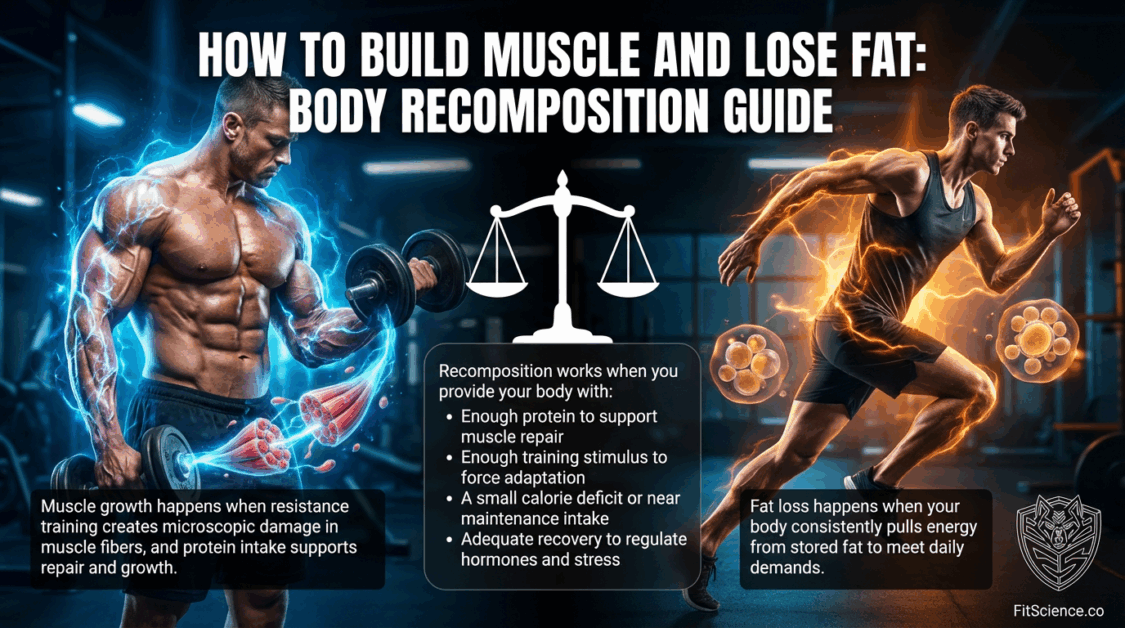
If you have searched for how to build muscle and lose fat at the same time, body recomposition plan, recomp diet, or best workouts to gain muscle while losing fat, you are not alone. Body recomposition is one of the most searched fitness goals because it promises something that once seemed impossible. Improving muscle mass while simultaneously reducing body fat.
For decades, fitness advice told people they had to choose. Either bulk and gain muscle while adding fat, or cut calories and lose fat while risking muscle loss. Modern research, combined with real world training data, shows that this all or nothing approach is outdated.
Body recomposition is real, achievable, and sustainable when done correctly.
This guide goes far beyond surface level advice. You will learn exactly how body recomposition works, who it works best for, how to structure nutrition and training, and how to execute a step by step plan that actually produces visible results.
What Is Body Recomposition
Body recomposition refers to improving your ratio of lean muscle mass to body fat. Instead of focusing on weight loss or weight gain, the goal is to look leaner, stronger, and more athletic at the same body weight or even a slightly higher one.
This is why the scale becomes a poor measurement tool during recomposition. Muscle is dense. Fat is bulky. You can lose inches and gain strength without dramatic changes in scale weight.
People searching for what is body recomposition often misunderstand it as a vague concept. In reality, it is a deliberate strategy built around nutrition timing, resistance training, recovery, and consistency.
Can You Build Muscle And Lose Fat At The Same Time
Yes. You can build muscle and lose fat at the same time.
This is most effective when at least one of the following is true:
• You are new to resistance training
• You are returning after time off
• You carry moderate body fat
• You are not close to your genetic muscular ceiling
If you are an advanced lifter at very low body fat, recomposition is still possible, but slower and more dependent on precise execution.
For beginners and intermediates, body recomposition often happens faster than expected because the body adapts rapidly to new training stress and improved nutrition.
How Body Recomposition Actually Works
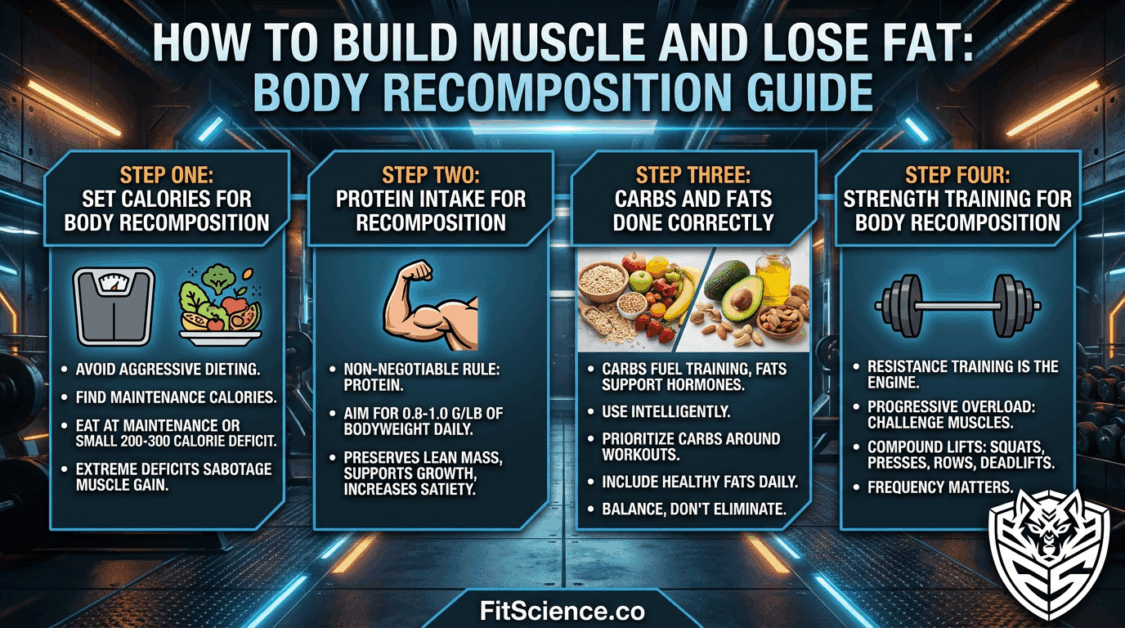
Muscle growth and fat loss are driven by different processes, but they are not mutually exclusive.
Muscle growth happens when resistance training creates microscopic damage in muscle fibers, and protein intake supports repair and growth.
Fat loss happens when your body consistently pulls energy from stored fat to meet daily demands.
Recomposition works when you provide your body with:
• Enough protein to support muscle repair
• Enough training stimulus to force adaptation
• A small calorie deficit or near maintenance intake
• Adequate recovery to regulate hormones and stress
When these conditions are met, the body can allocate nutrients toward muscle while still reducing fat stores.
Step One: Set Calories For Body Recomposition
If you search for body recomposition calories, the most common mistake you will see is aggressive dieting.
Large calorie deficits slow muscle growth and increase fatigue. Recomposition works best near maintenance calories.
Find Your Maintenance Calories
Maintenance calories are the number of calories required to keep your body weight stable. From there, most people succeed with one of two approaches:
• Eat at maintenance and let training drive recomposition
• Eat in a small deficit of 200 to 300 calories
Extreme deficits sabotage performance and recovery, which directly hurts muscle gain.
Step Two: Protein Intake For Recomposition
If there is one non negotiable rule for body recomposition, it is protein.
People searching how much protein to build muscle and lose fat should aim for:
0.8 to 1.0 grams of protein per pound of body weight per day
Protein preserves lean mass during fat loss and supports muscle growth when paired with training.
High protein intake also increases satiety, which helps control hunger while calories are managed.
Step Three: Carbs And Fats Done Correctly
Carbohydrates fuel training. Fats support hormones.
Recomposition does not require cutting carbs. It requires using them intelligently.
Carbohydrates
• Prioritize carbs around workouts
• Eat more carbs on training days
• Reduce carbs slightly on rest days if needed
Fats
• Include healthy fat sources daily
• Avoid dropping fats too low
• Balance fats rather than eliminating them
People searching best diet for body recomposition often fail because they remove entire macronutrient groups instead of structuring them.
Step Four: Strength Training For Body Recomposition
If nutrition is the foundation, resistance training is the engine.
People searching best workouts to build muscle and lose fat need to understand that cardio alone does not drive recomposition. Strength training does.
Training Principles That Matter
Progressive overload
You must challenge muscles with increasing weight, reps, or volume over time.
Compound lifts
Squats, presses, rows, deadlifts, and lunges recruit more muscle and stimulate greater hormonal responses.
Frequency
Train each muscle group at least twice per week for optimal growth.
Sample Weekly Body Recomposition Training Plan
Day One: Upper Body Strength
Bench press 4 sets of 6 to 8
Pull ups or lat pulldowns 3 sets of 8 to 10
Dumbbell rows 3 sets of 10
Overhead press 3 sets of 8
Day Two: Lower Body Strength
Squats 4 sets of 6
Romanian deadlifts 3 sets of 8
Leg press 3 sets of 12
Calf raises 3 sets of 15
Day Three: Active Recovery
Light cardio or walking
Mobility work
Day Four: Hypertrophy Focus
Incline dumbbell press 3 sets of 10
Cable rows 3 sets of 12
Lateral raises 3 sets of 15
Leg extensions 3 sets of 12
Day Five: Posterior Chain And Core
Deadlifts 4 sets of 5
Lunges 3 sets of 10
Hamstring curls 3 sets of 12
Core work
Day Six: Optional Cardio Or Conditioning
Low intensity cardio or intervals
Day Seven: Rest
Step Five: Cardio Without Killing Muscle Gains
People often ask does cardio hurt muscle growth.
Cardio does not kill muscle gains. Excessive cardio combined with under eating does.
For recomposition:
• Use low to moderate intensity cardio
• Keep sessions short and purposeful
• Avoid daily high intensity sessions
Cardio should support calorie expenditure, heart health, and recovery, not dominate the program.
Step Six: Sleep And Recovery Matter More Than You Think
Poor sleep directly reduces muscle protein synthesis and increases fat retention.
If you want to build muscle while losing fat, aim for:
• 7 to 9 hours of sleep per night
• Consistent sleep and wake times
• Reduced late night screen exposure
Recovery is not optional. It is a growth tool.
How To Track Body Recomposition Progress
Stop relying on the scale alone.
Better metrics include:
• Progress photos
• Strength increases
• Waist and hip measurements
• Clothing fit
Many people fail at recomposition because they quit when the scale stalls, even though their body is changing.
Highly Googled Body Recomposition Questions Answered
Can beginners build muscle and lose fat at the same time
Yes. Beginners often see the fastest recomposition.
Is body recomposition better than bulking and cutting
For many people, yes. It is more sustainable.
What is the best body recomposition diet
High protein, moderate carbs, controlled calories.
How long does body recomposition take
Visible changes often occur within 8 to 12 weeks.
Do supplements help body recomposition
Protein powder and creatine can support results, but are not required.
Can women do body recomposition
Absolutely. The principles are the same.
How often should I train for recomposition
Three to five strength sessions per week.
Does fasting help body recomposition
Only if it helps control calories without hurting training performance.
Should I bulk or recomp first
If you carry excess fat, recomposition is often the smarter first move.
Why am I not losing weight during recomposition
Muscle gain offsets fat loss on the scale.
Common Body Recomposition Mistakes
• Eating too little
• Skipping strength training
• Doing excessive cardio
• Underestimating protein intake
• Ignoring recovery
Avoiding these mistakes dramatically improves results.
Final Thoughts
Body recomposition is not magic. It is precision.
When you align calorie intake, protein, intelligent training, and recovery, your body adapts. You gain muscle. You lose fat. You look stronger and leaner without extreme dieting cycles.
If your goal is how to recomp, how to gain muscle and lose fat, or best plan to build muscle while cutting fat, this approach works because it respects how the body actually functions.
Consistency beats perfection. Execute the plan. Track intelligently. Adjust slowly.
That is how real recomposition happens.