

If you have ever taken a break from the gym and wondered how fast you lose muscle when you stop working out, you are not alone. Many people fear that a week without training erases all progress. The truth is more nuanced. There is muscle loss when training stops, but the rate, severity, and long-term consequences depend on many factors including your training history, nutrition, age, and how you manage the break.
This guide breaks down the science, the timeline, the real reasons muscle atrophy happens, and most importantly the exact action steps you can take to preserve muscle whether you are on a break, injured, traveling, or shifting your routine.
What Happens to Muscle When You Stop Training
Muscle is a use it or lose it tissue. Your body adapts to the demands you place on it. When those demands disappear, the body begins to reallocate resources. But muscle loss does not happen overnight.
The process is influenced by:
- How long and how hard you have trained before stopping
- Your age and hormonal profile
- Your diet, especially protein intake
- How active you remain outside formal workouts
Understanding muscle loss starts with knowing the timeline.
How Fast You Lose Muscle When You Stop Working Out
Week 1 Without Training
Most people feel an early drop in muscle “pump” and fullness within the first week off. This is primarily water loss and glycogen depletion, not actual muscle tissue shrinking. Real muscle protein breakdown has not accelerated yet.
During this period:
- Strength and muscle size feel slightly reduced
- Actual muscle fiber cross sectional area remains nearly intact
For most lifters, little to no actual muscle loss occurs in the first 7 days.
Week 2 Without Training
By the second week, the body begins to dial down the processes that support heavy lifting. Neuromuscular efficiency declines slightly, meaning your ability to recruit muscle fibers as effectively as before reduces a bit.
During this phase:
- You may feel weaker or slower in memory of strength
- Small reductions in muscle mass begin
- Protein synthesis slows because training stimulus is absent
Still, meaningful muscle loss is modest in most individuals.
Weeks 3 to 4 and Beyond
This is where measurable muscle loss begins for many people. Without training, the body starts repurposing amino acids more aggressively. Early signs may include:
- Visible reduction in muscle fullness
- Noticeable strength decline
- Slight decrease in measurements
However, even at this point, the rate of loss is gradual.
What Influences the Rate of Muscle Loss
Not everyone loses muscle at the same rate. Key factors include:
Training history
Long term lifters with years of consistent training have more muscle memory and slower atrophy.
Age
Younger people tend to retain muscle longer when inactive.
Diet, especially protein
Adequate protein slows the rate of muscle catabolism.
Activity levels outside the gym
Remaining active through walking, cycling, or bodyweight work helps preserve muscle signals.
Myth Versus Reality
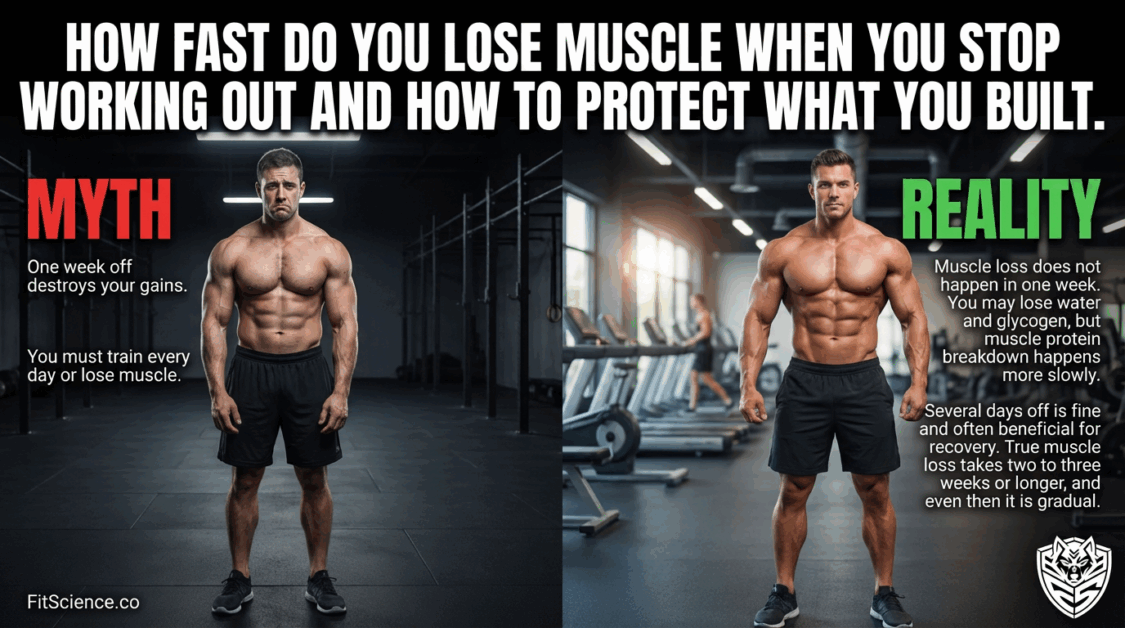
Myth: One week off destroys your gains.
Reality: Muscle loss does not happen in one week. You may lose water and glycogen, but muscle protein breakdown happens more slowly.
Myth: You must train every day or lose muscle.
Reality: Several days off is fine and often beneficial for recovery. True muscle loss takes two to three weeks or longer, and even then it is gradual.
How To Prevent Muscle Loss When You Stop Training
If you are concerned about muscle loss, there are proven strategies to protect your gains.
1. Maintain High Protein Intake
Protein is the most important nutritional factor for preserving muscle mass when training stops. Aim for:
0.8 to 1.0 grams of protein per pound of body weight daily
Protein provides amino acids that signal the body to maintain muscle.
2. Stay Active With Low Impact Movement
You do not need heavy lifts to preserve muscle signals. Activities that maintain tension and movement help:
- Bodyweight circuits
- Cycling
- Swimming
- Walking briskly
- Resistance bands
These increase caloric expenditure, maintain circulation, and keep the nervous system engaged.
3. Do Minimal Strength Work
Even a reduced volume program helps. For example:
- Two full body sessions per week at 50 to 70 percent intensity
- 6 to 8 reps per exercise
- Focus on major muscles: squats, rows, presses
This preserves neuromuscular coordination and slows atrophy.
4. Prioritize Sleep And Recovery
Sleep plays a crucial role in muscle maintenance by regulating hormones such as growth hormone and testosterone. Aim for:
- 7 to 9 hours per night
- Consistent sleep schedule
Poor sleep increases catabolic signals that accelerate muscle loss.
5. Manage Stress
High stress raises cortisol, which promotes muscle protein breakdown. Use stress management tools like:
- Meditation
- Deep breathing
- Light walking
- Time outdoors
Stress reduction becomes more important when training stimulus is reduced.
Sample Off Training Plan To Preserve Muscle
If you are taking a break for a week or more, follow this actionable routine:
Day One
Light full body resistance band session
Bodyweight squats
Push ups
Pull motion with band
Plank holds
Day Two
Brisk walk or cycling
Keep heart rate elevated but not exhausting
Day Three
Reduced load strength session
Moderate weights with controlled reps
Day Four
Active recovery
Yoga or mobility work
Day Five
Repeat Day One routine
Focus on form and muscle engagement
Day Six
Outdoor activity
Hiking, swimming, or power walking
Day Seven
Rest and recovery
This keeps movement in the system without overtaxing recovery.
Signs You Are Losing Muscle
Be aware of these signals so you can adjust your plan:
1. Clothes feel looser
When shirts and pants fit differently across shoulders, chest, or thighs.
2. Strength drops significantly
A loss of reps or weight in core lifts over consecutive weeks.
3. Visible reduction in muscle fullness
A flatter look even at similar body weight.
If you notice these signs earlier than expected, adjust your protein, add low intensity resistance work, and check sleep quality.
When Muscle Loss Is Normal
In situations such as serious injury, illness, or long term bed rest, some muscle loss is expected. In these cases, focus on:
- Gradual reintroduction of movement
- Targeted nutrition support
- Patience and progressive loading when ready
Muscle memory makes regaining lost muscle easier when you can train again.
How To Regain Muscle Faster After A Break
Muscle memory is real. When you return to training after a break:
You will rebuild muscle faster than you built it originally.
Recent research and training data show that prior training leaves lasting adaptations in satellite cells and neuromuscular pathways.
To maximize regained muscle:
- Start with moderate volume
- Progress loading gradually
- Eat plenty of protein
- Sleep well
This accelerated regrowth is one of the reasons consistent training early in life pays dividends later.
Short Answer: How Fast Do You Lose Muscle When You Stop Working Out
• First week: minimal muscle loss
• Second week: small decline begins
• Three to four weeks: measurable atrophy begins
• Eight weeks and beyond: noticeable declines if no activity or nutrition focus
Remember this: training absence does not erase years of progress in days. The body adapts slowly. You can preserve much of your muscle with smart nutrition and light activity.
Frequent Questions Answered Clearly
Will one week off ruin my progress?
No. You may see water and strength fluctuation, but muscle mass stays largely intact.
Can you lose muscle in 10 days?
Only in extreme inactivity, severe calorie restriction, or illness. Normal breaks do not cause significant loss this fast.
Should you train when sick?
Light movement may help, but avoid heavy training when you are unwell. Focus on recovery, protein, and sleep.
Does age affect muscle loss speed?
Yes, older adults lose muscle faster if inactive, but proper nutrition and activity still protect muscle.
Can walking preserve muscle?
Yes, walking maintains activity signals but should be combined with strength work for best results.
Final Recommendation
Muscle loss when you stop working out happens gradually. It is not a sudden downfall. With proper protein, activity, minimal strength work, sleep, and stress management, you can preserve most of your muscle even during extended breaks.
Training is powerful. But smart, strategic management of inactivity is equally important. With the right habits, you protect your gains, your confidence, and your long term progress.
Your muscle does not disappear. It adapts. Respect that process and manage it strategically. That is how real body transformation lasts.