
WHAT YOU’LL LEARN IN THIS GUIDE
- Why SARMs change your recovery capacity and how to train around it
- Exact volume, frequency, and intensity adjustments to make on cycle
- The best training splits for SARMs bulking, cutting, and recomp phases
- How to periodize your program during an 8–12 week cycle
- What happens to muscle when the cycle ends and how to protect your gains
- Common training mistakes that waste your cycle results
- Sample weekly training program for a SARMs cycle (intermediate lifter)
Training on a SARMs cycle without adjusting your program is like buying a sports car and keeping it in second gear. SARMs change your recovery ceiling, your protein synthesis rate, and how fast muscle tissue repairs between sessions and if your training doesn’t reflect that, you’re leaving serious gains on the table. Most lifters who start a RAD-140 or LGD-4033 cycle just keep doing the same three-days-a-week routine they ran before. That’s the wrong move. Here’s exactly how to structure your training on cycle to get everything the compound has to offer.
THE SHORT ANSWER
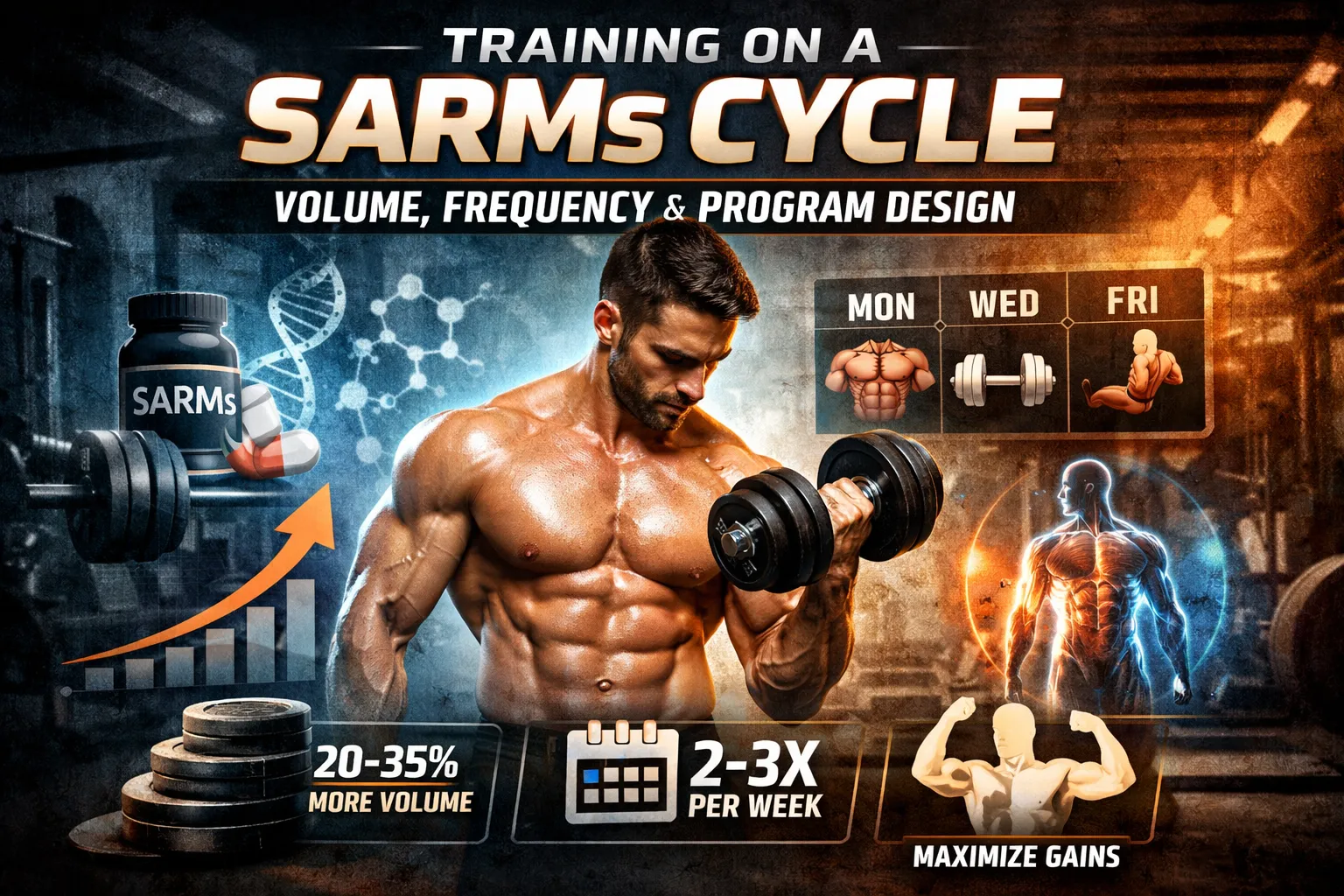
Training on a SARMs cycle should involve 20–35% more weekly volume than your natural baseline, with muscle groups hit 2–3 times per week to maximize the enhanced protein synthesis window. SARMs accelerate recovery significantly, which means you can handle more sets per session and more frequent sessions — but only if you systematically build toward that increased load over the first two weeks of your cycle. Training on SARMs without increasing volume is a missed opportunity; training with too much volume too fast increases injury risk.
1. How SARMs Change Your Recovery Capacity: The Physiology
To understand how to train on a SARMs cycle, you need to understand what SARMs actually do at the cellular level. Selective androgen receptor modulators bind to androgen receptors in muscle and bone tissue with relative selectivity, driving protein synthesis upward and accelerating the satellite cell activity that repairs muscle fibers after hard training.
The net result is a meaningful reduction in muscle recovery time. Studies on anabolic compounds consistently show that protein synthesis rates can increase by 25–40% in the early weeks of use. For a trained lifter, this translates directly to a shorter recovery window between sessions and a higher tolerable training load before you hit the point of diminishing returns.
WHAT THE RESEARCH SAYS
A 2023 review published in Molecular and Cellular Endocrinology confirmed that androgenic compounds — including selective AR modulators — enhance myofibrillar protein synthesis and reduce markers of muscle damage (creatine kinase, myoglobin) 24–48 hours post-exercise compared to controls. The practical implication: muscle that would normally need 72 hours to recover from a heavy training session may be ready again in 48 hours on cycle.
This isn’t permission to train every day until you fall apart. It’s a signal to program smarter. Your joints, tendons, and central nervous system still need time. The increased training load on cycle should come from volume — more sets and more weekly frequency — not from training to failure on every set or adding weight faster than your connective tissue can handle.
2. How Much to Increase Training Volume on Cycle
Volume is the primary lever when training on a SARMs cycle. Here’s a practical framework for how much to increase it, based on your starting point and the specific compound you’re running.
Baseline Volume (Natural Lifters)
Most intermediate natural lifters respond well to 10–20 working sets per muscle group per week. Going beyond 20 sets often produces diminishing returns without pharmaceutical support.
On-Cycle Volume Target
On a SARMs cycle, you can productively push to 16–28 sets per muscle group per week, depending on the compound, your training age, and how aggressive the cycle is. The key is to ramp up progressively — don’t jump from 12 sets to 24 sets in week one.
| Compound | Anabolic Potency | Recommended Volume Increase | Ideal Rep Range |
|---|---|---|---|
| RAD-140 (Testolone) | High | +25–35% weekly sets | 6–12 reps |
| LGD-4033 (Ligandrol) | High | +20–30% weekly sets | 6–10 reps |
| Ostarine (MK-2866) | Moderate | +15–20% weekly sets | 10–15 reps |
| S4 (Andarine) | Moderate | +15–20% weekly sets | 8–12 reps |
| YK-11 | Very High | +30–40% weekly sets | 6–10 reps |
| MK-677 (Ibutamoren) | Moderate (GH-based) | +10–20% weekly sets | 10–15 reps |
GYM APPLICATION
If you’re running RAD-140 and currently do 16 sets for chest per week, target 20–22 sets by week three of your cycle. Add two sets to one session in week one, two more in week two, then assess soreness and performance. Don’t chase maximum volume — chase performance. If your sets are weaker in week three than week one, you’ve gone too far too fast.
3. Training Frequency: How Often to Hit Each Muscle Group on Cycle
Training frequency is where most lifters on SARMs leave gains behind. Natural lifters often do fine hitting a muscle once or twice per week. On cycle, twice per week per muscle group is the floor — three times per week is often optimal for upper body muscle groups with shorter recovery needs.
- Bulking (LGD-4033, RAD-140, YK-11): Hit each major muscle group 2–3x per week. Upper body can handle three times; legs benefit from twice weekly with high volume.
- Cutting (Ostarine, S4, Cardarine stacks): Maintain 2x weekly frequency for each muscle to preserve mass in a caloric deficit. Don’t drop to once per week — the anabolic stimulus is what prevents muscle loss while you’re eating in a deficit.
- Recomp (Ostarine or LGD at moderate dose): 2–3x weekly. Priority is consistency over maximum volume since calories are maintenance-range.
4. Best Training Splits for a SARMs Cycle
Option 1: PPL 6-Day (Best for Bulking Cycles)
Push/Pull/Legs run twice per week — Monday through Saturday with Sunday rest. Each muscle gets two quality sessions per week, volume is spread across the week for optimal recovery, and the structure supports high weekly set counts without individual sessions becoming too long.
Option 2: Upper/Lower 4-Day (Best for Recomp/Cutting)
Upper body Monday and Thursday, Lower body Tuesday and Friday. Clean structure, easy to adjust volume per session, and effective at 4 days per week if life doesn’t allow for six. Works well with moderate-dose SARMs cycles like Ostarine or MK-677.
Option 3: Full Body 3x/Week (Best for MK-677 or Low-Dose Cycles)
Three full-body sessions per week with a day of rest between each. Good for lifters running MK-677 (Ibutamoren) for sleep and GH pulse benefits rather than strong AR agonists. Each session hits every major muscle group at least once per week, which satisfies the enhanced recovery window without overloading volume.
5. Intensity and Progressive Overload on Cycle
SARMs will help you recover faster and synthesize more protein — but progressive overload is still the mechanism that drives long-term strength and muscle gain. The mistake some lifters make on cycle is relying on the compound to do the work instead of driving the weight up session to session.
On a bulking SARMs cycle, aim to add weight to your compound lifts every 1–2 sessions. The enhanced protein synthesis means your muscles are primed to adapt quickly. If you’re not adding weight or reps to your main lifts across the course of a 10-week RAD-140 cycle, something is off with nutrition, sleep, or training intensity.
WHAT THE RESEARCH SAYS
Research consistently shows that anabolic compounds produce greater strength gains when paired with progressive resistance training versus rest. A well-designed 2021 study found that men on testosterone who trained progressively added 7.9 kg of lean mass in 12 weeks versus 2.0 kg in the non-training anabolic group. The compound supports adaptation — it doesn’t replace the training stimulus.
6. How to Periodize Your Program Across an 8–12 Week Cycle
Weeks 1–2: Ramp Phase
Keep volume close to your natural baseline while the compound builds in your system (most SARMs take 5–10 days to reach stable blood levels). This period is also useful for establishing rep and weight benchmarks you’ll use to track progress.
Weeks 3–6: Accumulation Phase
This is the highest-volume block. Progressively increase weekly sets by 2–4 per muscle group across this block. Drive compound lift weights up each session. Caloric intake should match your goal (surplus for bulk, deficit for cut, maintenance for recomp).
Weeks 7–10: Intensification Phase
Reduce total volume by 10–15% but increase average weight on the bar. Fewer sets, heavier loads. This is when strength peaks typically happen on a SARMs cycle.
Final Week / PCT Transition
Drop volume significantly (50%) the week after your cycle ends while you transition into PCT. Your testosterone production may be suppressed, and your recovery capacity returns to natural levels rapidly. Trying to maintain cycle-level training volume during PCT is the fastest way to lose your gains.
7. Sample Weekly Program: RAD-140 Bulking Cycle (Intermediate)
| Day | Session | Key Lifts | Sets x Reps |
|---|---|---|---|
| Monday | Push (Chest/Shoulders/Triceps) | Bench Press, Incline DB, OHP, Lateral Raises | 4–5 x 6–10 |
| Tuesday | Pull (Back/Biceps/Rear Delts) | Deadlift, Barbell Row, Pull-Up, Face Pull | 4–5 x 6–10 |
| Wednesday | Legs (Quad/Ham/Glute Focus) | Squat, Romanian DL, Leg Press, Leg Curl | 4–5 x 6–10 |
| Thursday | Push (Shoulder/Tricep Emphasis) | OHP, Incline Bench, Cable Flyes, Skullcrushers | 4 x 8–12 |
| Friday | Pull (Lat/Bicep Emphasis) | Weighted Pull-Up, Cable Row, Hammer Curls | 4 x 8–12 |
| Saturday | Legs (Hamstring/Posterior Focus) | Romanian DL, Hack Squat, Nordic Curl, Calf Raise | 4 x 8–12 |
| Sunday | Rest / Light Cardio | 20–30 min walk or zone 2 cardio | — |
8. Cardio on a SARMs Cycle
Cardio on cycle depends entirely on your goal. For bulking cycles, minimal cardio (2–3 sessions of 20–30 minutes low-intensity) is enough to maintain cardiovascular health and keep body fat in check during a caloric surplus. For cutting cycles, more cardio makes sense — but keep intensity low (zone 2 heart rate) to avoid competing with resistance training for recovery resources.
GYM APPLICATION
On a RAD-140 bulking cycle, 2–3 sessions of 25-minute incline treadmill walks (heart rate 120–135 bpm) is enough cardio. Save your recovery resources for the weight room where the anabolic signal actually produces muscle. On a cutting cycle with Ostarine or Cardarine, add one extra cardio session per week but cap individual sessions at 40 minutes to avoid cortisol accumulation that can blunt your results.
9. Common Training Mistakes on a SARMs Cycle
| Mistake | Why It Hurts | What to Do Instead |
|---|---|---|
| Keeping natural-level training volume | Under-stimulates muscle during enhanced recovery window | Add 20–35% more weekly sets progressively across the cycle |
| Maxing out weights every session | Connective tissue can’t keep up with rapid strength increases | Progress systematically; add 2.5–5% per session on compound lifts |
| Running bro split (1x/week per muscle) | Misses the accelerated recovery window | Use PPL 6-day or Upper/Lower 4-day to hit muscles 2–3x weekly |
| Not increasing calories on bulking cycle | Anabolic stimulus without sufficient substrate — limits gains | Add 300–500 kcal above maintenance; prioritize protein at 1g/lb bodyweight |
| Maintaining cycle volume during PCT | Suppressed testosterone = natural recovery speed; overtraining risk | Reduce volume 40–50% during PCT; gradually build back over 3–4 weeks |
| Ignoring sleep and recovery | SARMs amplify recovery — but only if you actually rest | 7–9 hours sleep; MK-677 users especially should prioritize sleep quality |
10. Training After Your Cycle Ends: Post-Cycle Volume Management
When your SARMs cycle ends and you transition into PCT (typically Enclomiphene citrate, Nolvadex, or Clomid for 4–6 weeks), your body’s natural testosterone production is still recovering. Your recovery capacity drops back toward baseline — sometimes temporarily below it during PCT.
⚠️ SAFETY NOTE
PCT drugs including Clomid (clomiphene citrate) and Nolvadex (tamoxifen) can cause side effects including visual disturbances, mood changes, and fatigue at higher doses. Any training fatigue during PCT should be managed with volume reduction, not by pushing through. Speak with a licensed physician before using any PCT compounds.
Key Takeaways
- SARMs accelerate protein synthesis and reduce muscle recovery time, meaning your natural training volume ceiling is higher on cycle than off
- Increase weekly sets per muscle group by 20–35% over the first 2–3 weeks of your cycle, not all at once
- Hit each major muscle group 2–3 times per week on cycle; PPL 6-day or Upper/Lower 4-day are the most effective splits
- Compound-specific volume increases are warranted — RAD-140 and LGD-4033 support higher volume than Ostarine or MK-677
- Progressive overload is still the primary mechanism of hypertrophy on cycle; SARMs enhance adaptation, they don’t replace the training signal
- Periodize your cycle into ramp, accumulation, and intensification phases rather than one static program for 10 weeks
- Drop training volume 40–50% when transitioning to PCT — your recovery capacity returns toward natural levels rapidly
- Cardio should be low-intensity on bulking cycles and moderate-frequency on cutting cycles; zone 2 cardio is the best fit for SARMs users
Frequently Asked Questions
How many days a week should I train on a SARMs cycle?
Training on a SARMs cycle, 5–6 days per week is optimal for most intermediate lifters running moderate-to-high potency compounds like RAD-140 or LGD-4033. This allows you to hit each muscle group 2–3 times per week while managing per-session volume. Lifters on lower-potency compounds like Ostarine or MK-677 can do well with 4–5 days per week.
Should I train to failure on every set when on a SARMs cycle?
No. Training to failure on every set is counterproductive whether you’re enhanced or natural. Reserve failure sets for isolation work and the last set of a compound exercise occasionally. Most sets on cycle should be taken to 1–2 reps in reserve (RIR). The volume increase is what you’re using to push adaptation — not failure-based intensity.
Can I overtrain on a SARMs cycle?
Yes, you can still overtrain on SARMs, though the threshold is higher than it is naturally. Joint and tendon stress, central nervous system fatigue, and life stress (sleep, nutrition, work) all still accumulate. Signs of overtraining include strength declining week-over-week, persistent fatigue, elevated resting heart rate, and worsening sleep. If you see these signs, reduce volume by 20–30% for one week.
How should I adjust training for a SARMs cutting cycle versus bulking?
On a cutting cycle (Ostarine, S4, or Cardarine-based stacks), maintain training frequency at 2x per week per muscle group but keep volume close to natural levels or slightly above. The goal is muscle retention in a caloric deficit, not maximum hypertrophy. On a bulking cycle, you can push volume to its upper range. The biggest mistake on cutting cycles is dropping volume too much — keep the anabolic signal strong while the caloric deficit does the fat-loss work.
How fast should I expect to add weight to the bar on a SARMs cycle?
On a well-designed bulking SARMs cycle with RAD-140 or LGD-4033, most intermediate lifters can expect compound lift strength to increase 5–15% across the cycle (roughly 8–12 weeks). Some see faster increases early in the cycle, particularly on bench press and squat. If you’re not adding weight to compound lifts at least every two sessions by weeks 3–6, evaluate your nutrition first — caloric surplus is often the limiting factor.
What happens to training gains after the SARMs cycle ends?
Some strength and size is typically retained after a cycle, particularly if PCT is handled properly and training volume is appropriately reduced during the hormonal recovery period. Muscle memory mechanisms mean that even if some size is temporarily lost post-cycle, it returns faster in subsequent training blocks. The best way to retain cycle gains is consistent training at natural-appropriate volume post-PCT and high protein intake (1g/lb bodyweight minimum) during the recovery period.
Disclaimer: This article is for informational and educational purposes only. It is not medical advice. The compounds and protocols discussed may carry serious health risks. Always consult a qualified healthcare provider before starting any new supplement, peptide, hormone, or training protocol. FitScience does not encourage or endorse the use of any illegal substances.
Related Reading on FitScience