WHAT YOU’LL LEARN IN THIS GUIDE
- Which 14 peptides the FDA peptide reclassification 2026 restores to legal compounding status
- Why BPC-157 and TB-500 are back on the table for recovery-focused lifters
- How the Category 1 vs. Category 2 peptide classification system works
- What “legal through compounding pharmacies” actually means for you
- Which reclassified peptides matter most for bodybuilding, fat loss, and recovery
- How to get a prescription and work with a compounding pharmacy
- What has NOT changed: peptides that remain restricted or banned
- Timeline and current status of the reclassification rollout
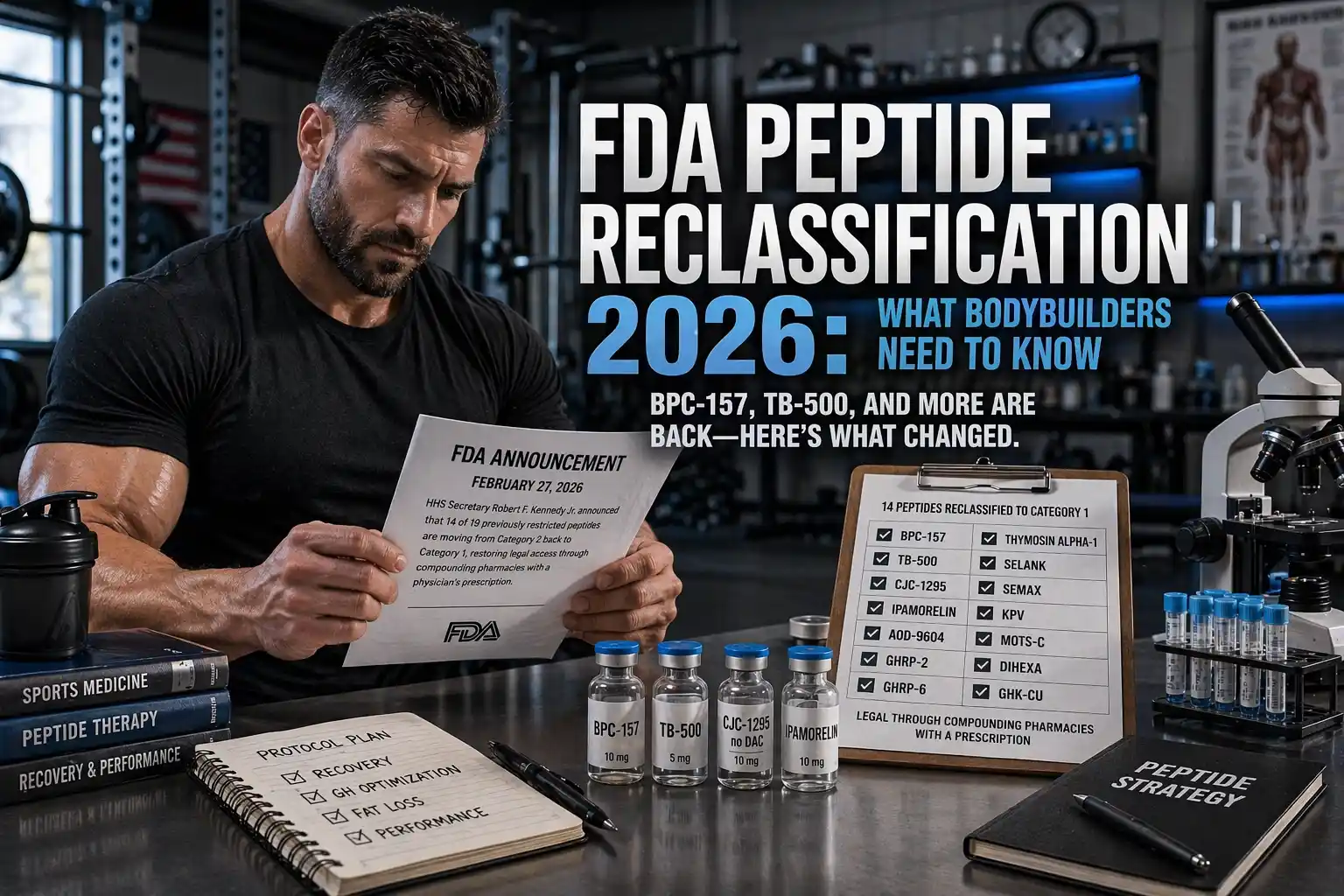
The FDA peptide reclassification 2026 is the biggest regulatory shift in performance-focused peptide access in over a decade. On February 27, 2026, HHS Secretary Robert F. Kennedy Jr. announced that 14 of the 19 peptides previously restricted under the FDA’s Category 2 list would be moved back to Category 1, restoring legal access through licensed compounding pharmacies with a physician’s prescription.
For bodybuilders, this changes the practical landscape of peptide use. Compounds like BPC-157, TB-500 (Thymosin Beta-4), CJC-1295, and Ipamorelin, long relegated to gray-market research chemical vendors, are moving back into the regulated healthcare system. That means pharmaceutical-grade sourcing, proper dosing oversight, and legal protection for the lifters who use them.
But the announcement comes with caveats. Reclassification is not the same as FDA approval. The formal guidance has been announced but not yet fully published. And not every peptide you care about made the cut.
Here’s what the FDA peptide reclassification 2026 actually means for serious lifters, what’s changing, what’s staying restricted, and how to position yourself to benefit.
THE SHORT ANSWER
The FDA peptide reclassification 2026 moves 14 previously restricted peptides, including BPC-157, TB-500, CJC-1295, Ipamorelin, and AOD-9604, from Category 2 (restricted) back to Category 1 (available through compounding pharmacies with a prescription). This means bodybuilders can legally obtain pharmaceutical-grade versions of these compounds through a licensed provider instead of relying on unregulated research chemical vendors. The reclassification was announced on February 27, 2026 by HHS Secretary Kennedy, though formal FDA implementation is still in progress.
1. How the FDA Peptide Classification System Works
Before breaking down what changed, you need to understand the system. The FDA classifies bulk drug substances (including peptides) into two categories for compounding purposes.
Category 1 peptides can be legally compounded by 503A (individual prescription) and 503B (outsourcing facility) pharmacies. A doctor writes you a prescription, a compounding pharmacy makes it, and you receive a product with verified potency and purity.
Category 2 peptides are restricted from compounding. Pharmacies cannot legally produce them, which pushes demand toward unregulated research chemical suppliers with zero quality oversight.
WHAT THE RESEARCH SAYS
A 2023 FDA analysis found that over 40% of peptide products sold through research chemical vendors contained inaccurate dosing, contamination, or degraded active compounds. The move back to Category 1 for key peptides directly addresses this quality control gap by restoring pharmaceutical-grade production pathways.
The Category 2 list was expanded significantly in 2023 and 2024, pulling popular bodybuilding peptides like BPC-157 and TB-500 out of the legal compounding pipeline. The FDA peptide reclassification 2026 reverses that trend for the majority of those compounds.
2. The Complete List of Reclassified Peptides
Here are the 14 peptides moving from Category 2 back to Category 1 under the FDA peptide reclassification 2026:
| Peptide | Primary Use for Bodybuilders | Previous Status | New Status |
|---|---|---|---|
| BPC-157 (Body Protection Compound) | Tendon/joint recovery, gut healing | Category 2 (Restricted) | Category 1 (Legal compounding) |
| TB-500 (Thymosin Beta-4) | Tissue repair, injury recovery | Category 2 (Restricted) | Category 1 (Legal compounding) |
| CJC-1295 | Growth hormone secretion | Category 2 (Restricted) | Category 1 (Legal compounding) |
| Ipamorelin | GH pulse stimulation, fat loss | Category 2 (Restricted) | Category 1 (Legal compounding) |
| AOD-9604 | Targeted fat metabolism | Category 2 (Restricted) | Category 1 (Legal compounding) |
| GHRP-2 | GH release, appetite stimulation | Category 2 (Restricted) | Category 1 (Legal compounding) |
| GHRP-6 | GH release, hunger signaling | Category 2 (Restricted) | Category 1 (Legal compounding) |
| Thymosin Alpha-1 | Immune modulation | Category 2 (Restricted) | Category 1 (Legal compounding) |
| Selank | Anxiolytic, cognitive support | Category 2 (Restricted) | Category 1 (Legal compounding) |
| Semax | Neuroprotective, focus | Category 2 (Restricted) | Category 1 (Legal compounding) |
| KPV | Anti-inflammatory (gut, skin) | Category 2 (Restricted) | Category 1 (Legal compounding) |
| MOTS-c | Mitochondrial function, fat loss | Category 2 (Restricted) | Category 1 (Legal compounding) |
| Dihexa | Cognitive enhancement | Category 2 (Restricted) | Category 1 (Legal compounding) |
| GHK-Cu | Skin repair, collagen synthesis | Category 2 (Restricted) | Category 1 (Legal compounding) |
This table represents the most significant expansion of legal peptide access since compounding pharmacies first began producing these compounds.
3. Which Reclassified Peptides Matter Most for Bodybuilders
Not all 14 peptides carry equal weight in a bodybuilding context. Here’s how the FDA peptide reclassification 2026 breaks down by training goal.
Recovery and Injury Repair
BPC-157 and TB-500 are the headliners. BPC-157 (Body Protection Compound-157) is a synthetic peptide derived from a gastric protein that has shown significant tissue-healing properties in animal studies, including accelerated tendon, ligament, and muscle repair. TB-500 promotes cell migration and angiogenesis (new blood vessel formation), which speeds recovery from soft-tissue injuries.
For lifters dealing with chronic tendinopathy, rotator cuff irritation, or knee issues from heavy squatting, legal access to pharmaceutical-grade BPC-157 and TB-500 is a practical shift. No more rolling the dice on research chemical purity.
GYM APPLICATION
If you’ve been running BPC-157 from a research vendor, the reclassification means you can switch to a compounding pharmacy source with verified potency. Talk to a TRT clinic or anti-aging physician who prescribes peptides. Many already have compounding pharmacy relationships in place.
Growth Hormone Optimization
CJC-1295, Ipamorelin, GHRP-2, and GHRP-6 are the GH secretagogue stack. CJC-1295 (with or without DAC) extends the half-life of growth hormone releasing hormone pulses, while Ipamorelin triggers clean GH release without spiking cortisol or prolactin significantly.
The CJC-1295/Ipamorelin combination is the most widely prescribed GH peptide stack in anti-aging medicine, and its return to Category 1 means broader access and lower cost through compounding.
Fat Loss
AOD-9604 targets the lipolytic (fat-burning) fragment of human growth hormone without affecting blood sugar or growth. MOTS-c is a mitochondrial-derived peptide that improves metabolic function and exercise capacity. Both are relevant for bodybuilders in cutting phases who want pharmacological fat loss support without the systemic effects of full GH therapy.
4. What Has NOT Changed: Peptides Still Restricted
The FDA peptide reclassification 2026 did not clear every peptide. Five compounds remain on the Category 2 restricted list:
- Cerebrolysin (neurotrophic complex)
- Epitalon (telomerase activator)
- Follistatin 344 (myostatin inhibitor)
- GDF-8 inhibitors (myostatin pathway)
- PE-22-28 (sigma-1 receptor agonist)
For bodybuilders, the notable absence is Follistatin 344. Follistatin is a potent myostatin inhibitor with direct muscle-growth implications, and it remains restricted from compounding. This means sourcing Follistatin still requires the unregulated research chemical market, with all its associated purity and dosing risks.
SAFETY NOTE
Reclassification to Category 1 does NOT mean FDA approval. These peptides are still considered off-label therapeutics. They require a physician’s prescription and ongoing monitoring. Self-prescribing or buying from unregulated vendors, even for Category 1 peptides, carries legal and health risks.
5. How To Get Reclassified Peptides Legally
The FDA peptide reclassification 2026 restores the legal pathway, but you still need to navigate it correctly. Here’s the step-by-step process.
- Find a prescribing physician. TRT clinics, anti-aging/longevity practices, and functional medicine doctors are the most likely to prescribe peptides. Many telemedicine platforms now offer peptide consultations.
- Get bloodwork done. Most physicians will require baseline labs (IGF-1, comprehensive metabolic panel, CBC, inflammatory markers) before prescribing GH secretagogues or recovery peptides.
- Receive a prescription. Your doctor writes a prescription for the specific peptide, dosage, and duration.
- Fill through a compounding pharmacy. The prescription goes to a 503A or 503B compounding pharmacy that produces the peptide to pharmaceutical standards with third-party testing.
- Follow up with monitoring. Responsible peptide use includes follow-up bloodwork at 4-8 weeks and ongoing physician oversight.
GYM APPLICATION
The cost of compounding pharmacy peptides is typically higher than research chemical vendors, but you’re paying for verified purity, accurate dosing, and legal protection. BPC-157 from a compounding pharmacy typically runs $150-300 per vial depending on concentration, compared to $40-80 from research vendors with unknown quality.
6. Timeline and Current Implementation Status
The FDA peptide reclassification 2026 announcement happened on February 27, 2026, but full implementation follows a regulatory process.
| Milestone | Date | Status |
|---|---|---|
| HHS Secretary Kennedy announcement | February 27, 2026 | Completed |
| Formal FDA reclassification guidance draft | Expected Q2 2026 | Pending |
| Public comment period | Expected 30-60 days after draft | Pending |
| Final rule publication | Expected Q3 2026 | Pending |
| Compounding pharmacies resume production | Varies by pharmacy | Some already preparing |
As of April 2026, the legal status is in a transitional phase. Some compounding pharmacies are already preparing to resume production based on the announcement, while others are waiting for the formal FDA guidance. The practical availability of reclassified peptides through pharmacies will likely expand significantly through mid-to-late 2026.
WHAT THE RESEARCH SAYS
An NPR investigation published March 26, 2026 confirmed that the government is actively moving to lift restrictions on the listed peptide treatments. Multiple compounding pharmacy associations have publicly stated their readiness to resume production as soon as formal guidance is published, with some pharmacies already accepting pre-orders for BPC-157 and CJC-1295/Ipamorelin combinations.
7. How This Affects the Research Chemical Market
The FDA peptide reclassification 2026 will likely reshape the peptide supply chain for bodybuilders. For years, the research chemical market has been the default source for compounds like BPC-157 and TB-500. That market operates in a legal gray area: vendors sell peptides “for research purposes only,” and buyers assume the risk of unverified purity.
With Category 1 reclassification, the pharmaceutical compounding pathway reopens. This creates a two-tier market.
Compounding pharmacy peptides will offer verified purity (typically 98%+ via HPLC testing), accurate dosing, legal purchase with a prescription, and physician oversight for safety monitoring.
Research chemical peptides will continue to exist but face increased scrutiny. Expect tighter enforcement against vendors marketing directly to consumers, and a gradual migration of informed buyers toward the legal compounding route.
For bodybuilders who prioritize knowing exactly what’s in their vial, the reclassification is a net positive regardless of the higher cost.
8. Bodybuilding Peptide Protocols That Become Easier To Access
The FDA peptide reclassification 2026 doesn’t just affect individual compounds. It unlocks entire stacking protocols that were previously difficult to source at pharmaceutical grade.
Recovery Stack (Post-Injury or Heavy Training Block)
- BPC-157: 250-500 mcg subcutaneous, 2x daily for 4-8 weeks
- TB-500: 2-5 mg subcutaneous, 2x weekly for 4-6 weeks (loading), then 2-5 mg monthly (maintenance)
GH Optimization Stack (Off-Season or Recomp)
- CJC-1295 (no DAC): 100-300 mcg subcutaneous before bed
- Ipamorelin: 200-300 mcg subcutaneous before bed
- Run 8-12 weeks on, 4 weeks off
Fat Loss Support Stack (Cutting Phase)
- AOD-9604: 300 mcg subcutaneous, fasted morning, daily
- MOTS-c: 5-10 mg subcutaneous, 3x weekly
- Run 8-12 weeks
SAFETY NOTE
These protocols are for educational reference only. Dosages are drawn from clinical literature and common practitioner protocols, not personal recommendations. Individual response varies significantly. Always work with a prescribing physician who can adjust dosing based on your bloodwork and clinical response.
9. Common Mistakes With the Peptide Reclassification
| Mistake | Why It Hurts | What to Do Instead |
|---|---|---|
| Assuming reclassification means FDA approval | These remain off-label compounds; claiming FDA approval is legally and medically inaccurate | Understand that Category 1 means legal compounding access, not FDA endorsement |
| Continuing to buy from research vendors when pharmacy access is available | You lose the purity verification and legal protection that compounding pharmacies provide | Switch to a compounding pharmacy source once your physician prescribes the peptide |
| Self-prescribing without bloodwork | Without baseline labs, you can’t track IGF-1 changes, inflammatory markers, or metabolic shifts | Get baseline bloodwork before starting and follow up at 4-8 weeks |
| Stockpiling peptides before formal guidance is published | Regulatory details may change during the comment period | Wait for formal FDA publication or work with a pharmacy that has confirmed its compliance status |
| Mixing reclassified and still-restricted peptides | Using Category 2 peptides alongside legal Category 1 peptides creates legal exposure | Keep your protocol within the reclassified compound list or accept the risk separately |
| Ignoring the prescription requirement | Category 1 does not mean over-the-counter; a physician prescription is still legally required | Establish a relationship with a prescribing physician before attempting to order |
10. What This Means for Peptide Pricing and Availability
Market dynamics will shift as the FDA peptide reclassification 2026 takes full effect. Compounding pharmacies operate under regulatory oversight that adds cost, but also adds competition.
Short-term (Q2-Q3 2026): Expect limited availability as pharmacies ramp up production. Early adopters who already have physician relationships will get access first. Prices will be premium.
Medium-term (Q4 2026 into 2027): As more pharmacies enter the market, competition will drive prices down. BPC-157, CJC-1295, and Ipamorelin are likely to become widely available at competitive price points, similar to how testosterone cypionate compounding has become cost-effective.
Long-term: The research chemical market for reclassified peptides will shrink. Vendors selling BPC-157 and TB-500 “for research only” will face a smaller customer base as the legal route becomes more convenient and affordable.
11. Article Summary
- The FDA peptide reclassification 2026, announced February 27, 2026, moves 14 peptides from Category 2 (restricted) back to Category 1 (legal compounding)
- BPC-157, TB-500, CJC-1295, Ipamorelin, AOD-9604, GHRP-2, GHRP-6, Thymosin Alpha-1, Selank, Semax, KPV, MOTS-c, Dihexa, and GHK-Cu are all included
- Follistatin 344, Cerebrolysin, Epitalon, and other myostatin-pathway compounds remain restricted
- Category 1 means legal access through compounding pharmacies with a physician’s prescription
- Reclassification is NOT FDA approval; these remain off-label therapeutics requiring medical oversight
- Formal FDA guidance is expected by Q2-Q3 2026; some pharmacies are already preparing to resume production
- Bodybuilders can access pharmaceutical-grade recovery stacks (BPC-157 + TB-500), GH optimization stacks (CJC-1295 + Ipamorelin), and fat loss support (AOD-9604, MOTS-c) through the legal compounding pathway
- The research chemical market for these compounds will likely shrink as pharmacy access expands
- Pricing will be higher initially but is expected to become competitive as more pharmacies enter the market
- Always work with a prescribing physician and get baseline bloodwork before starting any peptide protocol
Frequently Asked Questions
Is BPC-157 legal in 2026?
Under the FDA peptide reclassification 2026, BPC-157 is being moved from Category 2 (restricted) to Category 1, which means it can be legally compounded by licensed pharmacies with a physician’s prescription. This does not make BPC-157 an FDA-approved drug, and it remains an off-label therapeutic. However, the legal pathway for obtaining pharmaceutical-grade BPC-157 is being restored, which is a significant change from the restrictions imposed in 2023-2024.
Do I still need a prescription for reclassified peptides?
Yes. Category 1 reclassification means compounding pharmacies can legally produce these peptides, but only to fill a physician’s prescription. You cannot buy them over the counter or direct from a pharmacy without a prescriber. TRT clinics, anti-aging practices, and telemedicine peptide providers are the most common prescribing sources for bodybuilding-relevant peptides.
When will compounding pharmacies actually have these peptides available?
Availability varies by pharmacy. Some compounding pharmacies are already preparing to resume production of reclassified peptides based on the February 2026 announcement. Broader availability is expected once the FDA publishes formal guidance, likely in Q2-Q3 2026. If you have an existing relationship with a peptide-prescribing physician, ask them about current sourcing timelines from their pharmacy partners.
Which peptides are still restricted and cannot be compounded?
Five peptides remain on the Category 2 restricted list: Cerebrolysin, Epitalon, Follistatin 344, GDF-8 (myostatin) inhibitors, and PE-22-28. For bodybuilders, Follistatin 344 is the most notable absence. It remains unavailable through legal compounding and can only be obtained through unregulated research chemical vendors.
How does the FDA peptide reclassification 2026 affect peptide quality?
Compounding pharmacies operate under FDA and state board of pharmacy oversight, which requires adherence to USP standards for purity, potency, and sterility. This means peptides sourced from a compounding pharmacy undergo HPLC testing and quality verification that research chemical vendors do not consistently provide. For bodybuilders, this translates to knowing exactly what compound and dosage is in your vial.
Will peptide prices go down after reclassification?
Initially, compounding pharmacy peptides will cost more than research chemical alternatives, often 2-4x the price. As more pharmacies begin production and competition increases through 2026 and into 2027, prices are expected to decrease. The long-term trajectory mirrors what happened with compounded testosterone cypionate: initially premium, now widely available at competitive pricing.
Can I use research chemical peptides while waiting for pharmacy availability?
Technically, research chemical peptides are sold “for research purposes only” and not for human consumption. The FDA peptide reclassification 2026 does not change the legal status of research chemical vendors. Whether to use research chemical peptides during the transition period is a personal risk decision. The reclassification’s primary benefit is opening a regulated, quality-verified pathway that did not previously exist for these compounds.
Disclaimer: This article is for informational and educational purposes only. It is not medical advice. The compounds and protocols discussed may carry serious health risks. Always consult a qualified healthcare provider before starting any new supplement, peptide, hormone, or training protocol. FitScience does not encourage or endorse the use of any illegal substances.