How to Get Bigger Arms Fast: The Science-Backed Guide to Bigger Biceps, Triceps, and Forearms
WHAT YOU’LL LEARN IN THIS GUIDE
- Why your triceps, not your biceps, are responsible for most arm size
- The exact weekly training volume and frequency needed to build bigger arms
- The best biceps exercises ranked by EMG activation and stretch overload data
- How to get bigger biceps at home with minimal equipment
- A complete tricep muscle workout breakdown with sets, reps, and progression
- How to add forearm training without overloading your recovery
- The most common arm training mistakes and how to fix them immediately
- A ready-to-use 4-week arm specialization program
If you want to know how to get bigger arms fast, the answer is more specific than most gym influencers will tell you. Building arms that actually fill your sleeves requires understanding which muscles drive arm circumference, what training volume science recommends, and why the majority of lifters undercut their gains with the same handful of mistakes. This guide covers the full picture, from beginner to intermediate, with the research to back every recommendation.
THE SHORT ANSWER
To get bigger arms fast, train biceps and triceps 2–3 times per week with 12–20 weekly sets per muscle group, prioritizing full range of motion and stretch-focused exercises. The triceps make up roughly 60–65% of upper arm mass, so tricep training deserves at least as much volume as bicep work. Progressive overload, adequate protein intake (1.6–2.2g per kg bodyweight), and consistent sleep are the limiting factors for most people who aren’t seeing arm growth.
1. The Anatomy Behind Arm Size: Why Triceps Come First
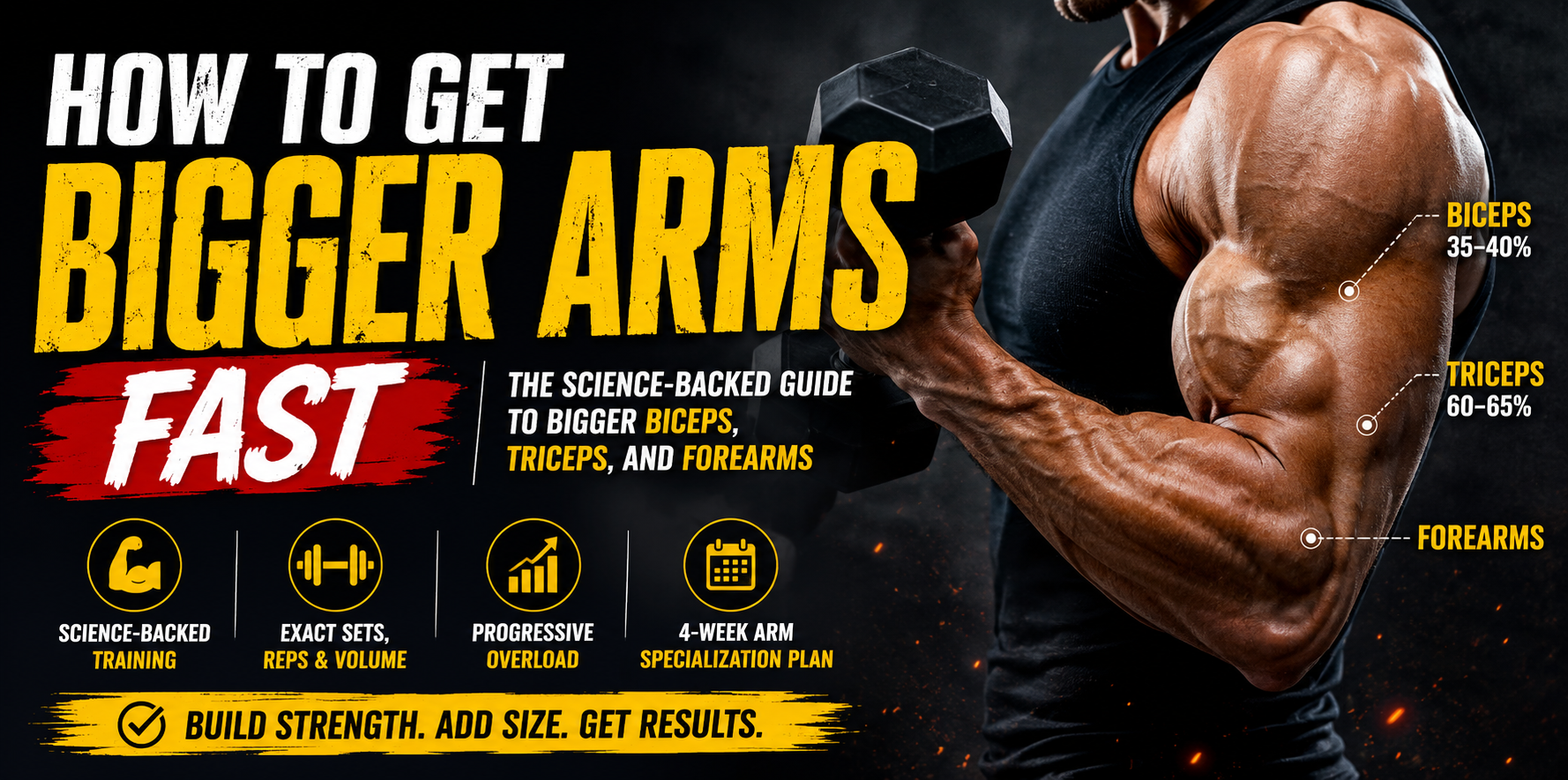
Most lifters obsess over bicep curls, but here’s the truth: the triceps brachii accounts for approximately 60–65% of total upper arm circumference. The biceps brachii covers the remaining 35–40%. If your goal is to make your arms look bigger, neglecting triceps is the single biggest mistake you can make.
The triceps has three heads: the long head, the lateral head, and the medial head. Each responds to slightly different exercises, and all three need to be trained to maximize the “horseshoe” shape visible from the side and back. The long head runs from the shoulder blade (infraglenoid tubercle) and is best targeted with overhead movements. The lateral head sits on the outside of the arm and responds best to pressdown variations. The medial head is deep and is hit by nearly all tricep exercises at the end range of motion.
For the biceps, the muscle has two heads: the long head (outer) and the short head (inner). The long head creates that bicep peak when you flex. The short head creates fullness and width when viewed from the front. Training both angles, specifically with supinated grip and neutral grip variations, develops both heads fully.
Understanding neuromuscular efficiency also matters here: the stronger the mind-muscle connection and the more efficiently your nervous system recruits motor units, the better your arm growth response to any given workout.
2. Training Volume: How Many Sets Do You Actually Need?
One of the most common reasons lifters fail to get bigger arms is doing too little volume, or wildly inconsistent volume. Research from Dr. Brad Schoenfeld and Dr. Mike Israetel’s work on minimum effective volume and maximum adaptive volume gives clear guidelines.
WHAT THE RESEARCH SAYS
A 2017 dose-response meta-analysis published in the Journal of Strength and Conditioning Research (Schoenfeld et al.) found that training muscle groups with 10+ sets per week produced significantly greater hypertrophy than lower volumes. For isolation muscles like the biceps and triceps, 12–20 weekly sets split across 2–3 sessions per week appears to be the sweet spot for most intermediate lifters.
Weekly Volume Targets by Experience Level
| Experience Level | Biceps (Weekly Sets) | Triceps (Weekly Sets) | Forearms (Weekly Sets) | Sessions Per Week |
|---|---|---|---|---|
| Beginner (0–1 year) | 8–12 | 8–12 | 4–6 (indirect) | 2 |
| Intermediate (1–3 years) | 12–16 | 12–18 | 6–8 | 2–3 |
| Advanced (3+ years) | 16–20 | 16–22 | 8–12 | 3 |
Note that these are direct sets. Compound pressing movements like bench press, overhead press, and dips contribute indirect volume to the triceps and should be factored into your total weekly count. If you’re already bench pressing 3x per week, your triceps are receiving indirect volume before your first tricep isolation exercise.
GYM APPLICATION
Track weekly sets per muscle group for 4 weeks. Most intermediate lifters who aren’t seeing arm growth discover they’re doing 6–8 direct sets per week — roughly half the minimum effective dose. Double your volume progressively over 4 weeks and reassess.
3. The Best Bicep Exercises: Ranked by Activation and Stretch
Not all curl variations produce the same stimulus. If you want to know how to develop bigger biceps, the exercise selection matters as much as the total volume. Here’s a research-informed ranking of the most effective bicep exercises.
Tier 1: Stretch-Position Bicep Exercises (Highest Growth Signal)
Research by Pedrosa et al. (2022) demonstrated that training muscles in a lengthened (stretched) position produces greater hypertrophy than training in shortened positions. For the biceps, exercises that stretch the long head at the shoulder are highest priority.
- Incline Dumbbell Curl — With the bench set to 45–60 degrees, the arm is behind the torso at the bottom, placing the long head in a full stretch. This is consistently the highest-ranked bicep exercise for muscle growth and is the foundation of any serious arm program. This is also the best answer to how to get bigger biceps at home if you have a bench and dumbbells.
- Cable Curl (Low Pulley) — The cable creates constant tension through the full range, particularly at the bottom stretch position. Superior to dumbbells for maintaining tension at the bottom of the curl.
- Bayesian Cable Curl — Stand in front of the cable and lean slightly forward, taking the arm behind the torso. Combines shoulder extension with elbow flexion to maximize the stretch. Popularized by exercise scientist Paul Carter.
Tier 2: Peak Contraction Bicep Exercises
- Preacher Curl (EZ-Bar or Dumbbell) — Isolates the short head with heavy resistance at peak contraction. Useful for building the inner bicep thickness visible from the front. The dumbbell single-arm version allows for better range of motion than the barbell version.
- Concentration Curl — Classic peak-contraction move. Not the highest activation exercise overall, but useful for finishing sets and building the mind-muscle connection. A solid option if you’re working out with minimal equipment at home.
- Spider Curl — Performed face-down on an incline bench, the arm is perpendicular to the torso, placing constant tension at the top of the movement. Good for peak-oriented training and a complement to the incline curl.
Tier 3: Compound Bicep Movements
- Chin-Up / Close-Grip Pull-Up — Pound for pound, one of the most effective bicep builders because it allows progressive overload with heavy weight. If you’re wondering how to get bigger biceps at home, a doorframe pull-up bar and a set of resistance bands are the most efficient tool investment you can make.
- Barbell Curl — A compound curl that lets you lift more total weight than dumbbells, which matters for progressive overload. Less range of motion than dumbbell variants and risk of compensating with shoulder swinging, but still a cornerstone of arm training.
WHAT THE RESEARCH SAYS
Pedrosa et al. (2022, European Journal of Sport Science) compared training the biceps in a shortened position vs. lengthened position. The lengthened-position group gained 2.6 times more muscle thickness in the biceps brachii over 8 weeks. This is why incline curls and Bayesian cable curls should anchor your best arm workout, not be treated as accessory moves.
4. Tricep Workouts: The Most Effective Movements for Each Head
A complete tricep muscle workout trains all three heads, but the emphasis shifts depending on whether your goal is total mass or aesthetic shape. Here are the movements that have the strongest evidence base and the highest activation data for each head.
Best Long Head Tricep Exercises (Most Important for Mass)
The long head is the largest of the three tricep heads and is only fully activated when the arm is elevated overhead, which stretches the long head across the shoulder joint. Many lifters skip overhead tricep work entirely and wonder why their arms don’t grow.
- Overhead Tricep Extension (EZ-Bar or Dumbbell) — The gold standard long head exercise. Position the arms behind the head, keep elbows tight, and lower the weight to maximize stretch. Research consistently shows this produces more long head hypertrophy than any pressdown variation.
- Cable Overhead Tricep Extension — Same mechanics as the dumbbell version but with cable tension maintained throughout the movement. Use a rope attachment and stand facing away from the stack.
- Skull Crusher (Lying EZ-Bar Extension) — A staple compound tricep movement. By lowering the bar to the forehead or even further back to above the head, you increase the long head stretch component.
Best Lateral Head Tricep Exercises (Shape and Definition)
- Cable Pressdown (Straight Bar or V-Bar) — The most effective movement for the lateral head based on EMG data. Keep your elbows locked at your sides and focus on squeezing at the bottom. The lateral head creates the visible horseshoe shape on the outer arm.
- Pushdown with Rope Attachment — The rope allows the wrists to rotate outward at the bottom, increasing range of motion and activating the lateral head from a different angle than the bar pressdown.
Compound Tricep Movements (Overall Mass)
- Close-Grip Bench Press — Allows the heaviest loading of any tricep exercise. Use a grip slightly narrower than shoulder-width. This is the best tricep workouts foundation for progressive overload.
- Tricep Dips — A bodyweight or weighted compound movement that hits all three heads with significant overload. Stay upright to keep emphasis on the triceps rather than shifting it to the chest.
- Diamond Push-Up — The best bodyweight tricep exercise for home training, particularly for the medial head. A study from the American Council on Exercise identified the triangle/diamond push-up as the highest-activation tricep bodyweight exercise tested.
| Exercise | Primary Head | Equipment | Best Rep Range | Overload Potential |
|---|---|---|---|---|
| Overhead Extension | Long Head | Barbell/Dumbbell/Cable | 8–15 | High |
| Skull Crusher | Long + Medial | Barbell/EZ-Bar | 8–12 | High |
| Cable Pressdown | Lateral + Medial | Cable | 10–15 | Moderate |
| Close-Grip Bench | All Three | Barbell | 5–12 | Very High |
| Tricep Dips | All Three | Parallel Bars / Bodyweight | 8–15 | High (add weight) |
| Diamond Push-Up | Medial + Lateral | Bodyweight | 10–20 | Low |
| Rope Pressdown | Lateral Head | Cable | 12–20 | Moderate |
5. How to Get Bigger Forearms: The Most Neglected Part of Arm Training
Forearm training often gets skipped because it’s painful, finicky, and slow to respond. But visually, forearms are one of the most exposed muscle groups and have a huge impact on how muscular you look in everyday settings. If you want to know how to get bigger forearms, the key is adding direct work alongside your grip-intensive pulling exercises.
Forearm Anatomy (What You’re Actually Training)
The forearm contains two main muscle groups: the flexors (on the underside of the forearm, responsible for wrist curls and grip) and the extensors (on the top, responsible for reverse curls and wrist extension). Most arm training works the flexors indirectly via pulling. The extensors are commonly underdeveloped because most people never directly train the back of the forearm.
Best Direct Forearm Exercises
- Wrist Curl (Barbell or Dumbbell) — Trains the flexor group. Sit on a bench, forearms on thighs, wrists hanging over your knees, and curl the weight upward. Go light and use strict form.
- Reverse Curl — Uses a pronated (overhand) grip on a barbell or EZ-bar to train the brachioradialis, which runs along the top of the forearm and contributes to forearm thickness. Also hits the extensor group. This is arguably the best answer to how to get bigger forearms because it builds both the brachioradialis and the extensor complex simultaneously.
- Wrist Roller — Old-school tool that trains the entire forearm through a rotational movement. Underused and highly effective. Available as a standalone device or improvised with a PVC pipe and a plate on a rope.
- Hammer Curl — A neutral-grip curl variation that directly develops the brachioradialis. Has the advantage of also training the biceps brachii long head and being an easily progressively overloaded movement.
- Dead Hangs and Farmer Carries — Grip strength training that builds the flexors under prolonged tension. Farmer carries with heavy dumbbells are particularly effective for developing forearm density and grip endurance.
GYM APPLICATION
Add 2–3 sets of reverse curls and 2–3 sets of wrist curls at the end of your arm training days. This adds 8–12 minutes to your session and provides adequate direct forearm stimulus without interfering with your recovery from the heavier bicep and tricep work. Forearms respond well to higher rep ranges (15–25 reps) due to their high proportion of slow-twitch muscle fibers.
6. How to Build a Complete Arm Workout: Structuring Your Sessions
One of the most practical questions for lifters who want to know how to get big arms fast is simply: how do I organize this into an actual session? Here are three proven arm workout structures depending on your training split.
Option A: Dedicated Arm Day (Bro Split or Upper/Lower Variation)
If you train with a dedicated arm day, this structure delivers the most direct work in a single session. Total time: 55–70 minutes.
| Order | Exercise | Sets | Reps | Target |
|---|---|---|---|---|
| A1 | Incline Dumbbell Curl | 3 | 10–12 | Biceps Long Head (Stretch) |
| A2 | Overhead Cable Tricep Extension | 3 | 10–12 | Triceps Long Head (Stretch) |
| B1 | Cable Curl (Low Pulley) | 3 | 12–15 | Biceps (Full ROM) |
| B2 | Cable Pressdown (Straight Bar) | 3 | 12–15 | Triceps Lateral Head |
| C1 | Preacher Curl (Dumbbell) | 2 | 10–12 | Biceps Short Head (Peak) |
| C2 | Skull Crusher | 2 | 10–12 | Triceps Long + Medial |
| D1 | Reverse Curl | 2 | 12–15 | Brachioradialis / Forearms |
| D2 | Wrist Curl | 2 | 15–20 | Forearm Flexors |
Option B: Arms at the End of a Push Day or Pull Day
If your split doesn’t have a dedicated arm day, you can add direct arm work at the end of push days (triceps) and pull days (biceps). After a push day, the triceps are pre-fatigued from pressing work, so 2–3 direct sets of overhead extension and pressdowns is usually sufficient. After a pull day, 2–3 direct sets of incline curls or cable curls supplements the indirect bicep work from rows and pulldowns.
Option C: Home Arm Workout (How to Get Bigger Biceps at Home)
If you’re training at home with dumbbells and a pull-up bar, this is an effective arm session for building muscle. The incline setup requires any adjustable bench or firm surface set at 45–60 degrees.
| Order | Exercise | Sets | Reps | Equipment |
|---|---|---|---|---|
| A | Chin-Up (Supinated Grip) | 3–4 | Max (weighted if possible) | Pull-up bar |
| B | Incline Dumbbell Curl | 3 | 10–12 | Dumbbells + Bench |
| C | Diamond Push-Up | 3 | 12–20 | Bodyweight |
| D | Dumbbell Overhead Tricep Extension | 3 | 12–15 | Single Dumbbell |
| E | Concentration Curl | 2 | 12–15 | Dumbbell |
| F | Reverse Dumbbell Curl | 2 | 12–15 | Dumbbell |
7. How to Get Bigger Shoulders to Complement Arm Size
Arm size doesn’t exist in isolation. The visual impression of big arms is dramatically enhanced by shoulder development, specifically the lateral deltoid. Wide shoulders make the arms look bigger by creating contrast with the waist and providing a visual frame for the arms.
For lifters asking how can I get bigger shoulders alongside their arm training, the key exercises are lateral raises, overhead press, and rear delt flies. But from a programming standpoint, avoid training shoulders directly before arm day because anterior deltoid fatigue from overhead pressing limits how much weight you can move on tricep overhead extensions.
Training shoulders and arms on the same day (shoulders first, then arms) works well in a 4-day upper/lower or push/pull split, as long as the shoulder volume is kept moderate and the arm work comes after. This also mirrors the approach used in the 5/3/1 training program, where pressing volume is balanced to avoid shoulder overuse.
8. Nutrition for Arm Growth: What Most Guides Skip
No matter how good your arm workout program is, you won’t build bigger arms without the right nutrition to support hypertrophy. The fundamentals are straightforward.
Protein Intake
Muscle protein synthesis requires adequate dietary protein. The current scientific consensus recommends 1.6–2.2g of protein per kilogram of bodyweight per day for optimizing muscle growth. For a 90kg lifter, that’s 145–200g of protein daily. For a deeper breakdown of how protein timing and distribution affects muscle protein synthesis, see the FitScience guide on creatine and muscle growth.
Calorie Surplus vs. Maintenance
Arm growth happens fastest in a caloric surplus. A modest surplus of 250–500 calories above maintenance supports hypertrophy without excessive fat gain. If you’re in a deficit, arm growth is possible (body recomposition) but significantly slower. For more on this trade-off, the FitScience article on building muscle and losing fat simultaneously covers the science in detail.
Creatine for Arm Training
Creatine monohydrate is the most evidence-backed performance supplement available. For arm training specifically, it improves performance in the 6–12 rep range by increasing phosphocreatine stores, enabling more reps at the same weight before failure. This directly translates to greater training volume and, over time, more muscle mass. 3–5g per day of creatine monohydrate is the standard protocol.
9. Progressive Overload: The Real Driver of Long-Term Arm Growth
Understanding how muscles adapt to training stimulus makes clear why progressive overload is the non-negotiable foundation of long-term arm growth. Progressive overload means consistently increasing the training stimulus over time, either by adding weight, adding reps, reducing rest periods, or increasing range of motion.
For arm training, a double-progression model works well. Pick a rep range (say, 10–15 reps). When you can hit the top of the range (15 reps) on all sets with good form, add weight. This ensures you’re always working toward a new stimulus rather than grinding out the same 12 reps with the same dumbbell indefinitely.
GYM APPLICATION
Keep a training log for every arm session. Record the weight used and reps completed per set. This forces accountability and makes it immediately obvious when you’ve stalled. Most lifters who fail to get bigger arms are lifting the same weights they were lifting 6 months ago — progressive overload has stopped completely.
10. A 4-Week Arm Specialization Program
This program is designed for intermediate lifters who want to prioritize arm development for a training block. Run it for 4 weeks, then deload and return to regular training. Arm specialization works best when you temporarily reduce volume on other body parts to create recovery capacity for the increased arm volume.
| Week | Bicep Sets (Direct) | Tricep Sets (Direct) | Frequency | Notes |
|---|---|---|---|---|
| Week 1 | 12 | 14 | 2x per week | Establish baseline weights |
| Week 2 | 14 | 16 | 2x per week | Add 1–2 sets per session |
| Week 3 | 16 | 18 | 3x per week | Add third session (shorter) |
| Week 4 | 18 | 20 | 3x per week | Peak volume week — push hard |
| Deload | 8 | 8 | 2x per week | 50% of working weight, technique focus |
For lifters who are also using performance enhancement compounds, training on cycle often allows for even greater volume tolerance and recovery. If you’re using SARMs for bulking, the anabolic environment supports adding additional arm volume without the same recovery cost as natural training. Even so, the principle of gradual progressive overload still applies.
11. Common Arm Training Mistakes
| Mistake | Why It Hurts Growth | What to Do Instead |
|---|---|---|
| Only doing bicep curls, ignoring triceps | Triceps = 60–65% of arm mass; neglecting them caps your total arm size permanently | Match or exceed bicep volume with tricep-specific work every week |
| Skipping overhead tricep movements | Long head of triceps only reaches full stretch in overhead position; untrained = underdeveloped horseshoe | Include at least 2 sets of overhead extensions per tricep session |
| Not using stretch-position exercises for biceps | Research shows 2.6x greater muscle growth from lengthened-position training; most lifters use peak-contraction exercises instead | Make incline curls or Bayesian curls the first bicep exercise in every session |
| Same weights for months | No progressive overload = no new growth stimulus = no size increase | Use double-progression; increase weight when top of rep range is achieved on all sets |
| Low protein intake | Muscle protein synthesis is substrate-limited; training without adequate protein is like building with no materials | Hit 1.6–2.2g/kg of protein every day, not just on training days |
| Swinging and using momentum on curls | Reduces time under tension on the biceps and increases shoulder impingement risk | Use lighter weight with strict form; control the eccentric phase for 2–3 seconds |
| No forearm-specific training | Forearms disproportionately affect the visual impact of the arm; neglected forearms make big biceps look incomplete | Add 4–6 direct forearm sets per week: reverse curls, wrist curls, hammer curls |
Article Summary
- The triceps make up 60–65% of upper arm circumference; prioritizing tricep training is the most impactful change most lifters can make to get bigger arms fast
- Train biceps and triceps 2–3 times per week with 12–20 weekly direct sets per muscle group for intermediate lifters
- Stretch-position exercises (incline curls, Bayesian curls, overhead tricep extensions) produce significantly greater hypertrophy than peak-contraction movements alone
- For the best arm workout, pair stretch-focused movements with compound overload movements (chin-ups for biceps, close-grip bench press for triceps)
- To get bigger biceps at home, prioritize chin-ups and incline dumbbell curls with a bench set to 45–60 degrees
- Forearm growth requires direct training: reverse curls, wrist curls, and hammer curls added after arm sessions
- Progressive overload is non-negotiable; track weights and reps every session and use a double-progression model
- Protein intake of 1.6–2.2g/kg per day and a modest caloric surplus support arm hypertrophy
- Creatine monohydrate (3–5g/day) improves performance in the hypertrophy rep range and directly supports greater arm training volume
- A 4-week arm specialization block with gradually increasing volume (12–20 sets/week) produces rapid measurable arm growth when followed consistently
Frequently Asked Questions
How long does it take to get bigger arms?
With consistent training and adequate nutrition, most intermediate lifters can expect to add 0.5–1 inch of arm circumference over 3–6 months of dedicated arm training. Beginners can see faster initial gains due to the “newbie gains” effect from improved neuromuscular efficiency and rapid muscle protein synthesis response to new training stimuli. The total amount of muscle you can gain is genetically capped, but most people are far below their genetic potential and have significant room for growth.
How do I get bigger biceps at home without a gym?
To get bigger biceps at home effectively, you need at minimum a set of dumbbells and a pull-up bar. Chin-ups (supinated grip) provide the best bicep stimulus of any equipment-minimal movement and allow progressive overload by adding a weight vest or backpack. Incline dumbbell curls, performed on any angled surface (a staircase step works), provide the stretch-position stimulus that drives the most bicep hypertrophy. Concentration curls and hammer curls round out the home bicep workout with no further equipment needed.
How many sets of curls should I do per week to get bigger biceps?
For intermediate lifters, 12–16 direct bicep sets per week, spread across 2–3 sessions, is the evidence-based target for hypertrophy. Beginners can start with 8–10 sets and add volume gradually over 4–8 weeks. Doing more sets does not automatically produce more growth if recovery is inadequate. Spreading volume across multiple sessions (rather than one marathon arm day) is more effective for muscle protein synthesis.
What is the best tricep exercise for building arm mass?
The overhead tricep extension is consistently ranked as the best exercise for maximizing long head hypertrophy, which is the largest tricep head. Combined with a compound movement like close-grip bench press for overloading with heavy weight, and cable pressdowns for lateral head isolation, you have a complete tricep muscle workout. Most research points to overhead extensions as the single exercise with the highest return on investment for total tricep mass.
How do I get bigger forearms?
To get bigger forearms, add direct training after your arm sessions: 2–3 sets of reverse curls, 2–3 sets of wrist curls, and 2–3 sets of hammer curls per week. Forearms respond to higher rep ranges (15–25 reps) and need direct work because they receive minimal stretch stimulus from standard bicep curls. Farmer carries and dead hangs also build grip strength and forearm density. Consistency over several months is required as forearms are a slow-responding muscle group.
Can I train arms every day?
Training arms every day is not optimal and is likely counterproductive. Muscles need 48–72 hours of recovery between hard training sessions to repair and grow. Training biceps or triceps to failure daily exceeds recovery capacity and leads to cumulative fatigue, not faster growth. The evidence-based frequency of 2–3 arm sessions per week, with adequate protein and sleep, produces consistently better long-term results than high-frequency, low-recovery approaches.
Is the bro split (one muscle per day) good for arm growth?
A classic bro split that trains arms once per week is suboptimal compared to training frequency of 2–3 times per week. Research consistently shows that higher frequency training (same volume spread over more sessions) produces greater hypertrophy. That said, a well-designed bro split with sufficient volume on arm day (16–20 sets) still produces results. The main limitation is that muscle protein synthesis peaks at 24–48 hours post-training and returns to baseline by 72 hours, meaning a once-weekly stimulus leaves several days of growth potential on the table.
Disclaimer: This article is for informational and educational purposes only. It is not medical advice. The compounds and protocols discussed may carry serious health risks. Always consult a qualified healthcare provider before starting any new supplement, peptide, hormone, or training protocol. FitScience does not encourage or endorse the use of any illegal substances.


