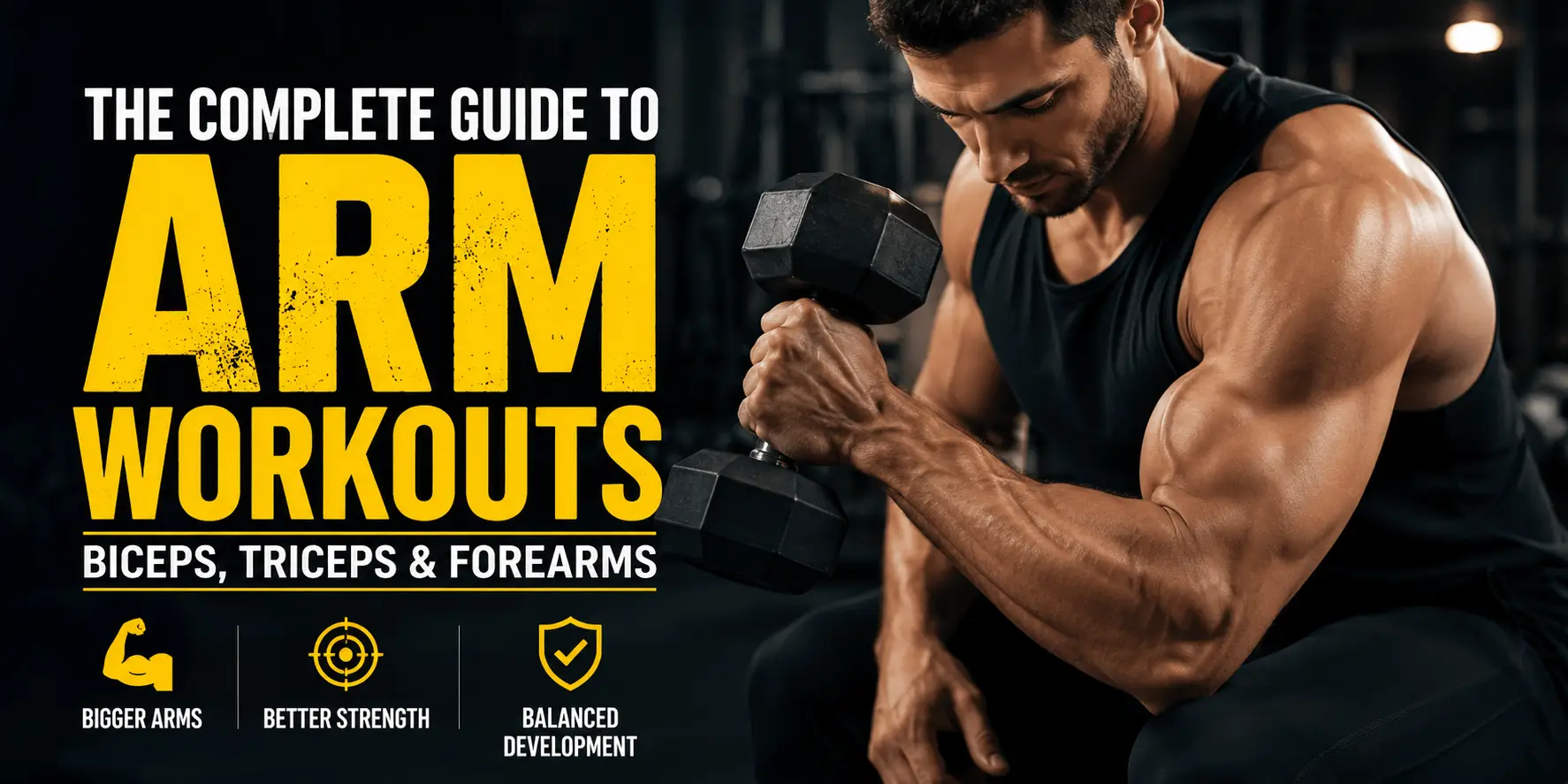
Good Arm Workouts: The Complete Bicep, Tricep, and Forearm Training Plan
What separates good arm workouts from wasted gym time? Not exercise selection alone — most people know the difference between a curl and a pushdown. The gap is in programming: how exercises are sequenced, how volume is distributed across the week, and whether every part of the arm is actually being trained. This guide builds complete arm workout plans from the ground up, covering biceps, triceps, and forearms with the exercise science to back every decision.
Whether you want a dedicated arm day, a push/pull integration, or an at-home bicep and tricep workout, you’ll find a ready-to-run program here. These are the best arm workouts for natural lifters who want balanced, full development — not just a bicep pump.
WHAT YOU’LL LEARN IN THIS GUIDE
- Why most arm day workouts fail (and the 3 variables that actually predict arm growth)
- The optimal bicep-to-tricep volume ratio for balanced arm development
- How to structure a dedicated arm day for maximum hypertrophy
- 4 complete arm workout programs: beginner, intermediate, advanced, and home-only
- The right exercise order for every arm training session
- How to integrate arm exercises into push/pull/legs and upper/lower splits
- Weekly volume, frequency, and progression guidelines for all experience levels
- Common arm training programming mistakes and their fixes
THE SHORT ANSWER
Good arm workouts require training triceps, biceps, and forearms with appropriate volume (12–20 sets/week each for bi/tri, 6–10 for forearms) across 2–3 sessions. The most common mistake is a 70/30 bicep-to-tricep volume split — since triceps are 60–65% of arm mass, a near-equal split produces better results. Every arm workout plan should include at least one overhead tricep movement (for the long head), one supinated curl (for full bicep activation), and one forearm exercise. Progressive overload on these three anchors drives arm growth more than exercise variety.
1. Why Most Arm Workouts Fail: The 3 Programming Errors
Before building your arm workout plan, understand the three most common reasons arm training stalls:
Error 1: Bicep-Dominant Volume Split
Walk into most commercial gyms on arm day and you’ll see 4–5 curl variations for every 1–2 tricep exercises. Since triceps make up 60–65% of upper arm circumference, this is backwards. Good arm workouts dedicate roughly equal volume to biceps and triceps — and in many programs, slightly more to triceps. A lifter who runs 20 weekly sets of curls and 6 sets of pushdowns is programming against their own arm-size goals.
Error 2: Missing the Long Head Stimulus
The tricep long head (55% of tricep mass) only reaches full stretch when the arm is overhead. The bicep long head produces its greatest hypertrophy stimulus when the arm is extended behind the torso (incline curl position). Most arm workouts include neither. Adding one overhead tricep extension and one incline curl to every arm day workout fixes this immediately.
Error 3: No Progressive Overload Tracking
Arms are trained by feel in most programs — “I’ll do some curls until it burns.” Progressive overload requires tracking: sets, reps, and weights logged each session. If you’re doing the same 3 × 10 with 25 lb dumbbells you were doing 6 months ago, your arms stopped growing 6 months ago. The same progressive overload principles that drive strength gains in 5/3/1 apply to arm isolation work.
2. The Optimal Volume and Frequency for Arm Development
| Muscle Group | Beginner Sets/Week | Intermediate Sets/Week | Advanced Sets/Week | Optimal Frequency |
|---|---|---|---|---|
| Biceps | 8–12 | 14–18 | 16–22 | 2–3x/week |
| Triceps | 8–12 | 14–20 | 18–24 | 2–3x/week |
| Forearms | 6–8 | 8–12 | 10–15 | 2–3x/week |
These ranges account for both direct work and indirect stimulus. Biceps get indirect stimulus from rows and pull-ups; triceps from all pressing; forearms from all gripping exercises. When calculating your weekly direct sets, subtract roughly 3–5 sets of indirect stimulus you’re already getting from compound work. For the full dose-response framework, see our guide on how many sets you need for muscle growth.
WHAT THE RESEARCH SAYS
A 2019 meta-analysis in the Journal of Strength and Conditioning Research examined dose-response relationships for muscle hypertrophy across 34 studies. For trained subjects, 10+ sets per muscle per week produced significantly greater hypertrophy than fewer sets, with diminishing returns above 20 sets per week. Frequency of 2–3 sessions per week outperformed single-session weekly training at matched volumes — due to protein synthesis cycling and reduced per-session fatigue accumulation.
3. Exercise Selection for Good Arm Workouts
Every complete arm workout should cover four movement categories:
| Category | Primary Muscle | Example Exercises | Sets Per Session |
|---|---|---|---|
| Compound Tricep Press | Triceps (all heads) | Close-grip bench, weighted dips | 3–5 |
| Overhead Tricep Extension | Tricep long head | DB/cable overhead extension, skull crusher | 3–4 |
| Supinated Bicep Curl | Bicep brachii (both heads) | Barbell curl, dumbbell curl, incline curl | 3–4 |
| Neutral/Hammer Curl | Brachialis + brachioradialis | Hammer curl, cross-body curl, reverse curl | 2–3 |
Forearm work (wrist curls, reverse wrist curls) is added at the end of the session for 2–3 sets each. For tricep exercise science in depth — including long-head stretch mechanics and EMG rankings — see our complete tricep workouts guide.
4. Complete Arm Workout Programs
Program 1: Beginner Arm Day Workout (0–1 Year)
Frequency: 1 dedicated arm day per week + indirect work on push/pull days. Duration: 45–55 minutes.
| Exercise | Target | Sets × Reps | Rest |
|---|---|---|---|
| Close-Grip Push-Up or Close-Grip Bench | Triceps (compound) | 3 × 10–12 | 90 sec |
| Overhead DB Extension | Tricep long head | 3 × 12–15 | 60 sec |
| Barbell or DB Curl (supinated) | Bicep brachii | 3 × 10–12 | 75 sec |
| Incline DB Curl | Bicep long head stretch | 3 × 10–12 | 60 sec |
| Hammer Curl | Brachialis + brachioradialis | 2 × 12–15 | 60 sec |
| Wrist Curl + Reverse Wrist Curl | Forearm flexors/extensors | 2 × 15 each | 45 sec |
Total working sets: 16. Weekly progression: add 1 rep to each set per week until you hit the top of the rep range for all 3 sets. Then add weight and reset to the bottom of the range.
Program 2: Intermediate Arm Day Workout (1–3 Years)
Frequency: 1–2 dedicated arm days per week. This program uses supersets to increase density without extending session length excessively.
| Superset | Exercise A | Exercise B | Sets × Reps | Rest Between Supersets |
|---|---|---|---|---|
| A | Close-Grip Bench Press | Barbell Curl | 4 × 8–10 | 90 sec |
| B | Skull Crusher | Incline DB Curl | 3 × 10–12 | 75 sec |
| C | Overhead DB Extension | Hammer Curl | 3 × 12–15 | 60 sec |
| D | Cable Pushdown (rope) | Concentration Curl | 3 × 15 | 45 sec |
| E (Forearms) | Wrist Curl | Reverse Wrist Curl | 3 × 15 | 45 sec |
Pairing tricep and bicep exercises in supersets works because these muscles don’t compete — tricep work doesn’t fatigue the biceps and vice versa. This allows you to complete more total arm volume in less time, a technique used widely in bodybuilding programming.
Program 3: Advanced Arm Specialization (3+ Years)
A 6-week arm specialization block for experienced lifters who want to bring up lagging arm size. Run this as a standalone arm program twice per week, reducing other upper body volume by 30% during the block. After 6 weeks, return to normal programming to consolidate gains.
| Session Type | Exercise | Sets × Reps | Technique |
|---|---|---|---|
| Heavy (Monday) | Close-Grip Bench Press | 5 × 5 | Heavy, 3-min rest |
| Heavy (Monday) | Weighted Chin-Up (supinated) | 4 × 5–6 | Full ROM, controlled eccentric |
| Heavy (Monday) | Weighted Dip | 4 × 6–8 | Tricep-focused lean |
| Volume (Thursday) | Incline DB Curl | 4 × 10–12 | 3-sec eccentric |
| Volume (Thursday) | Overhead Cable Extension | 4 × 12–15 | Full stretch, pause at bottom |
| Volume (Thursday) | Preacher Curl or Concentration Curl | 3 × 12–15 | Peak contraction focus |
| Volume (Thursday) | Skull Crusher | 4 × 10–12 | Behind-head for more stretch |
| Volume (Thursday) | Hammer Curl + Reverse Curl (superset) | 3 × 12 | Back-to-back, no rest |
| Volume (Thursday) | Wrist Curl + Reverse Wrist Curl (superset) | 3 × 15 | Seated, forearm on thigh |
Program 4: Complete At-Home Arm Workout (Dumbbells Only)
This is the most complete arm workout at home you can run with a single pair of dumbbells and bodyweight. Run it 2–3 times per week for progressive arm development without a gym membership.
| Exercise | Target | Sets × Reps | Progression Method |
|---|---|---|---|
| Diamond Push-Up | Triceps (lateral/medial) | 3 × max reps | Feet elevated when 15+ reps easy |
| Overhead DB Extension | Tricep long head | 3 × 12–15 | Add reps, then heavier DB |
| Chair Dip | Triceps overall | 3 × 12–20 | Add DB on lap for load |
| Standing DB Curl (supinated) | Bicep brachii | 3 × 10–12 | Add reps, then heavier DB |
| Incline DB Curl | Bicep long head | 3 × 10–12 | 3-sec eccentric when stuck |
| Hammer Curl | Brachioradialis + brachialis | 3 × 12 | Cross-body variation for variety |
| Wrist Curl | Forearm flexors | 2 × 15–20 | Seated, full ROM |
For the home-specific techniques here — particularly the incline curl and slow-eccentric progressions — apply the same proven hypertrophy techniques that maximize stimulus when load is limited.
5. How to Integrate Arm Work Into Any Training Split
| Training Split | Where Arm Work Goes | Direct Bicep Sets | Direct Tricep Sets | Notes |
|---|---|---|---|---|
| Push/Pull/Legs | Biceps: Pull day end. Triceps: Push day end. | 3–5 sets/pull day | 3–5 sets/push day | Most balanced split for arms |
| Upper/Lower | Both: Upper body day end, alternating focus | 4–6 sets/upper day | 4–6 sets/upper day | Superset bi/tri to save time |
| Full Body 3x/week | 1–2 arm exercises at end of each session | 2–3 sets/session × 3 | 2–3 sets/session × 3 | High frequency, low per-session volume |
| Bro Split (arm day) | Dedicated arm day | 8–12 sets/session | 8–12 sets/session | Works well; ensure 48h from chest/back |
The push/pull/legs split is the most structurally sound for arm development because it naturally separates bicep and tricep work by at least 24–48 hours (pull day vs. push day), allows each muscle group to recover before being stressed again, and integrates arm work with compound movements that provide additional indirect stimulus. If you’re choosing a structure to build around, see our guide to the top 5 training splits for bodybuilders and athletes.
6. How to Structure an Arm Day for Maximum Results
Exercise order within an arm day workout matters. The general rule: heaviest, most neurally demanding exercises first; isolation and pump work last. For a dedicated arm day session, the optimal sequence is:
- Heavy compound tricep movement (close-grip bench or weighted dip) — done first when CNS is fresh, allows heaviest loads
- Heavy compound bicep movement (barbell curl or weighted chin) — still early in session, high neural demand
- Long head tricep isolation (overhead extension, skull crusher) — moderate load, focus on full stretch
- Long head bicep isolation (incline curl, preacher curl) — moderate load, full ROM with stretch emphasis
- Neutral grip / brachialis work (hammer curl, reverse curl) — lower neural demand, works brachioradialis
- High-rep finishers (pushdowns, concentration curls) — pump work, 15–25 reps, minimal rest
- Forearm work (wrist curls, reverse wrist curls) — always last; forearm fatigue doesn’t affect preceding work
GYM APPLICATION
Keep your arm day to 60–70 minutes maximum. Beyond this, cortisol rises, focus drops, and the quality of each subsequent set decreases faster than volume benefits accumulate. If you’re regularly going 90+ minutes on arm day, you’re doing too many exercises, not training hard enough on each one, or resting too long. Cut variety, increase intensity, and watch both session quality and arm size improve.
7. Nutrition and Recovery for Arm Growth
Arms are smaller muscles with faster recovery times than legs or back — but they still respond to the same nutritional inputs. Protein (1.6–2.2 g/kg/day), adequate total calories, and creatine monohydrate (5 g/day) form the evidence-based foundation. Creatine’s impact on arm development is direct: more reps per set, more total volume per session, greater cumulative weekly overload.
Recovery timing: biceps and triceps typically recover within 48 hours of a session. This is faster than larger muscle groups and supports 2–3x weekly training frequency. If your arms feel sore and flat 72+ hours after training, it’s usually a sign of excessive volume (over 20+ sets in one session) rather than a recovery issue.
8. Common Arm Workout Programming Mistakes
| Mistake | Why It Limits Growth | What to Do Instead |
|---|---|---|
| 4+ bicep exercises, 1 tricep exercise | Triceps are 60% of arm mass — imbalanced volume produces imbalanced results | Match bicep and tricep volume within 20% of each other |
| No overhead tricep movement | Long head (55% of tricep) undertrained — arms look flat from the side | Include overhead extension in every tricep session |
| No incline curl in bicep work | Long head bicep undertrained — limits peak and overall upper arm fullness | Replace one standard curl with incline DB curl each session |
| Training arms 4–5x per week | Recovery capacity exceeded; quality of later sessions is poor | 2–3x per week with higher per-session quality |
| Never tracking sets, reps, or weights | No way to apply progressive overload — arms stall at the same size | Log every arm session; aim for a new PR each week on at least one exercise |
| Using momentum on curls | Reduces time under tension on biceps by 40–50% per rep | Strict form: upper arms fixed, full ROM, controlled eccentric |
| Skipping forearms entirely | Forearm development completes the arm aesthetic; small forearms shrink the appearance of developed upper arms | Add 4–6 sets of wrist curls and reverse curls twice per week |
Article Summary
- Good arm workouts target all three muscles proportionally — triceps get equal or more volume than biceps given their 60–65% share of arm mass
- The three programming pillars: overhead tricep extension (long head), incline curl (bicep long head), and progressive overload tracking
- Optimal weekly volume: 12–20 sets biceps, 14–20 sets triceps, 6–12 sets forearms, split across 2–3 sessions
- Supersets of opposing muscle groups (tricep/bicep) allow more volume in less time without performance compromise
- Push/pull/legs is the best structural foundation for arm development because it naturally times bi and tri work 24–48 hours apart
- A complete at-home arm workout requires only dumbbells: overhead extension + incline curl + hammer curl + diamond push-ups
- Arm day sessions should be 60–70 minutes maximum; quality beats quantity past that point
- Creatine monohydrate is the single most evidence-supported supplement for arm (and total muscle) hypertrophy
- Beginners can progress with 1 dedicated arm day + indirect stimulus from compound work; intermediates benefit from 2 sessions
- Always log arm sessions — progressive overload on isolation work requires data, not feel
Frequently Asked Questions
What are the best arm workouts for building mass?
The best arm workouts for mass combine close-grip bench or weighted dips (tricep compound), overhead extensions (tricep long head), barbell or dumbbell curls (bicep mass), and incline curls (bicep long head stretch). Run these across 2–3 sessions per week with 14–20 total weekly sets each for biceps and triceps. Progressive overload — adding reps or weight each week — is the non-negotiable driver of arm mass. No exercise selection alone compensates for a lack of progressive overload over time.
How do I structure a good arm day workout?
Start with heavy compound tricep work (close-grip bench or dips), then heavy compound bicep work (barbell curl or weighted chin), then isolation movements for both in the stretched position (overhead extension, incline curl), then brachialis work (hammer curls), then high-rep pump finishers, then forearms. This sequencing puts the heaviest loads early when neural output is highest and saves isolation work for when the muscle is pre-fatigued. Keep total session length under 70 minutes.
How many sets should I do per arm workout?
For a dedicated arm day, aim for 8–12 sets per muscle group (biceps and triceps) per session, with 4–6 sets of forearm work at the end. Total session sets: 20–30 working sets. This is enough stimulus for meaningful hypertrophy without exceeding recovery capacity. More than 35–40 sets in a single arm session produces diminishing returns and increases injury risk from cumulative elbow stress. Spread volume across 2 sessions per week rather than concentrating it all in one.
Should I do bicep and tricep workouts on the same day?
Yes — training biceps and triceps on the same day is efficient and effective. These muscles are antagonists, so working one doesn’t fatigue the other. Supersets of opposing movements (close-grip bench followed immediately by barbell curls) allow you to accumulate more volume per hour than resting between each set. Dedicated arm days or upper body sessions that include both muscles are both valid approaches. The main consideration is separating arm-heavy sessions from back sessions (which heavily stress biceps) and chest sessions (which heavily stress triceps) by at least 24–48 hours.
How long does it take to see results from arm workouts?
Beginners running their first structured arm workout plan typically see visible changes within 6–10 weeks. Intermediate lifters adding overhead tricep work and incline curls to fix existing gaps often notice fuller arms within 8–12 weeks. Measuring arm circumference (flexed and cold) every 4 weeks is the most reliable indicator of actual mass gain vs. pump or water. Expect 0.5–1.5 cm gain per 12-week block for natural intermediate lifters following a progressive program with adequate protein and calorie intake.
Do I need SARMs or steroids for good arm development?
No. Natural lifters can build well-developed arms through consistent, progressive training and proper nutrition. SARMs and androgenic compounds accelerate the rate of arm hypertrophy by increasing muscle protein synthesis, but they don’t change the fundamental training variables — they just make the same training produce faster results. For natural lifters who’ve only trained arms haphazardly, fixing programming (adding overhead tricep work and incline curls, tracking progressive overload) will produce more growth in the next 12 weeks than any compound without those training changes.
Disclaimer: This article is for informational and educational purposes only. It is not medical advice. The compounds and protocols discussed may carry serious health risks. Always consult a qualified healthcare provider before starting any new supplement, peptide, hormone, or training protocol. FitScience does not encourage or endorse the use of any illegal substances.


