
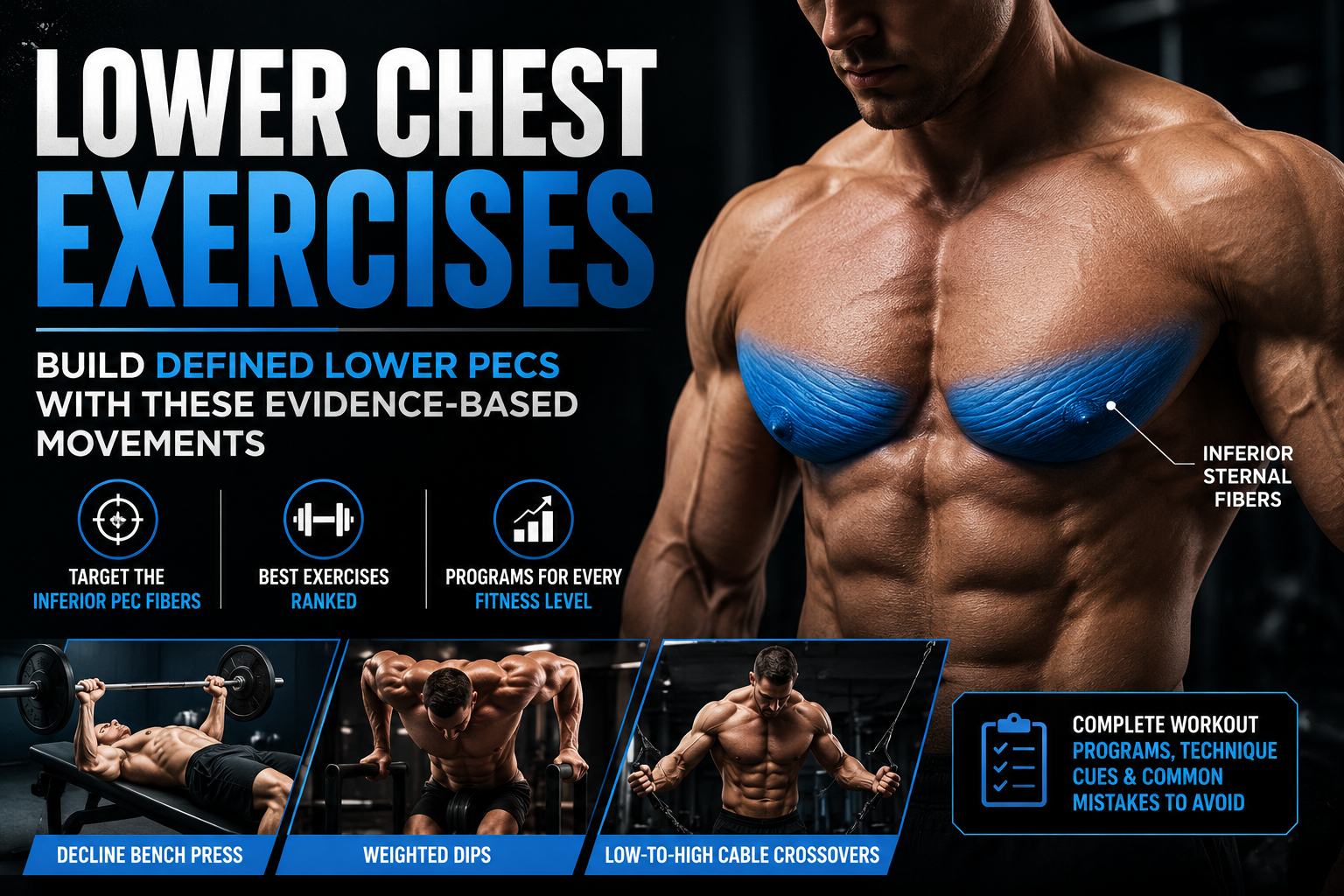
Lower Chest Exercises: Build Defined Lower Pecs With These Evidence-Based Movements
Lower chest exercises are the missing link in most chest training programs. The lower pec — the inferior fibers of the sternal head — creates the sharp definition line at the bottom of the chest that separates a developed physique from an average one. Without targeted lower chest work, even lifters with decent overall pec mass end up with a soft, undefined lower border that blurs into the abdominal region.
The best lower chest exercises create a downward pressing or crossing vector that aligns with the inferior sternal fibers — decline angles, low-to-high cable crossovers, and weighted dips are the primary tools. This guide covers the anatomy, the best exercise selections, and three complete lower pec workout programs so you can start building that defined lower chest today.
WHAT YOU’LL LEARN
- How the inferior sternal fibers differ from the rest of the pectoralis major
- Why most flat-bench-dominant programs leave the lower chest underdeveloped
- The 10 best lower chest exercises ranked by activation, load potential, and practical value
- Exact technique cues for decline bench press, cable crossovers, and weighted dips
- Three complete lower pec workout programs for beginner, intermediate, and advanced lifters
- A home-based lower chest workout with no equipment
- The most common lower chest mistakes and how to fix them
- Nutrition and supplementation context for lower pec development
THE SHORT ANSWER
The best lower chest exercises use a decline angle or a low-to-high cable path to load the inferior sternal fibers of the pectoralis major. Decline barbell bench press, weighted dips, and cable crossovers are the top three movements. Train lower chest with 10-16 sets per week across 2 sessions, prioritize a full range of motion, and maintain progressive overload across mesocycles. Visible lower pec definition takes 8-16 weeks of targeted work combined with adequate body fat reduction in the lower chest region.
Lower Chest Anatomy: The Inferior Sternal Fibers
The pectoralis major is a fan-shaped muscle with fibers running in multiple directions. The clavicular head originates at the clavicle and runs diagonally downward. The sternal head originates along the sternum, with its fibers spanning from the second rib down to the sixth rib, with the lowest fibers sometimes referred to as the costal head. These inferior fibers run diagonally upward toward the humeral insertion — meaning to load them, you need a movement that resists pressing or crossing in a downward direction.
This is why decline bench press works for lower chest and flat bench press has less specific emphasis. On flat bench, all sternal fibers share load relatively equally. On decline, the lower body position creates a vector that forces the inferior sternal fibers to do proportionally more work. The same logic applies to low-to-high cable crossovers: the cable pulls from below the chest, creating upward resistance that the inferior pec fibers must overcome by pressing and crossing downward and across the body.
Understanding this fiber direction also explains why dips are such an effective lower chest exercise. When you lean forward during a dip, the pressing vector shifts from directly overhead to angled forward and down — aligning with the inferior sternal fiber direction. Upright dips work more triceps. Forward-leaning dips shift the stimulus dramatically toward the lower chest. Angle is everything.
Why the Lower Chest Is Underdeveloped in Most Programs
The standard commercial gym chest program looks roughly like this: flat bench press for 4-5 sets, maybe some incline work, a cable fly or pec deck finisher. Decline pressing is either absent entirely or treated as an afterthought. Dips are usually programmed for triceps, not chest. The result is predictable: decent mid-chest mass, potentially improving upper chest if the lifter reads up on it, but a soft and undefined lower border.
Part of the neglect is philosophical. Decline bench press has an undeserved reputation as a “bodybuilder vanity movement” that isn’t functional. That framing has driven many program designers toward flat and incline only. But hypertrophy research doesn’t care about labels — if decline loading produces greater inferior sternal activation than flat pressing, and EMG data confirms it does, then decline pressing is a legitimate tool for anyone who wants a complete chest.
Body fat distribution also makes the lower chest visible — you can have well-developed inferior pec fibers that are obscured by a higher body fat percentage. This is worth noting because some lifters interpret a soft lower chest as a training problem when it may be partly or primarily a body composition issue. Check your complete chest guide for context on this distinction.
The Science of Decline Angle and Cable Direction
Research on optimal decline angle for lower chest is less extensive than incline research, but the available data and applied biomechanics point clearly. A decline of 15-30 degrees is sufficient to shift emphasis toward the inferior sternal fibers without creating the extreme body position of steeper declines, which make setup awkward and can create blood pressure issues in some individuals.
WHAT THE RESEARCH SAYS
A 2020 study by Rodiles-Guerrero and colleagues examined pectoralis major activation across flat, incline, and decline bench press conditions using surface EMG. The decline condition produced significantly greater inferior sternal activation compared to flat pressing, while showing reduced clavicular head activity. Earlier work by Glass and Armstrong (1997) in the Journal of Strength and Conditioning Research confirmed decline pressing as a meaningful stimulus for the lower pec region, with activation levels exceeding flat bench for inferior fibers specifically. Cable crossovers performed from a low pulley (low-to-high path) produced comparable lower chest activation to decline pressing in a 2019 biomechanical analysis by Calatayud and colleagues.
For cable work, the key variable is pulley position. Low-to-high cable crossovers — where the cable is anchored at the lowest pulley and you pull upward and across — align the resistance vector with the inferior sternal fiber direction. This is the opposite of high-to-low cables, which target the upper chest. Setting your cable at mid-height for a standard crossover produces a relatively even stimulus across the sternal fibers, which is fine for general chest work but less specific for lower chest emphasis.
For a full breakdown of how lower chest fits into overall programming, this complete chest guide covers all regions and all movement patterns in one place.
The 10 Best Lower Chest Exercises Ranked
The ranking below reflects a combination of EMG activation data for the inferior sternal fibers, load potential (which drives progressive overload), and practical applicability across training environments.
| Exercise | Head Targeted | EMG Activation | Load Potential | Best For |
|---|---|---|---|---|
| Decline Barbell Bench Press | Inferior sternal (primary) | ★★★★★ | Very High | Primary mass builder |
| Weighted Dips (forward lean) | Inferior sternal (primary) | ★★★★★ | High | Multi-joint compound, progresses well |
| Low-to-High Cable Crossover | Inferior sternal | ★★★★☆ | Moderate | Constant tension isolation |
| Decline Dumbbell Press | Inferior sternal | ★★★★☆ | High | Range of motion, unilateral balance |
| Decline Dumbbell Fly | Inferior sternal (stretch) | ★★★★☆ | Moderate | Stretch stimulus, isolation finisher |
| Decline Smith Machine Press | Inferior sternal | ★★★☆☆ | High | Fatigue sets, drop sets |
| Body Weight Dips (forward lean) | Inferior sternal | ★★★☆☆ | Moderate | Home training, beginner option |
| Decline Push-Up | Inferior sternal | ★★★☆☆ | Low-Moderate | No-equipment home training |
| Pec Deck (low setting) | Inferior sternal | ★★★☆☆ | Moderate | Machine isolation, rehab-friendly |
| Cable Crossover (mid-height) | Sternal (general) | ★★★☆☆ | Moderate | General chest isolation work |
Technique Breakdown: The Three Most Important Lower Chest Exercises
Decline Barbell Bench Press
The decline barbell bench press is the highest-load option for direct lower chest targeting and the best choice for building absolute mass in the inferior sternal region. It allows heavier loading than any other lower chest movement, and more load over time through progressive overload is the most reliable driver of hypertrophy.
Setup: Set the bench to a 15-30 degree decline. Anchor your feet securely. Grip the bar slightly wider than shoulder width — the same grip you’d use for flat bench is appropriate. Retract and depress your shoulder blades against the pad. Your eyes should be directly under the bar.
Execution: Unrack the bar and lower it to your lower chest — approximately at the level of your lower sternum, below the nipple line. Control the descent. Press back to lockout along a slight arc. Unlike flat bench, the bar path on decline is more vertical and less arced, which is natural given the body position. Keep the elbows at 60-75 degrees from the torso to protect the shoulder joint and maximize pec tension.
GYM APPLICATION
Most lifters find they can press heavier on decline than flat bench, which can feel psychologically satisfying but also makes it tempting to ego-load. Focus on controlled reps with full range of motion rather than maximizing bar weight. A solid lower chest training session will show up in muscle soreness along the lower pec and sternum 24-48 hours later — that’s your confirmation the right fibers were targeted. Improving your neuromuscular efficiency on the decline press specifically will help you recruit more lower pec fibers before compensatory muscles kick in.
Weighted Dips (Chest-Focused)
Weighted dips done with a forward torso lean are arguably the most functional lower chest exercise available. The forward lean shifts the pressing vector from tricep-dominant to chest-dominant by aligning the inferior sternal fibers with the direction of effort. Add weight via a dip belt, weight vest, or dumbbell held between the feet as you progress.
Setup: Grip the parallel bars with a shoulder-width or slightly wider grip. Before descending, tilt your torso forward approximately 20-30 degrees. Maintaining that forward lean throughout the entire rep is critical — if you drift upright, you’re doing a tricep dip.
Execution: Lower until the upper arms are roughly parallel to the floor or slightly below. Going too deep strains the anterior shoulder capsule unnecessarily — parallel is sufficient for a full lower chest stretch. Press back up while maintaining the forward lean. Squeeze the lower chest at the top without fully locking out to maintain constant tension. The tricep activation at lockout can be minimized by stopping just short of full elbow extension during working sets.
Low-to-High Cable Crossover
Set the cable pulleys at the lowest position — as close to the floor as possible. Stand centered between the cable stations, take a cable in each hand, and press upward and across in a sweeping arc until the hands meet at approximately sternum height or slightly above. The path is from low and wide to high and together, which is the exact movement vector that loads the inferior sternal fibers.
Keep a consistent elbow bend throughout. This is not a rowing movement — the elbow angle stays fixed and the work is entirely at the shoulder. Focus on the lower pec pulling the arms up and together, not the biceps curling the handles. This movement complements the upper pec high-to-low cable fly perfectly — they’re mirror images targeting opposite regions of the chest.
Lower Chest Workout Programs: Beginner, Intermediate, and Advanced
These programs are designed to provide targeted lower chest stimulus either as a standalone session or bolted onto the end of a regular chest day. If lower pec definition is a specific priority, run lower chest first in your pressing sessions for 8-12 weeks to allow the inferior fibers to be trained fresh before fatigue sets in.
Beginner Lower Pec Workout (2 days/week)
| Exercise | Sets x Reps | Rest | Notes |
|---|---|---|---|
| Decline Barbell Bench Press | 3 x 8-10 | 2-3 min | Focus on 15-20 degree decline, full ROM |
| Bodyweight Dips (forward lean) | 3 x 10-15 | 90 sec | Maintain forward lean throughout |
| Low-to-High Cable Crossover | 3 x 12-15 | 60 sec | Slow arc, squeeze at the top |
| Decline Push-Up | 2 x 15-20 | 60 sec | Use AMRAP on final set |
Intermediate Lower Chest Workout (2 days/week)
| Exercise | Sets x Reps | Rest | Notes |
|---|---|---|---|
| Decline Barbell Bench Press | 4 x 5-8 | 3 min | Primary strength work, add weight each session |
| Weighted Dips (forward lean) | 3 x 8-12 | 2 min | Add weight via dip belt when bodyweight becomes easy |
| Decline Dumbbell Press | 3 x 10-12 | 90 sec | Full range, pause at bottom |
| Low-to-High Cable Crossover | 3 x 12-15 | 60 sec | Focus on lower chest contraction at top |
| Decline Dumbbell Fly | 2 x 15-20 | 60 sec | Stretch at bottom, controlled arc |
Advanced Lower Pec Workout (2-3 days/week)
| Exercise | Sets x Reps | Rest | Notes |
|---|---|---|---|
| Decline Barbell Bench Press | 5 x 3-6 | 3-4 min | Periodized heavy loading, deload every 4-6 weeks |
| Weighted Dips (forward lean) | 4 x 8-10 | 2-3 min | Heavy dip belt loading |
| Decline Dumbbell Press | 4 x 10-12 | 2 min | Full range, slow eccentric |
| Low-to-High Cable Crossover | 4 x 12-15 | 75 sec | Cross hands at top for maximum contraction |
| Decline Dumbbell Fly | 3 x 15-20 | 60 sec | Maximum stretch at bottom |
| Decline Push-Up (weighted) | 3 x failure | 60 sec | Finisher with weight plate or vest |
These sessions total 11-23 working sets. For most intermediate lifters, 12-16 sets per week targeting the lower chest is appropriate. When combined with adequate protein and creatine monohydrate supplementation, these programs provide a complete stimulus for inferior sternal hypertrophy.
Lower Chest at Home: No-Equipment Lower Pec Training
Decline push-ups and forward-lean push-up variations can effectively target the lower chest without equipment. The key is recreating the decline angle — elevating the hands (not the feet) creates a decline for the torso, shifting load toward the inferior fibers. This is counterintuitive since most people think “feet elevated” for upper chest and “hands elevated” for lower chest, but the logic holds: hand elevation creates the same downward pressing vector as decline bench.
| Exercise | Sets x Reps | Rest | Notes |
|---|---|---|---|
| Hands-Elevated Push-Up (on chair/couch) | 4 x 15-25 | 60 sec | Main lower chest movement, treat as compound lift |
| Parallel Bar Dips (forward lean) | 3 x 10-20 | 90 sec | Use chairs or parallel surfaces if no dip station |
| Decline Push-Up (feet on floor, hands low) | 3 x 15-25 | 60 sec | Hands on low step or platform |
| Wide Push-Up (leaning forward) | 2 x 15-20 | 60 sec | Forward body lean activates inferior fibers |
Progress at home by adding reps, sets, reducing rest periods, slowing tempo (3-4 second eccentric), or adding load via a backpack or weight vest. Bodyweight lower chest training combined with body recomposition principles can produce meaningful lower pec development without a gym membership.
Balancing Lower Chest With Upper and Mid-Pec Training
A complete chest requires development across all three regions: the upper chest (clavicular head), the mid-chest (central sternal fibers), and the lower chest (inferior sternal fibers). Neglecting any one region creates visual imbalances that are difficult to correct once deeply established.
A balanced volume distribution looks like this: 40-50% of chest volume on flat pressing (mid-chest and general mass), 30-40% on incline pressing for upper chest work, and 20-30% on decline pressing and dips for lower pec development. Most lifters who come in with a lagging lower chest need to pull volume from flat pressing and redirect it to decline and dip movements for at least one complete mesocycle.
Lower chest development also intersects with shoulder and chest pressing mechanics. A well-developed lower pec creates the visual base of the chest that makes the chest-to-shoulder tie-in look complete. Weak lower pecs can contribute to anterior shoulder instability over time if the imbalance is severe. Training all regions of the pec reduces that risk.
Common Lower Chest Training Mistakes
| Mistake | Why It Hurts Progress | What to Do Instead |
|---|---|---|
| Skipping decline work entirely | Inferior fibers never receive specific stimulus; lower chest stays soft | Add 1-2 decline movements per chest session for 8+ weeks |
| Doing dips upright (tricep style) | Eliminates lower chest emphasis, becomes a tricep exercise | Lean torso forward 20-30 degrees and maintain it throughout every rep |
| Using too steep a decline (45+ degrees) | Extremely awkward setup, increased head pressure, reduced practical benefit | Limit decline to 15-30 degrees for optimal lower pec loading |
| Not touching the bar to lower chest | Reduces range of motion, removes stretch stimulus from inferior fibers | Lower the bar to the bottom of the sternum on every rep |
| Cable crossover at mid-height only | Loads central sternal fibers but misses inferior sternal region specifically | Set cables at the lowest pulley for a true low-to-high path |
| Treating lower chest as a finisher only | Lower chest never gets primary training stimulus when fresh | Move at least one lower chest movement to the beginning of your session when prioritizing this region |
| Ignoring body composition | Lower pec definition is obscured by fat regardless of muscle development | Combine targeted lower chest training with a mild calorie deficit if body fat is high |
⚠️ SAFETY NOTE
Decline bench press and deep dips both place the shoulder under load in a compromised position if form breaks down. On decline press, watch for excessive elbow flare — keep elbows at 60-75 degrees to the torso to protect the anterior shoulder capsule. On dips, avoid excessive depth past parallel, which strains the anterior capsule and AC joint. If you experience sharp pain in the front of the shoulder during either movement, stop and assess. Dumbbell variations are generally more shoulder-friendly than barbell if you have pre-existing shoulder issues.
Nutrition and Recovery for Lower Chest Development
Lower pec hypertrophy follows identical nutritional requirements to any other muscle group. The inferior sternal fibers are not metabolically special — they require the same protein synthesis environment as the upper chest, lats, or quadriceps. Target 1.6-2.2g of protein per kg of bodyweight, maintain a slight caloric surplus if adding mass is the priority, or a mild deficit if you want to improve lower chest definition by reducing fat coverage over the region.
For performance on decline pressing and dips, creatine monohydrate at 3-5g daily remains the most supported ergogenic available. Creatine’s mechanism — increasing phosphocreatine resynthesis during short-duration high-intensity efforts — directly benefits pressing strength, which drives progressive overload on the exercises that build the lower chest. The meta-analytic evidence is unambiguous: creatine users consistently outperform non-users on strength-based outcomes.
Recovery between lower chest sessions requires 48-72 hours minimum. Dips and decline pressing also load the anterior shoulder and arm training movements that stress the triceps — factor this into your weekly schedule. A common setup is a Monday/Thursday chest split where lower chest is trained both days with different movement selections.
Article Summary
- The lower chest (inferior sternal fibers) requires a downward pressing or low-to-high cable vector to be specifically loaded
- Decline barbell bench press, weighted forward-lean dips, and low-to-high cable crossovers are the three highest-priority lower chest exercises
- A decline angle of 15-30 degrees is optimal — steeper declines create an awkward setup without proportional benefit
- Forward torso lean during dips (20-30 degrees) is the difference between a tricep exercise and a lower chest exercise
- Most flat-bench-dominant programs chronically underload the inferior sternal fibers
- 12-16 sets per week across 2 sessions is the practical volume target for most intermediate lifters
- Home-based lifters can target the lower chest using hands-elevated push-ups and forward-lean dips on chair-height surfaces
- Lower chest definition requires both muscle development and sufficient body fat reduction to be visible
- Creatine monohydrate is the most evidence-supported supplement for improving pressing strength progression
- Balanced chest development means distributing volume across upper, mid, and lower regions — not defaulting to flat bench for everything
Frequently Asked Questions
Why can’t I feel lower chest exercises in my lower chest?
The most common cause is compensatory muscle dominance — the triceps and anterior deltoids take over before the inferior pec fibers are adequately loaded. Fix this with two strategies. First, establish a mind-muscle connection using light pre-activation work: do 2-3 sets of bodyweight dips with exaggerated forward lean before loading up on decline press, focusing exclusively on feeling the lower pec contract. Second, reduce the working weight by 20-30% and focus on the eccentric portion — slow three-to-four second lowering phases force the target muscle to do more work and build the neural pathway that improves lower pec recruitment over time.
Is decline bench press necessary or can I get by with flat bench and dips?
You do not have to do decline bench press specifically. Forward-lean weighted dips and low-to-high cable crossovers can provide sufficient lower chest stimulus without a dedicated decline bench. The advantage of decline bench is load potential — you can typically move more weight on decline than on dips, which benefits progressive overload over long training blocks. But the inferior sternal fibers don’t care whether the load comes from a barbell on a decline bench or from body weight plus a dip belt on parallel bars. The vector angle and the progressive overload are what matter. If your gym lacks a decline bench or you find it uncomfortable, dips plus cables is a completely legitimate alternative.
How do dips compare to decline bench for lower chest?
Both are excellent lower chest exercises and their differences are largely practical. Decline bench press allows higher absolute loading than dips in most scenarios, particularly for advanced lifters where dip belt loading has logistical limits. Dips, however, provide a greater range of motion, have a natural adduction component at the top of the movement (which increases pec contraction), and are more equipment-independent. EMG research places them roughly comparable in inferior sternal activation when the forward lean is maintained throughout. Running both movements in your program is ideal — decline bench for the heavy load stimulus and weighted dips for the range of motion and contraction quality. The tricep activation from dips is also a useful side benefit for pressing strength overall.
Do lower chest exercises work for women?
The anatomy and training principles are identical regardless of sex. The pectoralis major has the same inferior sternal fibers, and they respond to decline angles and low-to-high cable work in the same way. Women often have more subcutaneous fat in the chest region, which means lower chest definition requires both muscle development and a lower body fat percentage to become visible — but the underlying musculature responds to training identically. Women who train their lower chest with progressive overload on decline pressing and dips will develop inferior sternal hypertrophy the same way male lifters do. The practical application is the same: 12-16 sets per week, 2 sessions, emphasis on incline and decline angles to distribute chest stimulus appropriately.
Can SARMs help with lower chest development specifically?
SARMs accelerate general skeletal muscle hypertrophy through androgen receptor agonism, but they do not direct growth to specific muscle regions. A lifter using SARMs who doesn’t include specific lower chest exercises will not develop a defined lower pec from the compound alone — the training stimulus must target the inferior fibers specifically. What SARMs do is amplify the hypertrophic response to whatever training stimulus you’re providing. If your lower chest work is solid, SARMs can accelerate the timeline. If it’s absent, no amount of pharmacology compensates for missing the right mechanical stimulus.
How much lower chest volume is too much?
Most intermediate lifters reach a volume ceiling for lower chest at around 18-22 sets per week before recovery becomes compromised. Signs of excessive volume include persistent soreness that doesn’t resolve between sessions, declining performance on key lifts week-over-week, and joint discomfort in the anterior shoulder or AC joint. The shoulder structures involved in decline pressing and dips have their own recovery requirements that can be the limiting factor before the pec muscles themselves are overtrained. Track your weekly sets, note performance trends, and use neuromuscular efficiency indicators like rep quality degradation as early warning signs that volume needs to be reduced.
Why does my lower chest look good when I flex but flat when relaxed?
This is a body fat and muscle thickness issue, not a training problem. When you flex, the contracted inferior sternal fibers push against the overlying tissue and create visible definition even at higher body fat percentages. When relaxed, the same fibers don’t create enough surface relief to be visible through the overlying fat. The solution is two-pronged: continue building inferior sternal mass through targeted lower chest training, and reduce body fat to the point where the resting muscle creates enough relief against the skin to show detail. This is why lower chest definition is often visible at 10-12% body fat in men but less visible at 15-18%, regardless of how much lower chest muscle is present.
DISCLAIMER
This article is for educational and informational purposes only. The exercise programs, volume recommendations, and supplementation information provided are general guidelines and do not constitute personalized medical or fitness advice. Consult a qualified healthcare provider or certified strength and conditioning specialist before beginning any new training program, particularly if you have pre-existing shoulder, joint, or musculoskeletal conditions. Any mention of performance-enhancing compounds is for informational context only and is not an endorsement or recommendation to use such substances.
Related Reading
- Complete Chest Training Guide: Build Every Region of the Pec
- Upper Chest Workout: The Complete Guide to Clavicular Head Development
- 5/3/1 Program Guide: Progressive Overload for Natural Lifters
- How to Get Bigger Shoulders: Complete Deltoid Development Guide
- Creatine Monohydrate: The Complete Evidence-Based Guide