How to Get Bigger Forearms and Develop Bigger Biceps at Home: The Complete Protocol
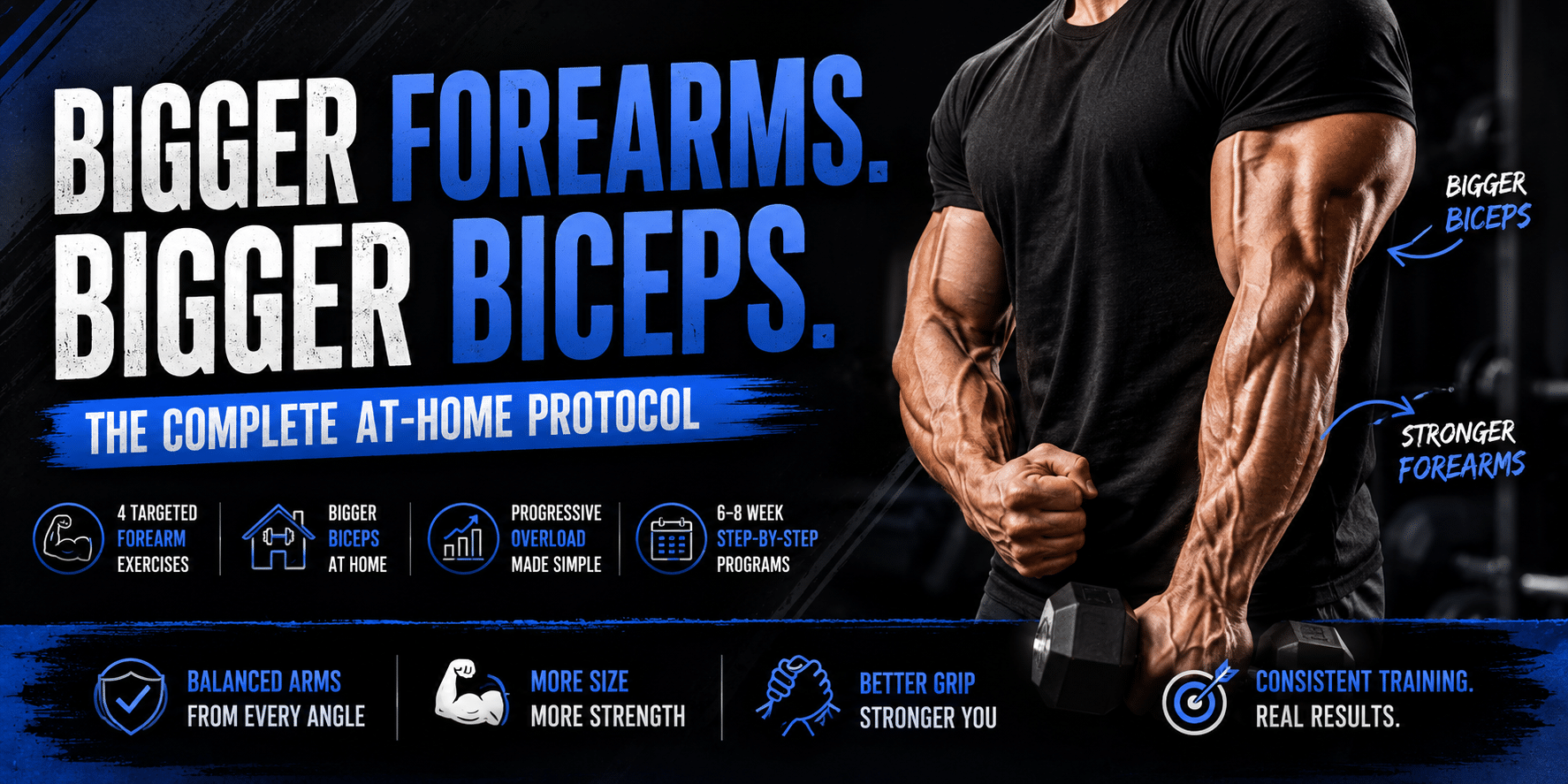
Learning how to get bigger forearms is one of the most overlooked goals in arm training — and one of the most impactful. Most lifters hammer bicep curls and wonder why their arms still look underwhelming in a t-shirt. The answer is almost always the forearms: they’re visible from every angle, they wrap around the entire lower arm, and they’re the first thing people notice when you extend your hand for a shake.
This guide covers forearm anatomy, the specific exercises that actually build forearm mass, and a complete at-home protocol to develop bigger biceps without a barbell or cable machine. Whether you’re asking “how do I get bigger arms” and you train at a gym, or you’re working from a spare bedroom with a set of dumbbells, the principles here apply.
WHAT YOU’LL LEARN IN THIS GUIDE
- The 3 forearm muscle groups and why each one needs a different exercise type
- The #1 reason your forearms won’t grow despite heavy barbell work
- How to get bigger forearms with 4 targeted exercises (gym or home)
- A complete at-home bicep protocol using only dumbbells
- Why hammer curls build more total arm mass than standard curls
- Progressive overload methods when you have limited equipment
- The forearm-to-bicep ratio that signals a balanced, developed arm
- A 6-week beginner program and 8-week intermediate home program
THE SHORT ANSWER
To get bigger forearms, you need direct forearm flexor and extensor work beyond what compound pulling provides. Wrist curls, reverse curls, and loaded carries build the flexors; reverse wrist curls and pronation/supination work the extensors and brachioradialis. For at-home bicep development, dumbbell curls with supination, incline curls, and hammer curls performed in a 3–4 day per week frequency with progressive overload are sufficient to develop bigger biceps to their near-genetic potential.
1. Forearm Anatomy: Why You Can’t Train What You Don’t Understand
The forearm contains over 20 muscles split into two compartments. For size purposes, you care about five key players.
| Muscle | Function | Best Exercise | Visible From |
|---|---|---|---|
| Flexor Carpi Radialis | Wrist flexion (radial side) | Wrist curl, barbell curl | Inner forearm |
| Flexor Carpi Ulnaris | Wrist flexion (ulnar side) | Wrist curl, reverse grip row | Inner forearm |
| Brachioradialis | Elbow flexion (neutral grip) | Hammer curl, reverse curl | Outer forearm, elbow area |
| Extensor Carpi Radialis | Wrist extension | Reverse wrist curl | Top of forearm |
| Pronator Teres | Forearm pronation | Pronation drill, reverse curl | Upper inner forearm |
Most lifters only train the flexors (wrist curls, standard curls). This creates an imbalanced forearm — thick on the inside, flat on top. To get bigger forearms that look full from every angle, you need to hit both compartments. The brachioradialis, which runs from the outer elbow down to the wrist, is the standout muscle for forearm width and gets maximally recruited with a neutral (hammer) grip.
2. Why Heavy Compound Work Isn’t Enough for Forearm Growth
A common argument against direct forearm work: “rows and deadlifts are enough.” This is partly true — heavy pulling builds grip strength and the flexors get meaningful stimulus. But it misses two critical points.
First, compound pulling typically occurs at medium to high loads with moderate rep ranges. Forearm muscles, being slow-twitch dominant, respond better to higher volume and longer time under tension — conditions that compound pulling rarely creates. Second, forearm extensors get almost no stimulus from standard pulling movements. If you’ve ever compared your inner and outer forearm in the mirror and seen a visible thickness difference, that’s the extensor deficit.
WHAT THE RESEARCH SAYS
A 2018 EMG analysis published in the Journal of Human Kinetics measured forearm muscle activation across 12 upper-body exercises. Direct wrist curl variations produced 60–80% higher peak EMG in forearm flexors compared to barbell rows and deadlifts. The study concluded that compound movements alone are insufficient for maximal forearm hypertrophy stimulus, particularly in trained subjects.
The practical takeaway: treat forearms like calves. They get incidental work all session, but that incidental stimulus plateaus quickly. Direct work — 3–4 sets twice per week — breaks that plateau.
3. The 4 Best Exercises to Get Bigger Forearms
These four movements cover all forearm compartments and can be done at home with a single dumbbell or barbell:
Wrist Curl (Forearm Flexors)
Sit at the edge of a bench or chair, forearm resting on your thigh, palm up. Hold a dumbbell and let the wrist extend fully — you should feel a stretch in the flexors. Curl the wrist up through a full range of motion. Control the eccentric. Sets/reps: 3 × 15–20. Rest: 45–60 seconds. If you’re training forearms at home, lighter dumbbells and higher reps work well here because the flexors are endurance-oriented muscles.
Reverse Wrist Curl (Forearm Extensors)
Same setup, but palm down. This is uncomfortable at first — most people have undertrained extensors. Use significantly lighter weight than your wrist curl weight; even experienced lifters find their extensor strength is 40–50% of their flexor strength. 3 × 12–15, slow and controlled.
Hammer Curl (Brachioradialis + Bicep Brachii)
Neutral grip, thumbs up. This is the single best exercise for the brachioradialis and it also hits the biceps and brachialis hard. Research consistently shows the brachialis is maximally activated at a neutral grip — and a thick brachialis pushes the bicep peak up visually. Perform these as strict alternating curls: no swing, full extension at the bottom. 3–4 × 10–12.
Reverse Barbell or Dumbbell Curl
Overhand grip, elbows at your sides, curl to chin height. This is uncomfortable for many lifters at first because the extensors are weak. It directly targets the brachioradialis and extensor carpi radialis longus — the two muscles responsible for the outer forearm “wrap.” Use 50–60% of your regular curl weight. 3 × 10–12.
GYM APPLICATION
Add forearm work at the END of arm day, after your bicep and tricep work. Your forearms contribute to every pulling exercise — taxing them first will limit performance on compound lifts. 10–15 minutes of focused forearm work twice per week is enough for noticeable growth within 8–12 weeks.
4. How to Get Bigger Biceps at Home: The Dumbbell-Only Framework
If you’re asking how to get bigger biceps at home, the honest answer is that dumbbells alone can take you surprisingly far — but only if you understand the three variables that matter: exercise selection, angle variation, and progressive overload.
Exercise selection: The bicep brachii has two heads (long and short) and also performs forearm supination. Most people only do one curl variation, which means they’re only fully developing one stimulus pathway. At minimum, use three movements: a supinated curl (long head emphasis), a hammer curl (brachialis emphasis), and a cross-body or concentration curl (short head/peak emphasis).
Angle variation: Where your elbow is relative to your torso changes which portion of the strength curve is stressed. Incline curls (elbow behind torso) stretch the long head more and have been shown in neuromuscular efficiency research to produce greater hypertrophy stimulus than standard standing curls. Preacher-style curls (elbow in front) emphasize the short head and peak contraction.
Progressive overload: Without a cable machine or preacher bench, you have fewer options for adding load — but you still have options. See the progressive overload section below.
5. The 5 Best At-Home Bicep Exercises (Dumbbells Only)
| Exercise | Primary Target | Sets × Reps | Key Technique Point |
|---|---|---|---|
| Standing Dumbbell Curl (supinated) | Bicep brachii (both heads) | 3 × 10–12 | Supinate fully at top; squeeze 1 sec |
| Incline Dumbbell Curl | Bicep long head (stretch) | 3 × 10–12 | Let arm hang fully; don’t swing |
| Hammer Curl | Brachioradialis + brachialis | 3 × 10–12 | Neutral grip; strict alternating |
| Concentration Curl | Bicep short head (peak) | 3 × 12–15 | Elbow on inner thigh; full ROM |
| Cross-Body Hammer Curl | Brachialis + long head | 2 × 12–15 | Curl across to opposite shoulder |
For the incline curl, lie back on a chair or bench set to roughly 45–60 degrees. Let your arms hang behind your torso. This elongated position places the long head under maximum stretch — the most potent mechanical signal for bicep hypertrophy according to stretch-mediated hypertrophy research.
6. Progressive Overload at Home: How to Keep Growing Without a Weight Stack
The number one limiting factor for home bicep training isn’t equipment — it’s people stopping progressive overload when they run out of heavier dumbbells. Here’s how you continue to progress with fixed-weight dumbbells:
- Rep progression: If you can do 3 × 12 at a given weight, bump to 3 × 15 before moving to the next dumbbell weight.
- Tempo manipulation: Add a 3-second eccentric. A 3-second lowering on a 15 lb dumbbell creates more mechanical tension than a 1-second lowering with 20 lbs. This is how to develop bigger biceps when you’re stuck at the same dumbbell.
- Pause reps: Add a 2-second pause at peak contraction. This eliminates momentum and increases time under tension at the most contracted point — where the bicep is weakest and most stimulated.
- Rest-pause sets: Hit failure at 10 reps, rest 15 seconds, grind out 3–5 more. This method packs more effective volume into a set without adding weight.
- Mechanical drop sets: Start with hammer curls (hardest), immediately transition to supinated curls (slightly easier), then finish with partial range supinated curls. Three movements, same dumbbell, maximum bicep fatigue.
WHAT THE RESEARCH SAYS
A 2023 meta-analysis in the Journal of Strength and Conditioning Research compared tempo manipulation (3-second eccentric) vs. standard tempo at matched volumes for bicep hypertrophy. After 8 weeks, slow-eccentric groups showed 11% greater bicep cross-sectional area increase. The mechanism: longer eccentric duration increases total time under mechanical tension, which is a primary driver of satellite cell activation and mTOR signaling.
7. The 6-Week Beginner Home Arm Program
This program uses only dumbbells and requires 30–40 minutes, 3 days per week. It targets both forearms and biceps and is structured for someone who has been training less than one year.
| Day | Exercise | Sets × Reps | Rest |
|---|---|---|---|
| Day A (Bicep + Forearm Focus) | Standing DB Curl (supinated) | 3 × 10–12 | 60 sec |
| Incline DB Curl | 3 × 10–12 | 60 sec | |
| Hammer Curl | 3 × 10–12 | 60 sec | |
| Wrist Curl | 3 × 15–20 | 45 sec | |
| Reverse Wrist Curl | 3 × 12–15 | 45 sec | |
| Day B (Upper Body + Arms) | Push-up (chest + triceps) | 4 × max | 75 sec |
| Concentration Curl | 3 × 12–15 | 60 sec | |
| Cross-Body Hammer Curl | 3 × 12–15 | 60 sec | |
| Farmer Hold (grip) | 3 × 30 sec | 45 sec |
Run Day A on Monday and Friday, Day B on Wednesday. Every week, add 1 rep to each set. When you reach the top of the rep range for all 3 sets, increase dumbbell weight by the smallest increment available and reset to the bottom of the rep range. This is the same progressive overload principle used in 5/3/1 programs — applied to isolation work.
8. The 8-Week Intermediate Home Program
For lifters with 1+ years of training experience who want to break through a forearm and bicep plateau with home equipment:
| Phase | Weeks | Focus | Sets per Muscle/Week | Rep Range |
|---|---|---|---|---|
| Accumulation | 1–4 | Volume buildup | 16–20 sets biceps, 8–10 sets forearms | 10–15 |
| Intensification | 5–8 | Load + techniques | 12–14 sets biceps, 6–8 sets forearms | 6–10 (heavier + tempo) |
During the intensification phase, swap standard curls for the slow-eccentric variation (3-second lowering) and add rest-pause techniques to your final bicep set each session. This creates a mechanical stress shift — the same adaptation concept behind body recomposition periodization where you alternate stimulus types to avoid accommodation.
9. Forearm Training: Frequency, Volume, and Recovery
Forearms recover faster than larger muscle groups. Their high proportion of slow-twitch fibers and smaller total mass mean they can handle higher frequency without overreaching. Most intermediate lifters can train forearms 3 times per week without issue — once as direct work, twice as supplemental (grip work, reverse curls appended to upper body days).
| Experience Level | Weekly Forearm Sets | Weekly Bicep Sets | Training Frequency | Notes |
|---|---|---|---|---|
| Beginner (0–1 yr) | 6–9 | 9–12 | 2–3x/week | Focus on form first |
| Intermediate (1–3 yr) | 9–15 | 14–20 | 3–4x/week | Add frequency before volume |
| Advanced (3+ yr) | 12–18 | 16–22 | 4–5x/week | Periodize; deload every 4–6 weeks |
If your forearms feel chronically tight or your wrists ache during curls, the problem is almost always undertrained extensors combined with overworked flexors. Add 2 sets of reverse wrist curls and stretching (passive wrist extension held for 30 seconds) and the issue resolves within 2–3 weeks in most cases.
⚠️ SAFETY NOTE
Wrist and elbow tendinopathy are the two most common overuse injuries in arm training. The radial tunnel syndrome and lateral epicondylitis (tennis elbow) are both associated with sudden increases in forearm extensor volume. Increase forearm training volume by no more than 2 sets per week. If you feel sharp pain on the outer elbow during reverse curls, stop immediately and consult a physiotherapist before resuming.
10. Nutrition for Forearm and Bicep Growth
Arm size is ultimately a function of muscle protein synthesis rate minus muscle protein breakdown rate. No forearm protocol — at home or in the gym — will work without adequate nutritional support.
For arm hypertrophy specifically, the key variables are total protein intake, caloric surplus (or at minimum, maintenance), and creatine supplementation. Creatine monohydrate at 3–5 g/day increases intramuscular phosphocreatine, which directly improves the ability to complete more reps per set — translating to greater weekly volume accumulated for the biceps and forearms. Meta-analyses consistently show 5–10% greater lean mass gain in creatine users vs. placebo across 8–12 week resistance training programs.
Protein targets for arm hypertrophy fall within the general muscle-building range: 1.6–2.2 g/kg/day. There’s no evidence that timing protein specifically around arm training sessions provides additional benefit beyond hitting your daily total. Eat enough, hit your protein, lift progressively — those three actions explain roughly 80% of arm development outcomes.
11. Common Mistakes When Trying to Develop Bigger Forearms and Biceps
| Mistake | Why It Hurts Growth | What to Do Instead |
|---|---|---|
| Only doing wrist curls for forearms | Ignores extensors and brachioradialis — 40% of forearm volume | Add reverse wrist curls and hammer/reverse curls each session |
| Curling with a bent wrist | Shifts load to forearm flexors prematurely, reduces bicep peak activation | Keep wrist neutral or very slightly extended during curl |
| Always the same curl variation | Stimulates only one portion of the strength curve — leads to plateau after 4–6 weeks | Rotate: supinated, hammer, incline, concentration each week |
| No supination at the top of curls | Misses the strongest bicep contraction signal — supination is a primary bicep function | Start with palms facing each other, supinate fully at peak |
| High volume, low frequency for forearms | Forearms are slow-twitch dominant and recover fast — once-a-week blitzing is inefficient | 2–3x per week with moderate volume (4–6 sets per session) |
| Skipping the eccentric on curls | Eccentric phase produces greater hypertrophy signal than concentric — dropping the weight wastes half the set | 2–3 second controlled lowering on every rep |
| Training forearms before compound lifts | Pre-fatigued forearms limit grip on rows, deadlifts, and pull-ups — reduces total training volume | Always train forearms at the end of the session |
12. How Long Does It Take to Get Bigger Forearms?
Forearm growth is slower than bicep growth — full stop. Forearms are a high-tendon, low-belly muscle group with a smaller cross-sectional mass ceiling and a strong genetic component (insertion point length determines how “full” the forearm looks). Realistic expectations:
- Beginners (0–1 year of direct forearm training): Visible size and firmness changes within 8–12 weeks. Measurable circumference gain of 0.5–1.0 cm in 3 months is achievable.
- Intermediates (1–3 years): Growth slows significantly. Focused forearm specialization blocks (4–6 weeks) with higher frequency produce the best results.
- Advanced lifters: Forearm growth is largely genetic at this point. Vascularity, leanness, and brachioradialis development become the primary “look” factors.
For biceps at home: a well-designed arm volume and programming plan running 8–16 weeks can produce 0.5–2 cm arm circumference gain in natural lifters, provided progressive overload and adequate protein are in place. The variance is large because genetics (bicep peak, insertion point, muscle belly length) dominates long-term outcomes.
Article Summary
- Forearms contain 5+ muscles split into flexor and extensor compartments — both need direct training for full development
- Compound pulling builds the flexors but almost completely ignores the extensors and brachioradialis
- The 4 essential forearm exercises are: wrist curl, reverse wrist curl, hammer curl, and reverse curl
- At-home bicep training with dumbbells can approach near-genetic potential if exercise selection, angle variation, and progressive overload are applied correctly
- The incline dumbbell curl creates the greatest stretch-mediated hypertrophy signal for the bicep long head
- When stuck at the same dumbbell weight, use tempo (3-sec eccentric), pause reps, and rest-pause to continue driving progress
- Forearms recover faster than larger muscles — train them 2–3x per week rather than once per week with high volume
- Creatine monohydrate (3–5 g/day) consistently produces greater arm hypertrophy outcomes vs. placebo across meta-analyses
- Always train forearms at the end of your session to protect grip for compound movements
- Realistic forearm circumference gain for beginners: 0.5–1.0 cm in 12 weeks of direct training
Frequently Asked Questions
How do I get bigger forearms if I already do a lot of pulling?
Pulling exercises like rows and deadlifts train the forearm flexors under isometric (grip) conditions, not through a full range of motion. To get bigger forearms beyond what pulling provides, add 2–3 sets each of wrist curls and reverse curls at the end of your upper body sessions. The wrist curl covers the flexors through a full range; the reverse curl develops the brachioradialis and extensors that pulling misses entirely. 6–10 total sets per week over 8+ weeks will produce noticeable forearm growth in most intermediate lifters.
How do I get bigger biceps at home without a cable machine?
Cables provide a different strength curve (constant tension throughout the range of motion), but they’re not essential for bicep growth. With dumbbells, you can replicate the key stimuli: use incline curls for the stretched position, concentration curls for peak contraction, and add slow eccentrics (3-second lowering) to increase time under tension throughout the movement. These three techniques together cover the main advantages of cable training. Dumbbell-only programs have been shown in research to produce equivalent hypertrophy to cable programs when volume and progressive overload are matched.
How many times per week should I train biceps to develop bigger biceps?
For most natural lifters, 2–4 times per week is the optimal frequency range for bicep development. Research on muscle protein synthesis shows that splitting your weekly bicep volume across 2+ sessions produces greater hypertrophy than the same volume done in one session. A practical split: 2 dedicated arm days per week (Monday and Thursday, or Tuesday and Friday) with 12–16 total sets per week for intermediates. Beginners can develop bigger biceps effectively with 9–12 sets across 2 sessions.
Why are my forearms small even though I lift heavy?
Three common causes: (1) You’re not doing direct forearm work — compound lifting doesn’t provide enough range-of-motion stimulus for wrist flexors and extensors. (2) Your genetics may favor a shorter muscle belly with longer tendons, which limits visible forearm mass regardless of training. (3) Body fat percentage — forearms look significantly larger and more vascular at 12–15% body fat vs. 18–22%. Before blaming genetics, add 6–8 weeks of direct wrist curl and reverse curl work twice per week and reassess.
Are SARMs or other compounds effective for forearm and arm growth?
Anabolic compounds — whether SARMs like LGD-4033 or traditional androgenic compounds — do accelerate arm hypertrophy, primarily by increasing the rate of muscle protein synthesis and nitrogen retention. Forearm response is generally smaller than bicep/tricep response due to the forearm’s lower androgen receptor density relative to larger muscles. For natural lifters, the ceiling for forearm development is largely genetic — no compound changes forearm tendon-to-belly ratio. If you’re considering any PEDs for arm development, understand the risk profile before the potential gain.
What’s the fastest way to develop bigger biceps as a natural lifter?
The fastest evidence-based path: train biceps 3× per week with 12–16 total sets, include incline curls (stretch-mediated hypertrophy), use 3-second eccentrics, and eat 1.8–2.2 g protein per kg bodyweight in a slight caloric surplus (200–300 kcal above maintenance). Add creatine monohydrate (5 g/day). In 12–16 weeks, this approach consistently produces the maximum natural bicep growth rate. Anything marketed as faster than this either involves undisclosed pharmaceutical use or is overstated.
How do I get bigger arms overall — is it biceps, forearms, or triceps I should focus on?
The triceps make up roughly 60–65% of upper arm mass. If your arms aren’t growing, tricep development is usually the bottleneck, not biceps. For total arm size, prioritize close-grip bench, dips, and overhead tricep extensions. Once your triceps are well-developed, bicep and forearm work rounds out the visual. Forearms contribute less to total arm circumference but significantly to aesthetics — a lean forearm with visible muscle bellies and vascularity completes the arm look from wrist to shoulder.
Disclaimer: This article is for informational and educational purposes only. It is not medical advice. The compounds and protocols discussed may carry serious health risks. Always consult a qualified healthcare provider before starting any new supplement, peptide, hormone, or training protocol. FitScience does not encourage or endorse the use of any illegal substances.


