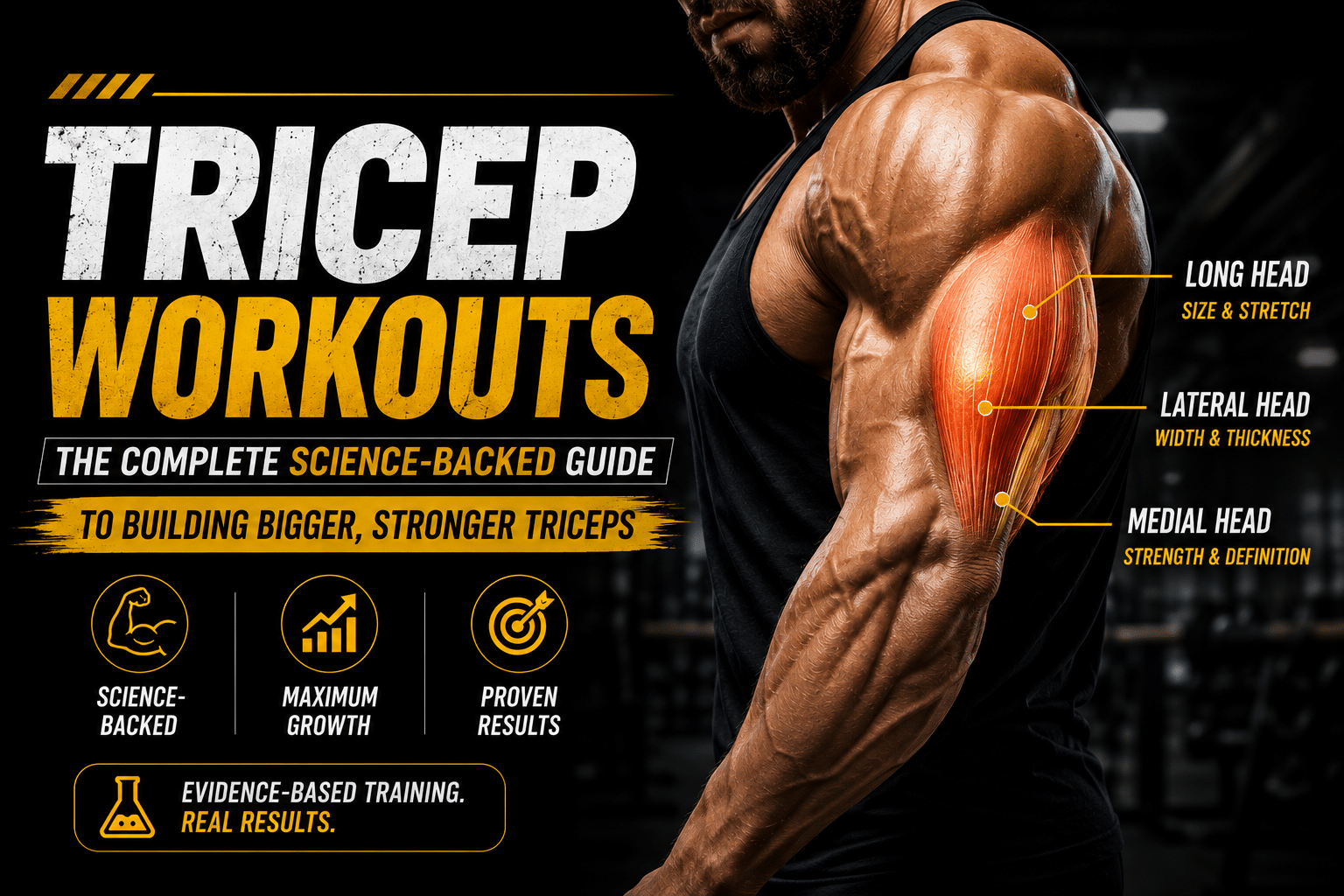
Tricep Workouts: The Complete Science-Backed Guide to Building Bigger, Stronger Triceps
If you want bigger arms, your tricep workouts matter more than your bicep curls. The triceps make up roughly 60–65% of upper arm mass — yet most lifters spend twice as much time curling as they do pressing and extending. This guide fixes that. You’ll get the anatomy, the exercise science, and complete tricep muscle workout programs that actually build the long, lateral, and medial heads proportionally.
Whether you train with a barbell, dumbbells, cables, or just bodyweight at home, the principles here apply. The difference between arms that look full and arms that look skinny from the side usually comes down to one thing: how intelligently you’re programming your tricep workouts.
WHAT YOU’LL LEARN IN THIS GUIDE
- Tricep anatomy — why all 3 heads need different exercise types
- The #1 most effective tricep exercise for mass (backed by EMG data)
- Why the long head is undertrained in most programs and how to fix it
- The best tricep exercises ranked by muscle activation and practicality
- A complete tricep workout at home with zero equipment
- 3 full tricep muscle workout programs (beginner, intermediate, advanced)
- How to combine tricep work with chest and shoulder pressing for maximum volume
- Common tricep training mistakes and how to correct them
THE SHORT ANSWER
The best tricep workouts for mass must include overhead work (to stretch the long head), a pressing movement (close-grip bench or dips), and an isolation movement (skull crushers or pushdowns). Research consistently shows the overhead tricep extension produces the highest long head activation of any tricep muscle workout exercise. Aim for 12–20 weekly sets across 2–3 sessions, with rep ranges of 6–15 and progressive overload applied each session.
1. Tricep Anatomy: Why 3 Heads Means 3 Different Training Demands
The triceps brachii is a three-headed muscle that sits on the posterior upper arm. All three heads share a common insertion at the olecranon (the point of the elbow) and work together to extend the elbow — but they differ in their origin points, which determines how they respond to different exercises.
| Head | Origin | % of Tricep Mass | Stretch Position | Best Exercises |
|---|---|---|---|---|
| Long Head | Infraglenoid tubercle of scapula | ~55–60% | Arm overhead (shoulder flexed) | Overhead extension, incline skull crusher |
| Lateral Head | Posterior humerus (upper) | ~25–30% | Neutral arm position | Pushdowns, close-grip bench, dips |
| Medial Head | Posterior humerus (lower) | ~15–20% | Active at all positions | Reverse pushdown, close-grip bench |
The long head is the most important head for overall tricep size because it makes up the largest portion of tricep mass and is responsible for the “horseshoe” shape visible from the back and side. It crosses two joints (elbow and shoulder), which means it only reaches full stretch when the arm is overhead. This is why tricep workouts that only include pushdowns and dips leave significant size on the table — those exercises never fully lengthen the long head.
2. The Science of Long Head Tricep Training
Stretch-mediated hypertrophy has become one of the most discussed topics in exercise science over the past five years — and the tricep long head is the textbook example of why it matters for your tricep muscle workout.
WHAT THE RESEARCH SAYS
A 2023 study in the European Journal of Sport Science compared overhead tricep extensions vs. pushdowns for 12 weeks in trained subjects. The overhead extension group gained 40% more tricep long head cross-sectional area than the pushdown group, despite matched volumes. The mechanism: overhead loading places the long head under maximum stretch at the loaded position, producing a stronger hypertrophic stimulus through titin-based tension and satellite cell activation.
The practical application: every effective tricep workout for mass needs at least one overhead movement. If your current program is pushdowns-only or dips-only, you’re training two heads well and largely ignoring the biggest one.
3. The Best Tricep Exercises Ranked
These rankings are based on peak EMG activation data, mechanical tension through full range of motion, and practical loading capacity (how much progressive overload you can apply over time).
| Exercise | Primary Head | EMG Activation | Load Potential | Best For |
|---|---|---|---|---|
| Overhead Tricep Extension (cable/dumbbell) | Long head | ⭐⭐⭐⭐⭐ | Medium | Long head mass, stretch stimulus |
| Close-Grip Bench Press | All heads (lateral dominant) | ⭐⭐⭐⭐ | Very High | Overall strength + mass |
| Skull Crushers (EZ bar/dumbbell) | Long + lateral head | ⭐⭐⭐⭐ | High | Balanced mass, progressive overload |
| Dips (tricep-focused) | Lateral + medial head | ⭐⭐⭐⭐ | High (weighted) | Compound mass builder |
| Cable Pushdown (straight bar) | Lateral + medial head | ⭐⭐⭐ | Medium | Pump, detail work, finisher |
| Diamond Push-Up | Lateral + medial head | ⭐⭐⭐ | Bodyweight | Home training, high reps |
| Incline Skull Crusher | Long head | ⭐⭐⭐⭐⭐ | Medium-High | Long head with greater stretch |
Overhead Tricep Extension: The King of Long Head Exercises
Whether done with a cable, dumbbell, or EZ bar, the overhead extension consistently produces the highest long head EMG activation of any tricep exercise for mass. Setup: stand or sit, arms raised overhead with elbows pointing forward, lower the weight behind your head until elbows are fully bent, then extend. Keep elbows close to your head — flaring them out shifts load to the deltoids. 3–4 × 10–15. Use a weight you can control through the full range; this is not an exercise to ego-load.
Close-Grip Bench Press: The Best Mass Builder
The close-grip bench press is the highest-load tricep exercise available and should anchor any tricep workout focused on strength and overall mass. Grip the bar at shoulder width (not narrower — a grip that’s too close causes wrist pain and reduces tricep activation). Lower the bar to your sternum, elbows tucked at roughly 45 degrees from your torso. Drive up through the triceps, not the shoulders. 3–5 × 5–10. This lift allows progressive overload over years, making it the foundation of long-term tricep development.
Skull Crushers: The Best Balanced Mass Exercise
Skull crushers (lying tricep extensions) hit the long and lateral heads with a significant stretch at the bottom position. Use an EZ bar or dumbbells lying on a bench. Lower the weight toward your forehead (or slightly behind it for more long head stretch) with elbows fixed pointing at the ceiling. 3–4 × 8–12. A common upgrade: the “JM press” hybrid — lower like a skull crusher but finish with a close-grip press at the top. This extends range of motion and allows slightly heavier loads.
GYM APPLICATION
Pair skull crushers immediately after close-grip bench as a superset for maximum tricep time under tension. The close-grip bench pre-fatigues the lateral and medial heads; the skull crusher then targets the long head when it’s relatively fresh. This sequencing is used by bodybuilding coaches to bring up lagging long head size without adding training days.
4. Tricep Workout at Home: Bodyweight and Dumbbell Protocols
A solid tricep workout at home is entirely possible with just bodyweight or a pair of dumbbells. The limitation is load, not stimulus — as long as you apply progressive overload through rep manipulation, tempo, and technique, home training can produce near-identical tricep hypertrophy to gym training.
Home Tricep Exercise 1: Diamond Push-Up
Place hands together forming a diamond shape beneath your sternum. Keep elbows close to your sides as you lower and press. This shifts significant load from the chest to the triceps. 3–4 sets to near-failure. Progress by elevating your feet on a chair (increases difficulty) or adding a weighted vest/backpack.
Home Tricep Exercise 2: Tricep Dip (Chair)
Hands on a chair or bench, legs extended forward, lower your body by bending the elbows until upper arms are roughly parallel to the floor. Keep your back close to the chair. This is primarily a lateral and medial head exercise. Add a dumbbell on your lap for load progression. 3 × 12–20.
Home Tricep Exercise 3: Overhead Dumbbell Extension
Sit on a chair, hold one dumbbell with both hands overhead, lower behind your head and extend. This is the critical long head tricep exercise that most home workouts skip. Even a light dumbbell at 3 × 12–15 with slow eccentrics produces meaningful long head stimulus. This single exercise upgrades a basic home tricep workout into one that targets all three heads.
5. Three Complete Tricep Workout Programs
Beginner Tricep Workout (0–1 Year Training Experience)
Frequency: 2x per week. Duration: 25–35 minutes. This can be added to any push or upper body session.
| Exercise | Sets × Reps | Rest | Notes |
|---|---|---|---|
| Close-Grip Push-Up or Close-Grip Bench | 3 × 10–12 | 75 sec | Foundation movement |
| Overhead Dumbbell Extension | 3 × 12–15 | 60 sec | Long head priority |
| Cable Pushdown or Chair Dip | 3 × 12–15 | 60 sec | Lateral/medial finisher |
Intermediate Tricep Workout (1–3 Years Experience)
Frequency: 2–3x per week across push/upper/arm days. This program uses the same progressive overload principles as 5/3/1 — add reps before weight.
| Exercise | Sets × Reps | Rest | Notes |
|---|---|---|---|
| Close-Grip Bench Press | 4 × 6–8 | 2 min | Main strength movement |
| Skull Crushers (EZ bar) | 3 × 10–12 | 75 sec | Superset with above possible |
| Overhead Cable/DB Extension | 3 × 12–15 | 60 sec | Long head stretch work |
| Cable Pushdown (rope) | 3 × 15–20 | 45 sec | Pump/detail finisher |
Advanced Tricep Specialization Block (3+ Years)
Use for a 4–6 week arm specialization block when triceps are a lagging body part. Total weekly sets: 18–22. Frequency: 3x per week.
| Day | Exercise | Sets × Reps | Technique |
|---|---|---|---|
| Day 1 (Heavy) | Close-Grip Bench Press | 5 × 4–6 | Standard progressive overload |
| Day 1 (Heavy) | Weighted Dips | 4 × 6–8 | Lean forward slightly for more tricep |
| Day 2 (Volume) | Incline Skull Crusher | 4 × 10–12 | Bar behind head for extra stretch |
| Day 2 (Volume) | Overhead Cable Extension | 4 × 12–15 | Long head priority |
| Day 2 (Volume) | Rope Pushdown | 3 × 15–20 | Spread rope at bottom for medial activation |
| Day 3 (Technique) | Single-Arm DB Extension | 3 × 12–15 | Unilateral for imbalance correction |
| Day 3 (Technique) | JM Press | 3 × 8–10 | Skull crusher/close grip hybrid |
6. How to Integrate Tricep Workouts Into Your Weekly Program
Triceps get substantial indirect stimulus from all pressing movements — bench press, overhead press, and dips. This means programming your dedicated tricep workouts requires awareness of total weekly pressing volume to avoid overreaching.
| Training Split | Tricep Indirect Sets/Week | Recommended Direct Tricep Sets | Total Weekly Sets |
|---|---|---|---|
| Push/Pull/Legs (3 days) | 6–10 (from push day) | 6–10 direct | 12–20 |
| Upper/Lower (4 days) | 8–12 (from upper days) | 6–8 direct | 14–20 |
| Full Body (3 days) | 6–9 (from pressing) | 6–9 direct | 12–18 |
| Bro Split (arm day) | 4–8 (from chest day) | 12–16 direct (arm day) | 16–24 |
Place direct tricep muscle workout exercises at the END of push or upper body sessions, after your compound pressing. Tricep fatigue during pressing reduces your ability to overload the chest and shoulders — always prioritize the multi-joint movements first. This same sequencing principle applies across all of the major training splits.
7. Tricep Training and Elbow Health
Tricep exercises — particularly skull crushers and overhead extensions — are among the most common causes of elbow pain in strength training. The olecranon and tricep tendon are under significant stress during heavy extension work, and errors in programming (too much volume, too fast of progression) lead to tricep tendinopathy or olecranon bursitis.
⚠️ SAFETY NOTE
If you feel sharp pain at the outer elbow during skull crushers or pushdowns, stop immediately. This is a common early sign of lateral epicondylitis or tricep tendinopathy. Do NOT push through it — these injuries become chronic quickly. Switch to overhead extensions (which load the tendon differently) and reduce total volume by 30–40%. Resume skull crushers only when pain-free for 2+ weeks. Increase weekly tricep volume by no more than 2 sets per week to avoid recurrence.
8. Nutrition for Tricep Development
Tricep hypertrophy follows the same nutritional rules as any muscle group. Protein intake (1.6–2.2 g/kg/day) and total caloric intake are the primary levers. For lifters specifically focused on arm size, two evidence-based supplements are worth adding: creatine monohydrate (3–5 g/day) and caffeine pre-workout (3–6 mg/kg, 45–60 minutes pre-training).
Creatine directly increases the number of reps you can complete per set at a given weight, which accumulates to meaningfully higher weekly volume for the triceps over a 12-week program. Meta-analyses show 5–10% greater lean mass gains with creatine vs. placebo in resistance training programs. Caffeine improves maximal force output, which is particularly useful on heavy close-grip bench and dip sessions.
9. Common Tricep Training Mistakes
| Mistake | Why It Limits Growth | What to Do Instead |
|---|---|---|
| Only doing pushdowns | Pushdowns never fully stretch the long head — the largest tricep head barely gets stimulated | Add overhead extensions as the first isolation exercise every tricep session |
| Flaring elbows during overhead extension | Shifts load to rear deltoids, reduces long head tension | Keep elbows pointed forward, tight to head throughout the movement |
| Partial range of motion on skull crushers | Reduces time under tension in the stretched position where hypertrophy stimulus is greatest | Lower bar until elbows are fully flexed; pause 1 second at bottom |
| Too narrow a grip on close-grip bench | Causes wrist pain and actually reduces tricep activation below shoulder-width grip | Use shoulder-width grip, not hands touching |
| Training triceps twice in 48 hours | Triceps need 48–72 hours between direct sessions; pressing the day after tricep day accumulates fatigue | Separate pressing sessions and direct tricep work by at least 2 days |
| No overhead tricep work in program | Missing the most important stimulus for 55–60% of tricep mass (long head) | Make overhead extension non-negotiable in every tricep session |
| Ego loading on isolation exercises | Heavy skull crushers with poor form produce elbow injury, not growth | Use weights you can control through full ROM with a 2-sec eccentric |
Article Summary
- Triceps make up 60–65% of upper arm mass — they matter more for arm size than biceps
- The long head is the largest head (~55%) and only reaches full stretch when the arm is overhead
- Overhead tricep extensions produce 40% more long head hypertrophy than pushdowns in controlled studies
- Every effective tricep workout for mass needs: one overhead movement, one compound press, one isolation finisher
- Close-grip bench press is the best strength and mass builder for overall tricep development
- A home tricep workout is viable with just bodyweight (diamond push-ups, chair dips) plus a dumbbell for overhead extensions
- Target 12–20 weekly sets across 2–3 sessions, not all in one “arm blast” session
- Tricep exercises should always follow compound pressing movements in a session
- Creatine monohydrate is the most evidence-backed supplement for tricep (and overall muscle) hypertrophy
- Elbow pain during skull crushers is a warning sign — reduce volume and switch to overhead extensions until resolved
Frequently Asked Questions
What are the best tricep workouts for mass?
The best tricep workouts for mass combine three movement types: a heavy compound press (close-grip bench or weighted dips), a skull crusher or overhead extension for the long head, and a cable or dumbbell finisher (pushdowns or single-arm extensions). This combination ensures all three heads are trained, with particular emphasis on the long head — the largest portion. Aim for 3–4 exercises per session, 12–20 total weekly sets, and progressive overload applied every session or week.
How often should I do tricep workouts per week?
Most natural lifters benefit from direct tricep training 2–3 times per week. Triceps also receive significant indirect stimulus from all pushing movements (bench press, overhead press, dips), so your total effective weekly tricep volume is higher than just your isolation work. Beginners can see excellent progress with 2 dedicated sessions per week. Intermediates and advanced lifters often respond well to 3 sessions — one heavy, one volume-focused, one technique/pump session. More than 3 direct tricep sessions per week typically leads to accumulated elbow fatigue without meaningful extra growth.
What is the best long head tricep exercise?
The overhead tricep extension — done with a cable, EZ bar, or dumbbell — consistently produces the highest long head EMG activation of any tricep exercise in peer-reviewed research. The incline skull crusher (where the bar is lowered behind the head rather than to the forehead) is a close second. Both exercises share the same mechanism: the long head is at full stretch when the arm is overhead, making these movements irreplaceable for long head development. If you’re only doing pushdowns and dips, your long head is significantly undertrained.
Can I build triceps at home without a gym?
Yes. A complete tricep workout at home requires only bodyweight and ideally one dumbbell. Diamond push-ups and chair dips cover the lateral and medial heads effectively. An overhead dumbbell extension covers the long head — the most important exercise in any home tricep program. With progressive overload applied (adding reps, then weight, then tempo manipulation), a home-based tricep workout can produce comparable hypertrophy to a gym program over 8–12 weeks. The limiting factor is the ceiling on load, which becomes relevant for advanced lifters.
Why don’t my triceps grow even though I bench press a lot?
Flat bench press is primarily a chest exercise with significant anterior deltoid contribution — the triceps assist but are rarely the limiting factor. If your triceps aren’t growing from bench pressing, it’s because (1) you’re not doing direct tricep work, (2) you’re only doing pushdowns (missing the long head), or (3) you’re not applying progressive overload specifically to tricep exercises. Add close-grip bench press as a dedicated tricep movement, plus overhead extensions, and you’ll see different results within 6–8 weeks. See our guide on how many sets you need for muscle growth for the full programming framework.
Are SARMs or peptides useful for tricep development?
Compounds like LGD-4033 and RAD-140 do accelerate muscle protein synthesis broadly — including in the triceps. The triceps have moderate androgen receptor density, similar to other upper body muscles. Peptides like BPC-157 are sometimes used by lifters for elbow tendon recovery, which is particularly relevant for heavy skull crusher and close-grip bench users. If you’re a natural lifter, focus on the training and nutrition variables — they explain the vast majority of tricep development outcomes without the risk profile of exogenous compounds.
How long does it take to see results from tricep workouts?
Beginners can see visible tricep development within 6–10 weeks of consistent, progressive tricep training. Intermediate lifters who add overhead work to an existing pushdown-only routine often see noticeably fuller arms (from long head development) within 8–12 weeks. Advanced lifters require more time and periodized specialization blocks. Consistent overload and adequate volume are the primary predictors of progress, not training novelty.
Disclaimer: This article is for informational and educational purposes only. It is not medical advice. The compounds and protocols discussed may carry serious health risks. Always consult a qualified healthcare provider before starting any new supplement, peptide, hormone, or training protocol. FitScience does not encourage or endorse the use of any illegal substances.
Related Reading on FitScience
- Why the Incline Bench Press Might Be the Most Underrated Full Chest Builder
- Top 5 Training Splits for Bodybuilders and Athletes
- Hypertrophy Hacks: 5 Proven Training Techniques Backed by Data You’re Probably Not Using
- Creatine for Maximum Muscle Growth: Dosage, Timing & New Research Insights
- The 5/3/1 Strength Training Program: Progressive Overload That Lasts


