
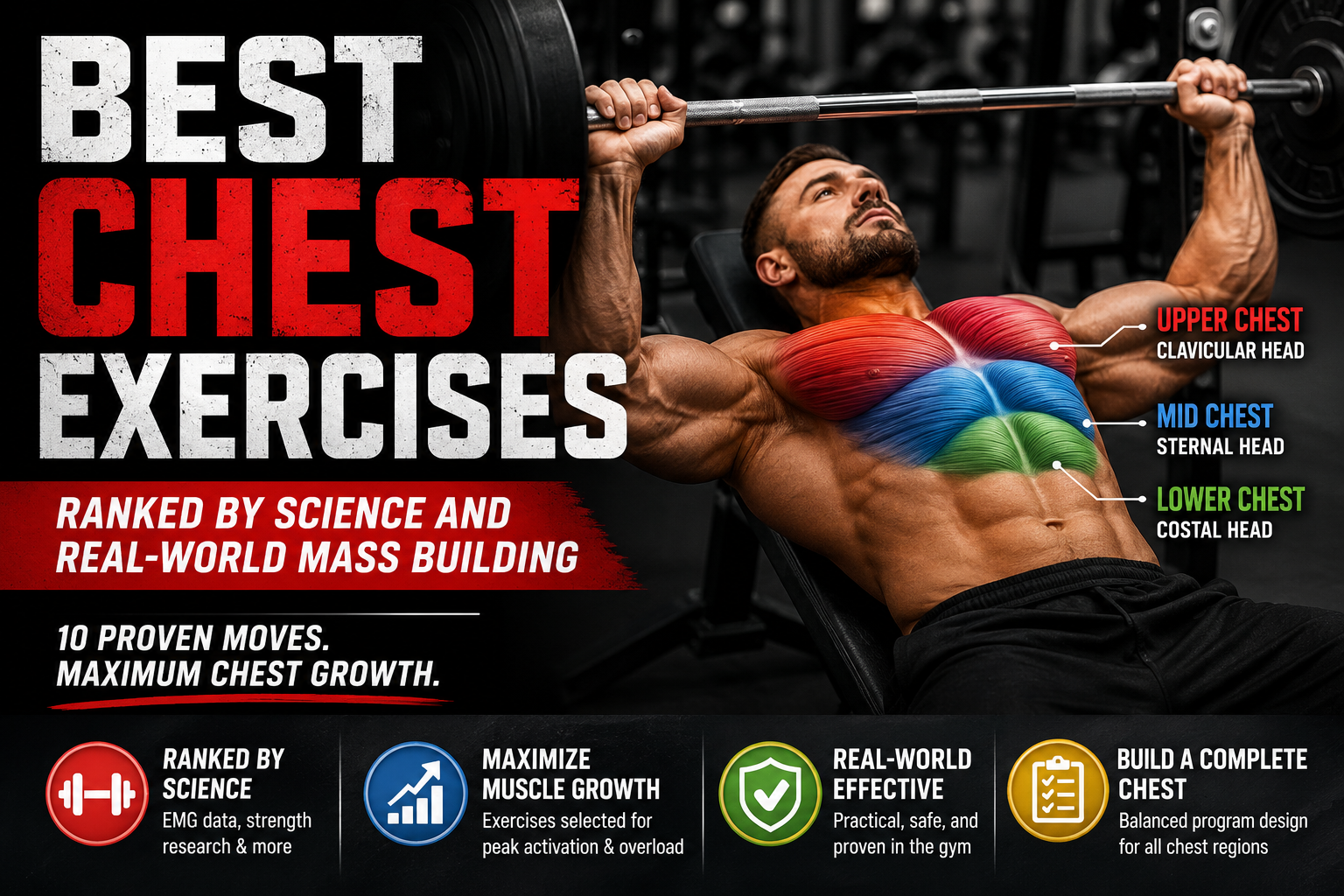
Best Chest Exercises: Ranked by Science and Real-World Mass Building
The best chest exercises are not a matter of opinion — they can be ranked objectively using EMG activation data, progressive overload potential, range of motion, and decades of applied hypertrophy research. Knowing which chest exercises produce the most muscle fiber recruitment, and how to structure them into a program, is the difference between a lagging chest and a thick, full pec shelf that shows from every angle.
This guide ranks the 10 most effective chest exercises, explains the anatomy behind why exercise angle matters, and shows you exactly how to build a complete chest training program around the exercises that will move the needle fastest.
WHAT YOU’LL LEARN
- How to rank chest exercises using EMG data, load potential, and ROM
- The 10 best chest exercises with a full comparison table
- Flat barbell bench press technique and mass-building application
- Why incline dumbbell press is the single best upper chest exercise
- How dips compare to bench press for lower chest hypertrophy
- Cable flyes and crossovers — where they fit in the program hierarchy
- Best exercise choices for beginners vs advanced lifters
- How to build a complete chest program from the ranked list
THE SHORT ANSWER
The flat barbell bench press, incline dumbbell press, weighted chest dips, and cable crossovers form the core of any evidence-based chest program. EMG research consistently shows that multi-angle loading — hitting the clavicular, sternal, and costal heads through different planes — produces greater overall pec development than any single exercise alone. Most lifters stall because they rely on one or two movements instead of systematically targeting the full chest through its entire range of motion.
Chest Anatomy: Why Exercise Angle Changes Everything
The pectoralis major is not a single-function muscle. It has three anatomical regions — the clavicular head (upper chest), the sternal head (mid chest), and the costal head (lower chest) — each with slightly different fiber orientations and lines of pull. This matters because no single exercise fully loads all three regions at peak stretch and contraction simultaneously.
The clavicular head runs from the clavicle to the humerus and is most activated when the press angle is inclined (30 to 45 degrees). The sternal head, the largest portion of the pec, runs from the sternum and is best loaded in the flat to slight decline range. The costal head — the lower fibers — is hit hardest in decline positions and in dips with a forward-lean torso.
Beyond just angle, the chest functions to horizontally adduct the arm (bring it across the body), flex the shoulder, and internally rotate the humerus. Exercises that include a strong adduction component — like cable crossovers and dumbbell flyes — achieve a peak contraction that a straight press movement never fully replicates. This is why a complete chest program needs both pressing and fly-pattern movements.
For upper chest development, incline work is non-negotiable. The clavicular head is chronically undertrained in lifters who only flat bench press, which is why many experienced trainees have thick mid-chest but shallow upper pecs. Addressing angle variety is the first fix.
How to Rank Chest Exercises: The Four Criteria
Ranking chest exercises requires more than gut feel. Four objective criteria determine where each exercise sits in the hierarchy:
- EMG activation: Electromyography studies measure electrical activity in muscle fibers during a movement. Higher EMG = more motor unit recruitment. Research from studies by Bret Contreras, the American Council on Exercise (ACE), and multiple peer-reviewed sport science journals provides a consistent picture of which exercises recruit the most pectoral muscle fibers.
- Load potential: How much absolute load can you apply to the muscle? Barbell movements allow the most progressive overload over time, which drives long-term hypertrophy. An exercise with modest EMG but high load potential can still produce significant mass gains.
- Range of motion: Greater ROM at a challenging load means more total mechanical tension across the full fiber length. Dumbbell variations typically allow greater ROM than barbell variations. The stretch position, in particular, has been shown in recent research to drive significant hypertrophy through stretch-mediated mechanisms.
- Practical factors: Injury risk, learning curve, equipment availability, and fatigue cost all affect whether an exercise is actually useful in a real training program. An exercise that is marginally superior on EMG but has a high injury risk (e.g., behind-the-neck press variations) drops in real-world ranking.
Applying neuromuscular efficiency principles, the best exercises are the ones that allow you to consistently load the target muscle progressively without generating excessive joint stress or systemic fatigue that bleeds into recovery from other sessions.
The Top 10 Best Chest Exercises: Master Ranking Table
The table below ranks the 10 most effective chest exercises using the four criteria above. EMG ratings are relative (High / Medium / Medium-High) based on available research. Load potential reflects how well the movement scales with added resistance over a training career.
| Rank | Exercise | Primary Target | EMG Activation | Load Potential | Best For |
|---|---|---|---|---|---|
| 1 | Flat Barbell Bench Press | Sternal head / overall mass | High | Very High | Maximum strength + mass baseline |
| 2 | Incline Dumbbell Press | Clavicular head / upper chest | High | High | Upper chest development, ROM |
| 3 | Weighted Chest Dips | Costal / lower sternal | High | High | Lower chest mass, compound volume |
| 4 | Incline Barbell Press | Clavicular head | High | Very High | Upper chest strength + mass |
| 5 | Flat Dumbbell Press | Sternal head | High | High | ROM advantage over barbell flat |
| 6 | Cable Crossover (low-to-high) | Clavicular head | Medium-High | Medium | Upper chest peak contraction |
| 7 | Cable Crossover (high-to-low) | Sternal / costal | Medium-High | Medium | Mid/lower chest peak contraction |
| 8 | Dumbbell Fly (incline or flat) | Sternal / clavicular stretch | Medium | Low-Medium | Stretch-mediated hypertrophy, isolation |
| 9 | Decline Barbell Press | Costal / lower sternal | High | Very High | Lower chest mass |
| 10 | Machine Chest Press | Sternal head | Medium | Medium-High | Beginners, pump work, injury rehab |
Flat Barbell Bench Press: The Cornerstone Movement
The flat barbell bench press ranks first in overall chest exercises not because it has the highest pec EMG of any movement — it does not — but because it allows the greatest absolute loading over a training career, and progressive overload is the primary driver of hypertrophy. A lifter who adds 50 pounds to their bench press over two years will have a noticeably larger chest. No isolation movement offers that kind of long-term stimulus.
Grip width affects muscle recruitment. A wider grip (roughly 1.5x shoulder width) reduces range of motion but increases pectoral loading and reduces the tricep contribution. A narrower grip shifts load toward the triceps. For chest development specifically, a moderate-to-wide grip with a controlled descent to the sternum — not a bounce — produces the best results.
WHAT THE RESEARCH SAYS
A 2017 study in the Journal of Human Kinetics found that pausing at the bottom of the bench press (a 1-2 second pause) significantly increased pectoralis major activation compared to a touch-and-go repetition. The pause eliminates the elastic energy stored in the bar path and forces the pecs to generate force from a dead stop. For hypertrophy specifically, this variation adds meaningful tension time to the most stretched position of the movement.
Common technique errors that reduce pec activation: letting the bar drift toward the clavicle (shifts load to front delts), bouncing off the chest (reduces tension at the bottom), and flaring the elbows excessively (shifts load to the shoulder joint and increases rotator cuff stress). Keep a moderate arch, retract the scapulae, and control the descent over 2-3 seconds for maximum pec tension.
For progressive overload on the bench press, a structured approach to adding load over weeks and cycles outperforms random weekly weight selection. A 3-5 rep range for strength cycles combined with 6-12 rep hypertrophy work covers both neurological and muscular adaptations.
GYM APPLICATION
For maximum chest hypertrophy, try a 3-second eccentric on the bench press. Lower the bar under control over 3 seconds, pause 1 second at the chest, then press explosively. This technique, known as tempo training, increases time under tension dramatically and is one of the fastest ways to break through a chest development plateau without changing the exercise at all.
Incline Dumbbell Press: Best Single Exercise for Upper Chest
The incline dumbbell press is arguably the single best exercise for upper chest development. It combines the high clavicular head activation of incline pressing with the greater range of motion that dumbbells allow — the arms can travel slightly past the torso at the bottom, placing the pec in a deep stretch that barbell pressing cannot replicate.
Bench angle is critical and frequently misunderstood. Most lifters set the incline too high — at 60-70 degrees — which shifts the primary load to the anterior deltoid rather than the upper chest. Research and practical application consistently point to 30-45 degrees as the optimal range for clavicular head activation. At 30 degrees, you get strong upper chest emphasis with minimal deltoid takeover. At 45 degrees, you begin to involve more anterior delt, but the upper chest still receives significant stimulus.
During the descent, allow a slight outward arc so the elbows travel down and slightly out, maintaining the forearms roughly perpendicular to the floor at the bottom. At the top, do not fully lock out and let the shoulders roll forward — keep tension on the pecs by stopping just short of lockout and maintaining scapular retraction throughout the set.
WHAT THE RESEARCH SAYS
A 2020 study in the Journal of Strength and Conditioning Research compared pectoralis major EMG across seven common chest exercises and found that incline dumbbell press produced the highest clavicular head activation of any movement tested, including incline barbell press. The added ROM of the dumbbell variation was identified as the primary contributor to superior muscle activation in the stretched position.
Dips for Chest: An Underrated Mass Builder
Chest dips are one of the most underused exercises in chest training and one of the best for targeting the lower and outer portions of the pecs. The key difference between a tricep dip and a chest dip is body position: leaning forward (roughly 30-40 degrees forward torso tilt) shifts the primary loading from the triceps to the pectoralis major, particularly the lower sternal and costal fibers responsible for the deep lower chest shelf that many lifters struggle to develop.
For lower chest work, dips beat decline bench press in several important ways. First, the range of motion is typically greater — the chest descends further below the hands than it does in any barbell variation. Second, dips involve a strong adduction component as you press back to the top, creating a double stimulus: stretch at the bottom and peak contraction at the top. Third, the movement is closed-chain on the upper limb, which recruits stabilizing muscles that straight barbell pressing does not fully engage.
Once bodyweight dips become easy for 3 sets of 15+ reps, add load using a dip belt. Progressive overload on weighted dips can continue for years and produces remarkable lower chest and overall pec development.
SAFETY NOTE
Dips place significant stress on the anterior shoulder capsule, particularly when descending too deep (past 90 degrees of elbow flexion) or using excessively wide bar spacing. Lifters with a history of anterior shoulder impingement or AC joint issues should approach weighted dips carefully, limit depth to the point where discomfort begins, or substitute incline cable flyes as a lower chest alternative. Always warm up the shoulder joint thoroughly before weighted dips.
Cable Flyes and Crossovers: The Peak Contraction Specialists
Cable crossovers and flyes occupy a specific and important role in chest training: they provide peak contraction tension that pressing movements cannot generate. When you press a barbell or dumbbell, resistance decreases as the bar approaches lockout — you are pressing against gravity, which pulls straight down. A cable changes the force vector so the pec is under significant tension all the way through the adduction, including at full arm extension where the muscle fibers are at their shortest and most contracted position.
The cable setup determines which part of the chest you are targeting. A low-to-high cable (handles set at or below hip height, pressing upward and inward) places peak contraction load on the clavicular head. A high-to-low cable (handles set above shoulder height, pressing downward and inward) targets the sternal and costal heads. Mid-cable setup (handles at shoulder height) provides the broadest sternal head stimulus.
For maximum hypertrophy, use cables at the end of a pressing session as a finisher. The muscle is pre-fatigued from the heavy compound work, and cables allow you to generate a strong mind-muscle connection and pump without additional joint stress. 3-4 sets of 12-20 reps per cable variation is typically sufficient.
Tricep activation during cable work is minimal when the movement pattern stays in the horizontal adduction plane. Keep the elbows slightly bent and fixed throughout — do not allow a bending-and-extending motion that turns the fly into a press.
Best Chest Exercises for Beginners vs Advanced Lifters
Exercise selection should match training age. A beginner and an intermediate lifter have fundamentally different needs, and applying an advanced program to a novice produces diminishing returns at best and injury at worst.
Beginners (0-12 months of consistent training)
Beginners should anchor chest training around two to three exercises maximum: flat barbell or dumbbell bench press as the primary movement, machine chest press or push-ups for volume work, and a single cable or dumbbell fly for isolation. The goal in this phase is to build the motor patterns and tendon strength that support heavier loading later. Attempting a full advanced program too early generates fatigue without adding proportional stimulus.
Intermediate (1-3 years)
Intermediate lifters should introduce angle variety. Add incline work as a second primary movement, begin integrating weighted dips, and use two cable variations (high-to-low and low-to-high) to address the full length of the pec. At this stage, exercise order matters: start with the angle you are weakest at, since that area will receive the most quality stimulus when you are fresh.
Advanced (3+ years)
Advanced lifters have typically identified specific weak points and should program specifically to address them. If the upper chest lags, prioritize incline work first in the session with maximal loading before any flat pressing. If the outer chest shape is lacking, increase cable and fly work volume. Advanced lifters also benefit from techniques such as rest-pause sets, mechanical drop sets (incline to flat to decline with the same dumbbells), and partial rep finishers at the stretched position.
Supplementing with creatine monohydrate has consistent research support for improving output across high-rep sets and reducing fatigue, which is particularly useful in advanced chest programs where total weekly volume is high.
How to Build a Chest Workout from the Ranked List
A well-structured chest workout follows a movement hierarchy: compound presses first (when you are fresh), then secondary compound movements (dips or incline variations), then isolation work (cables and flyes). This ensures maximum loading on the exercises that produce the greatest hypertrophic stimulus.
Below is a sample evidence-based chest workout built from the ranked list, suitable for intermediate lifters training chest twice per week:
| Order | Exercise | Sets | Reps | Notes |
|---|---|---|---|---|
| 1 | Flat Barbell Bench Press | 4 | 4-6 | 3-second eccentric, 3-min rest |
| 2 | Incline Dumbbell Press | 3 | 8-10 | 30-degree angle, 2-min rest |
| 3 | Weighted Chest Dips | 3 | 8-12 | Forward lean, controlled descent |
| 4 | Cable Crossover (high-to-low) | 3 | 12-15 | Pause at peak contraction |
| 5 | Incline Dumbbell Fly | 2 | 15-20 | Stretch emphasis, light weight |
For the second chest session of the week, reverse the angle priority: start with incline barbell press as the primary movement, follow with flat dumbbell press, then low-to-high cables, then a machine press for pump volume. This ensures both sessions address different areas of the pec with fresh muscles.
Total weekly chest volume for intermediate lifters should fall between 12 and 20 working sets. Beginners can achieve results with 8-12 sets. Advanced lifters sometimes push to 20-25 sets per week, but this requires proportional recovery investment. For a structured approach to periodizing this volume, see the guide to complete chest training.
Note that shoulder pressing work from shoulder pressing sessions also contributes significant anterior deltoid and upper pec stimulus, so total pressing volume across the week should be managed to avoid overreaching the shoulder girdle.
Common Chest Training Mistakes
The table below covers the five most common errors that derail chest development, along with what to do instead:
| Mistake | Why It Happens | What It Costs You | The Fix | Priority |
|---|---|---|---|---|
| Only flat bench pressing | Benchmark lift ego | Underdeveloped upper chest and poor overall shape | Prioritize incline work equally; start sessions with incline 1-2x per week | High |
| Too-high incline angle (60-70 degrees) | Misunderstanding anatomy | Anterior deltoid takeover, poor upper chest stimulus | Set incline to 30-45 degrees; confirm via feel, not appearance | High |
| Bouncing the bar off the chest | Ego loading, fatigue | Reduced pec tension at stretch position, shoulder injury risk | Control descent 2-3 seconds; touch and pause briefly | High |
| Skipping isolation work | “Compounds are enough” belief | Underdeveloped outer chest shape, no peak contraction work | Add 2-3 sets of cables or flyes at end of each session | Medium |
| No progressive overload on isolation exercises | Treating cable work as “just a pump” | Stalled development from isolation movements | Track weights and reps on cables and flyes; aim for progressive improvement | Medium |
Article Summary
- The pectoralis major has three heads — clavicular, sternal, costal — each requiring different exercise angles for full development
- Chest exercises should be ranked by EMG activation, load potential, range of motion, and practical risk factors
- Flat barbell bench press ranks #1 for overall mass due to its unmatched progressive overload potential
- Incline dumbbell press ranks #1 for upper chest development; keep the angle at 30-45 degrees, not 60-70
- Weighted chest dips are an underused lower chest mass builder with a strong adduction component
- Cable crossovers provide unique peak contraction tension that pressing movements cannot replicate
- Beginners need 2-3 exercises; intermediate lifters benefit from 4-5 exercises across multiple angles
- Total weekly chest volume of 12-20 working sets is appropriate for most intermediate lifters
- The most common mistake is relying solely on flat bench pressing and neglecting angle variety
- Programming structure should follow compound-first hierarchy: press, secondary compound, then isolation
Frequently Asked Questions
Is the bench press the best chest exercise?
The flat barbell bench press is the best single exercise for overall chest mass due to its progressive overload potential, but no single exercise is “the best” for developing the full chest. You need pressing from multiple angles — flat, incline, and decline or dip — plus isolation work to develop the pec major across all three heads. The bench press is the cornerstone, not the complete program.
How many sets of chest exercises per week do I need?
Most intermediate natural lifters achieve strong results with 12-20 direct weekly chest sets. Beginners can make excellent progress with 8-12 sets. Going beyond 20 sets per week requires careful management of sleep, nutrition, and overall training stress. The quality and intensity of sets matters more than raw volume — 15 hard, well-executed sets beats 25 sloppy ones.
Are dumbbell exercises better than barbell for chest growth?
Neither is categorically better. Dumbbell exercises provide a greater range of motion and allow each side of the chest to work independently, which can address strength imbalances and provides better stretch loading. Barbell exercises allow greater absolute loading and are easier to apply progressive overload systematically. A comprehensive chest program uses both. If forced to choose one, barbells edge out dumbbells for long-term mass building due to load potential.
Do SARMs or other compounds improve chest development?
Anabolic compounds including SARMs can accelerate muscle protein synthesis and allow for greater training volume recovery. However, they do not change which exercises are most effective — the biomechanics of the pectoralis major remain constant regardless of hormonal environment. A well-structured natural program using the exercises ranked in this article will always outperform a poor program with pharmaceutical support.
How often should I train chest for maximum hypertrophy?
Research on training frequency for hypertrophy consistently shows that two sessions per week targeting a muscle group is superior to one for intermediate and advanced lifters. This allows you to distribute 16-20 weekly sets across two fresh, high-quality sessions rather than cramming all volume into one session where fatigue accumulates and later sets produce diminishing returns. Three sessions per week can be effective for advanced lifters managing total volume carefully.
Is incline or flat bench better for chest development?
Both are essential. Flat bench press develops the sternal head (the largest portion of the pec), while incline develops the clavicular head (upper chest) — the area that creates the full, high-set chest appearance. Most lifters have a naturally stronger sternal head and underdeveloped clavicular head, which means incline work deserves at least equal programming priority. Start sessions with whichever angle is lagging.
Can I build a big chest without a barbell?
Yes, with limitations. Dumbbell pressing, cable work, weighted dips, and push-up variations can build significant chest mass. The limitation is the ceiling on progressive overload — dumbbells in most gyms cap out at 100-120 lbs, and once you can press those for high reps, progress stalls without a barbell or specialty loading equipment. For most lifters in commercial gyms, this ceiling is years away, so a dumbbell-focused program is genuinely viable for a long time.
DISCLAIMER
This article is for educational and informational purposes only. The exercise recommendations and program structures provided are general in nature and may not be suitable for individuals with pre-existing injuries, orthopedic conditions, or specific health concerns. Consult a qualified physician or physical therapist before beginning any new exercise program, particularly if you have a history of shoulder, elbow, or wrist injuries. Progressive overload protocols should be implemented gradually under appropriate supervision when possible.
Related Reading
- Complete Chest Training Guide: Full Programs, Volume, and Periodization
- Upper Chest Workout: The Best Exercises and Programs for Clavicular Head Development
- Lower Chest Exercises: How to Build the Lower Pec Shelf
- How to Get Bigger Arms Fast: The 8-Week Arm Specialization Protocol
- 5/3/1 Program Guide: Progressive Overload for Long-Term Strength and Mass