WHAT YOU’LL LEARN IN THIS GUIDE
- The four key leg muscle groups and exactly how to train each of them
- Quad-dominant vs hip-dominant exercises — and why you need both every week
- RDL vs leg curl: which builds more hamstring mass and when to use each
- Knee joint loading science and how to protect your joints without limiting gains
- How many sets per week you actually need for legs (with volume landmarks by experience level)
- Complete beginner, intermediate, and advanced leg workout programs with sets, reps, and progression
- The most common leg training mistakes — and how to fix every one of them
- How to integrate leg training into your full weekly program without sacrificing recovery
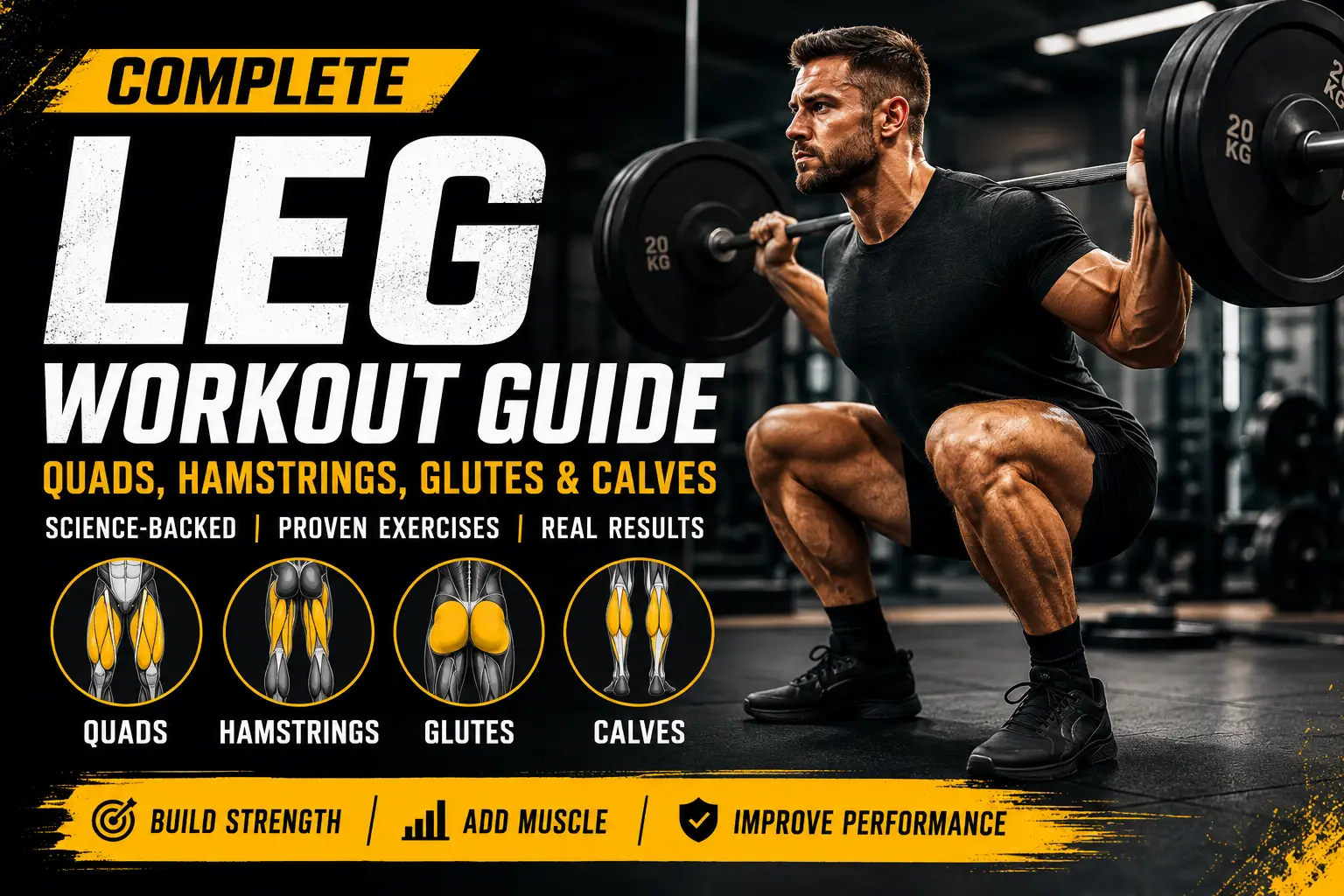
This complete leg workout guide covers everything you need to build bigger, stronger legs — from the biomechanics of quad vs hip-dominant loading to a full program template for every experience level. Legs are the most skipped muscle group and the most undertrained one in serious lifters at the same time. If your lower body lags your upper body, or if your legs have stopped growing despite consistent training, the issue is almost certainly your exercise selection, loading strategy, or volume distribution — not your genetics.
THE SHORT ANSWER
The complete leg workout guide comes down to balancing quad-dominant exercises (squats, leg press, hack squats) with hip-dominant exercises (Romanian deadlifts, leg curls, glute-ham raises) across 2 training sessions per week. Intermediate lifters need 14–20 sets per week across quads, hamstrings, and glutes. Calves require 12–16 dedicated sets per week with a full range of motion to grow. Every leg session should include at least one bilateral compound movement, one unilateral exercise, and one isolation movement per targeted muscle group.
1. Leg Anatomy: The Four Muscle Groups You Need to Train
The legs contain some of the largest muscles in the human body. Treating “legs” as a single training category is like treating “upper body” as one. Each muscle group has distinct functions, fiber-type characteristics, and optimal movement patterns.
Quadriceps
The quads are four muscles — rectus femoris, vastus lateralis, vastus medialis, and vastus intermedius — that collectively extend the knee. The rectus femoris is the only quad muscle that crosses the hip, which means it’s better recruited when the hip is in slight extension (as in a deep squat bottom position). The vastus lateralis (outer quad) and vastus medialis (teardrop) respond to different knee flexion angles. Knee-dominant movements like squats, leg press, and hack squats are the primary quad developers.
Hamstrings
The hamstrings — biceps femoris (long and short head), semimembranosus, and semitendinosus — cross both the hip and the knee. They both flex the knee and extend the hip. This dual function is critical for training design: hip extension exercises (Romanian deadlifts, good mornings) train the hamstrings through their longer muscle-length position and produce greater hypertrophy stimulus per the current research. Knee flexion exercises (leg curls) train the hamstrings through a different length and add volume. Both are needed.
Glutes
The gluteus maximus is the largest muscle in the body and the primary hip extensor. It’s most active when the hip moves from deep flexion to full extension — the final 30 degrees of a squat or hip thrust. The gluteus medius (hip abductor) stabilizes the pelvis during single-leg movement. Hip thrusts, Romanian deadlifts, and Bulgarian split squats are among the highest glute activators. Squats, despite being excellent quad exercises, produce relatively modest glute activation unless you actively drive the hips through full extension.
Calves (Gastrocnemius and Soleus)
The gastrocnemius (two heads) crosses the knee and ankle, meaning it’s best targeted with a straight knee. The soleus only crosses the ankle, meaning seated calf raises (bent knee) isolate it effectively. Both need direct training because they’re notoriously stubborn. Calves respond best to high frequency (3–4x/week), high volume (15–20 sets/week), and full range of motion — heel stretching all the way to the bottom of each rep.
GYM APPLICATION
Most undertrained muscle groups on the legs are the hamstrings and calves. Pull your shorts up in front of a mirror: if your quad sweep is visible but your hamstrings look flat from the side, you need more hip-dominant volume. If your calves look like round pebbles rather than developed muscle bellies, add seated calf raises (soleus-focused) to every leg session — gastrocnemius work alone misses the deeper layer.
2. Quad-Dominant vs Hip-Dominant Training: The Most Important Distinction
Every leg exercise loads either the quads predominantly (knee-dominant) or the glutes and hamstrings predominantly (hip-dominant). Most people do one and neglect the other. A complete leg workout guide requires both, programmed with intention.
Quad-dominant exercises (knee moves over the toe, torso stays upright):
- Back squat, front squat, goblet squat
- Leg press, hack squat
- Bulgarian split squat (quad-focused with upright torso)
- Leg extension (isolation)
Hip-dominant exercises (hips hinge backward, torso inclines forward):
- Romanian deadlift (RDL), conventional deadlift
- Glute-ham raise, Nordic curl
- Hip thrust, cable pull-through
- Lying/seated leg curl (knee flexion isolation)
- Good morning
| Goal | Primary Movement Type | Best Exercises | Weekly Sets |
|---|---|---|---|
| Quad mass and strength | Knee-dominant (quad) | Squat, leg press, hack squat | 8–12 |
| Hamstring mass | Hip-dominant + knee flexion | RDL, leg curl, Nordic curl | 8–12 |
| Glute development | Hip extension | Hip thrust, RDL, Bulgarian split squat | 8–12 |
| Calf size | Ankle plantarflexion | Standing calf raise, seated calf raise | 12–16 |
| Overall leg mass | Mixed bilateral + unilateral | Squat + RDL + split squat combination | 18–24 total |
WHAT THE RESEARCH SAYS
A 2015 meta-analysis by Schoenfeld et al. found that exercises targeting muscles in a lengthened position (where the muscle is stretched under load) produce superior hypertrophy per set compared to exercises that load the muscle in a shortened position. For hamstrings, this means RDLs and good mornings — which load the hamstrings at long muscle lengths — produce more hypertrophy stimulus per set than leg curls alone. For quads, deep squats and full-range leg press load the rectus femoris in a more stretched position than partial-range movements. Full range of motion is not just about safety — it directly affects how much muscle you build.
3. RDL vs Leg Curl: Which Builds More Hamstring Mass
The Romanian deadlift vs leg curl question is the hamstring equivalent of the pull-up vs lat pulldown debate. Both have a role, but they’re not interchangeable — they train the hamstrings through different mechanisms.
The case for RDLs: RDLs load the hamstrings in their lengthened position (hip flexed, knee extended). Research on length-tension training consistently shows that loading muscles at long lengths produces more hypertrophic stimulus per set. The hamstring stretch under load during an RDL creates greater mechanical tension — the primary driver of muscle growth. RDLs also develop the glutes simultaneously and strengthen the posterior chain as a functional unit.
The case for leg curls: Leg curls isolate the hamstrings through knee flexion. Because the hip is neutral or extended during a lying leg curl, the biceps femoris short head (which only crosses the knee) gets its primary stimulus. Seated leg curls keep the hip in flexion, loading the hamstrings at a longer length than lying curls — making seated leg curls the best machine option for hamstring hypertrophy. Leg curls also allow precise load progression and training to failure without fatigue affecting other movements.
The practical recommendation: Use RDLs (or stiff-leg deadlifts) as your primary hip-dominant hamstring developer. Follow with seated leg curls for additional isolated volume. Lying leg curls are a secondary option for variety. This combination covers both mechanisms of hamstring hypertrophy — hip extension loading and knee flexion loading — giving you the most complete hamstring development possible.
GYM APPLICATION
If you only have time for one hamstring exercise, choose the Romanian deadlift. If you have time for two, add seated leg curls. The RDL builds more total hamstring mass; the leg curl adds targeted volume and helps develop the knee flexion function of the biceps femoris. Use a 3-second eccentric on RDLs — the slow lowering phase while the hamstrings are stretched is where the growth signal is strongest.
4. Knee Joint Loading: How to Train Hard Without Destroying Your Knees
The most common reason lifters avoid heavy leg training is knee pain or fear of knee injury. Some of this fear is warranted — high-volume squatting with poor mechanics does create cumulative joint stress. But most knee pain in training is manageable and preventable with proper technique and programming.
Knee tracking over the toe: The knee should track in line with the foot throughout any squat or leg press movement. Valgus collapse (knees caving inward) increases medial compartment stress and is the primary cause of patellar tendon irritation in lifters. Cue: “push your knees out” on every rep of any squat variation.
Depth and range of motion: Deep squats (below parallel) are not more dangerous than partial squats for healthy knees. In fact, the menisci act as buffers at deep flexion, and the larger range of motion distributes load more evenly across the joint. Partial squats place more compressive force on the patellofemoral joint. Train through full range of motion unless you have a specific contraindication.
Leg extensions for knee health: Contrary to popular belief, leg extensions do not damage healthy knees. They’re a safe isolation exercise for the vastus medialis and can actually reduce anterior knee pain by strengthening the VMO. Open-chain knee extension is contraindicated only in ACL rehabilitation early stages — not in healthy training.
⚠️ SAFETY NOTE
Patellar tendinopathy (“jumper’s knee”) is common in high-volume leg trainers. Early warning signs include pain below the kneecap during or after training that persists for more than 2 sessions. If you experience this, immediately reduce squat frequency and volume, replace deep squats with leg press at a shallower depth, and add isometric leg extensions (hold 60 seconds at 60° of flexion) 3x/day as a proven pain-management and tendon-loading protocol.
5. The Best Leg Exercises, Ranked by Evidence and Practicality
Tier 1 — Primary mass builders (must be in every program)
- Barbell Back Squat: The foundational quad and overall leg developer. Requires more technique investment than any other leg exercise. Go below parallel, keep the chest up, drive the knees out. Variations: low bar (more posterior chain) vs high bar (more quad).
- Romanian Deadlift (RDL): The most effective hamstring and glute builder available. Control the eccentric; feel the stretch in the hamstrings at the bottom. Keep the bar close to the body throughout.
- Leg Press: Quad-dominant compound movement with less spinal loading than squats. Excellent for volume accumulation. Foot placement changes muscle emphasis: high and wide targets glutes and hamstrings more; low and narrow emphasizes quads.
- Bulgarian Split Squat: Unilateral compound exercise with high glute and quad activation. Addresses left-right asymmetries. More difficult technique-wise but produces excellent hypertrophy with moderate loads.
Tier 2 — High-value accessories (include 1–2 per session)
- Hack Squat: Machine-based quad isolation with lower spinal demand than barbell squats. Superior for targeting the vastus lateralis sweep. Safer loading environment for high rep ranges.
- Seated Leg Curl: Best machine option for hamstring hypertrophy due to hip flexion during the exercise (loading hamstrings at longer length than lying variant).
- Hip Thrust: Highest glute activation of any exercise. Not a major quad or hamstring builder but indispensable for glute development. Load progressively with a barbell.
- Walking Lunge / Reverse Lunge: Unilateral quad and glute work. Reverse lunges are easier on the knees for lifters with patellar tendon issues.
Tier 3 — Supplementary and isolation work
- Leg Extension: Quad isolation. Most effective when performed through full range of motion with a 2-second hold at full extension. Valuable for VMO development.
- Lying Leg Curl: Knee flexion hamstring work. Shorter hamstring length than seated variant but useful for variety.
- Standing Calf Raise: Gastrocnemius-dominant. Heavy load, full stretch. Non-negotiable for calf development.
- Seated Calf Raise: Soleus-dominant. Often neglected; critical for full calf development. Moderate weight with full range of motion.
- Nordic Curl: The most effective exercise for hamstring injury prevention. Also an excellent hamstring builder. Very difficult — start with assisted negatives.
6. Squatting for Mass: Technique Points That Actually Matter
The squat is the cornerstone of the complete leg workout guide, but poor squatting technique wastes potential and risks injury. Here’s what actually matters, based on biomechanics rather than gym mythology.
Stance width: Your optimal squat stance depends on hip anatomy, not on any universal rule. Wider stances allow greater depth for lifters with shallow hip sockets (acetabular anteversion). Narrower stances work for lifters with deeper sockets. Experiment: find the stance that lets you hit below-parallel depth without excessive forward lean or knee valgus. That’s your optimal stance.
Depth: Below parallel (hip crease below knee) is the minimum effective range for quad and glute hypertrophy. Ass-to-grass squats are not necessary for most hypertrophy goals and add compressive stress to the knee. Aim for just below parallel as the standard.
Torso angle: High-bar squats with a more upright torso maximize quad loading. Low-bar squats with a more inclined torso shift load toward the glutes and posterior chain. For pure quad development, high-bar or goblet squat positioning is superior. For overall leg mass, incorporating both over your training cycle is optimal.
Bar position: High bar (upper traps) creates more knee flexion and quad demand. Low bar (rear delts) creates more hip hinge and posterior chain demand. Both are valid — choose based on your goals and mobility.
WHAT THE RESEARCH SAYS
A 2019 study in the Journal of Human Kinetics compared high-bar and low-bar back squats at matched loads and found that high-bar squatting produced significantly greater quadriceps activation while low-bar produced greater glute activation. Neither was superior for overall leg hypertrophy — they produced complementary adaptations. This supports rotating between both variations over a training mesocycle rather than committing exclusively to one style.
7. Weekly Volume for Legs: How Many Sets You Need
Leg muscles are large and recover more slowly than upper-body muscles. The volume landmarks below represent practical ranges based on hypertrophy research and real-world training outcomes.
| Muscle Group | Beginner (0–1 yr) | Intermediate (1–3 yr) | Advanced (3+ yr) |
|---|---|---|---|
| Quadriceps | 6–10 sets/week | 12–16 sets/week | 16–22 sets/week |
| Hamstrings | 6–10 sets/week | 10–14 sets/week | 14–20 sets/week |
| Glutes | 4–8 sets/week | 8–12 sets/week | 12–16 sets/week |
| Calves | 8–12 sets/week | 12–16 sets/week | 16–20 sets/week |
Compound exercises count toward multiple muscle groups at once. A set of squats counts as both a quad set and a partial glute set. A set of RDLs counts as both a hamstring set and a glute set. This means you don’t need separate isolation work for every muscle group in every session — the compound lifts carry most of the volume load, and isolation exercises fill in the gaps.
Frequency matters more for legs than for any other muscle group. Training legs once per week (“legs day on Thursday”) leaves 6 days without a training stimulus. Two sessions per week, spaced 72 hours apart, consistently outperforms one heavy session for hypertrophy in research settings.
If you’re currently following a training program that includes enhanced training on a cycle, leg volume tolerance is often the first to increase — your recovery from heavy squatting and RDL work improves substantially when anabolics accelerate muscle protein synthesis and reduce systemic fatigue markers.
8. Rep Ranges for Leg Hypertrophy: What the Research Shows
Like back training, leg muscles respond to a wide rep range. However, the specific exercises and fiber-type proportions of each leg muscle influence practical rep range selection:
- Squats and leg press (5–15 reps): Heavy sets of 5–8 build the neuromuscular strength base; sets of 10–15 accumulate the most hypertrophy volume per unit of fatigue. Heavy quad work at low reps is taxing and takes longer to recover from — program accordingly.
- RDLs (6–12 reps): Control is everything on RDLs. Reps above 12 tend to compromise the controlled eccentric that makes RDLs so effective. Stay in the 6–10 range for heavy work, 10–12 for lighter volume sets.
- Bulgarian split squat (8–15 reps): Heavy loading creates instability risk. This exercise thrives in the moderate rep range with a controlled tempo. The stretch-mediated stimulus is significant even at moderate loads.
- Leg curls and extensions (10–20 reps): Machine isolation exercises respond well to moderate-to-high reps with constant tension. Use slow eccentrics and peak contraction holds.
- Calves (10–20 reps): Calves are predominantly slow-twitch fibers in most people and respond to high reps with full range of motion. The critical variable is the stretched position — pause for 1–2 seconds at the bottom of each rep.
9. The Complete Leg Workout: Programs by Experience Level
Beginner Leg Program (0–12 months)
| Exercise | Sets | Reps | Rest | Notes |
|---|---|---|---|---|
| Goblet Squat or Leg Press | 3 | 10–12 | 2 min | Below parallel; knees over toes |
| Romanian Deadlift | 3 | 10–12 | 90s | 3-sec eccentric; feel hamstring stretch |
| Walking Lunge | 3/side | 10–12 | 90s | Control each step; don’t rush |
| Leg Curl (seated or lying) | 3 | 12–15 | 60s | Full range; control the eccentric |
| Standing Calf Raise | 4 | 15–20 | 60s | Pause 2 sec at bottom stretch |
Intermediate Leg Program (1–3 years)
| Exercise | Sets | Reps | Rest | Notes |
|---|---|---|---|---|
| Barbell Back Squat | 4 | 6–10 | 3 min | Below parallel; controlled descent |
| Romanian Deadlift | 4 | 8–10 | 2 min | Heavy; 3-sec eccentric |
| Bulgarian Split Squat | 3/side | 10–12 | 90s | Rear foot elevated; torso upright |
| Seated Leg Curl | 3 | 10–12 | 60s | Slow negative; pause at peak |
| Hack Squat or Leg Press | 3 | 10–15 | 90s | Quad pump set; full depth |
| Leg Extension | 3 | 12–15 | 60s | Hold 1 sec at full extension |
| Standing + Seated Calf Raise | 4+3 | 15–20 | 60s | Full stretch required; slow reps |
Advanced Leg Program (3+ years)
| Exercise | Sets | Reps | Rest | Notes |
|---|---|---|---|---|
| Barbell Back Squat (heavy) | 5 | 5–7 | 3–4 min | Working up to a top set each session |
| Romanian Deadlift | 4 | 8–10 | 2–3 min | Heavy; maximize hamstring stretch |
| Hack Squat | 4 | 8–12 | 2 min | Quad sweep focus; full depth |
| Bulgarian Split Squat | 3/side | 10–12 | 90s | Add dumbbells or barbell |
| Seated Leg Curl | 4 | 10–12 | 90s | Hamstring volume finisher |
| Hip Thrust | 3 | 10–15 | 90s | Full hip extension lockout each rep |
| Leg Extension | 3 | 15–20 | 60s | VMO pump; 2-sec hold at top |
| Standing Calf Raise (weighted) | 5 | 12–15 | 60s | Heavy; full stretch each rep |
| Seated Calf Raise | 4 | 15–20 | 60s | Soleus isolation; slow tempo |
10. How to Split Leg Volume: Quad Day vs Hamstring Day
Advanced lifters training legs twice per week benefit from organizing sessions by muscle-group emphasis rather than training all muscles to equal failure twice per week.
Session 1 — Quad-emphasis: Lead with squats and leg press. Add hack squats and leg extensions as accessories. Include one hip-dominant movement (RDL or leg curl) as secondary volume. Calves at the end.
Session 2 — Hamstring/glute emphasis: Lead with Romanian deadlifts or sumo deadlifts. Follow with seated leg curls, hip thrusts, and Nordic curls. Include one quad movement (Bulgarian split squat or front squat) for balance. Calves at the end.
This split allows you to push each muscle group with higher intensity on its dedicated day while still maintaining twice-weekly stimulus across the board. Both sessions hit calves, since calves recover faster than larger muscle groups and benefit from higher frequency.
This approach integrates naturally with push-pull-legs splits. On a PPL, your pull day already covers back and biceps. Structuring leg sessions with this quad/hamstring emphasis division gives you a 6-day routine with each major muscle group hit approximately twice per week at high quality. For complete program design, the training split guide covers how to arrange this across a full week.
11. Common Leg Training Mistakes and How to Fix Them
| Mistake | Why It Hurts | What to Do Instead |
|---|---|---|
| Training legs once per week | Protein synthesis from one session lasts ~72 hours — leaves 4 days with no stimulus; growth potential wasted | Train legs 2x/week minimum; distribute volume across two sessions |
| Only doing quad exercises (squats, leg press) | Posterior chain underdeveloped; hamstrings and glutes lag; knee injury risk increases | Balance every quad exercise with a hip-dominant exercise in the same week |
| Partial-range squats and leg press | Reduces stretch-mediated hypertrophy signal; shifts load to joints rather than muscles | Full range of motion on every rep; below parallel on squats, full depth on leg press |
| Skipping calves entirely | Underdeveloped lower legs; proportionality issues; calves are the most visually noticeable leg muscle on most physiques | Include 12–16 weekly calf sets; prioritize full stretch at the bottom of every rep |
| No unilateral work | Bilateral dominance creates left-right strength and size asymmetries; unilateral training also provides greater glute activation per unit of load | Include Bulgarian split squats, reverse lunges, or single-leg press in every training week |
| Going too heavy on RDLs with no eccentric control | Sacrifices the key hypertrophy mechanism of RDLs (loaded stretch); loads shift to lower back rather than hamstrings | Use a 3-second eccentric on every RDL rep; reduce load if this is not achievable |
| No calf stretch at the bottom of raises | The stretched position is where calf hypertrophy stimulus is greatest; bouncing through range of motion eliminates this signal | Pause 1–2 seconds at the bottom of every calf raise rep; use a heel-drop platform if possible |
12. Integrating Leg Training With Your Full Program
Leg training generates more systemic fatigue than upper-body work. Heavy squatting and Romanian deadlifts elevate cortisol, deplete glycogen, and produce EPOC (excess post-exercise oxygen consumption) that lasts 24–48 hours. This has implications for how you schedule your full week.
Spacing leg sessions: At minimum, 72 hours between leg sessions is recommended for intermediate and advanced lifters. Most programs space them across the week: Monday legs, Thursday legs — or Tuesday and Saturday on a 6-day PPL. Training legs on back-to-back days or directly after a deadlift day produces accumulated fatigue that limits performance.
Leg day timing relative to pressing: Squatting affects upper-body training minimally. However, if you deadlift heavy, your thoracic spinal erectors and upper back are fatigued — this can limit bench press performance if scheduled the following day. Plan upper-body pressing sessions at least 48 hours after deadlift-heavy leg sessions.
Cardio and leg recovery: If you include LISS cardio for conditioning or fat loss — particularly cycling or incline walking — schedule it at least 8 hours away from leg sessions, or on non-leg days. Adding 30 minutes of stationary cycling immediately post-leg session increases total leg volume load and should be treated as additional leg work when calculating weekly recovery demands.
For lifters incorporating peptides or compounds that accelerate tissue repair, leg recovery windows can compress. If you’re using an enhanced training protocol, the volume landmarks in this guide represent conservative estimates — you may be able to push total weekly sets higher during mid-cycle phases when recovery is at its peak.
Article Summary: Key Takeaways
- The four leg muscle groups — quads, hamstrings, glutes, and calves — each require specific movements and cannot all be trained adequately with squats alone
- Balance quad-dominant exercises (squats, leg press, hack squats) with hip-dominant exercises (RDLs, leg curls, hip thrusts) every training week
- RDLs build more total hamstring mass due to loading the muscle at longer lengths; leg curls add knee-flexion volume — both are needed
- Deep, full-range movements produce superior hypertrophy compared to partial-range movements for every leg exercise
- Intermediate lifters need 12–16 weekly quad sets, 10–14 hamstring sets, and 12–16 calf sets to drive continued growth
- Training legs twice per week consistently outperforms once per week for hypertrophy outcomes
- Bulgarian split squats and other unilateral exercises address strength asymmetries and produce high glute activation at moderate loads
- The Romanian deadlift is the single most effective hamstring exercise — use a 3-second eccentric on every rep
- Calves require a full stretch at the bottom of every rep; the stretched position is where the hypertrophy stimulus is greatest
- Advanced lifters should split leg volume into quad-emphasis and hamstring/glute-emphasis sessions for better quality per session
- Knee tracking, full depth, and controlled tempos are the three technique variables that most determine long-term knee health during leg training
- Leg training generates significant systemic fatigue — plan at least 72 hours between leg sessions for adequate recovery
Frequently Asked Questions
How often should I train legs for maximum growth?
Most intermediate and advanced lifters get the best results from training legs twice per week. The protein synthesis window from a single training session lasts approximately 48–72 hours, after which it returns to baseline — meaning training legs just once per week wastes 4–5 days of potential growth stimulus. Beginners can see adequate results from once-per-week leg training, but moving to twice per week typically accelerates results as soon as technique is solid. Very advanced lifters may use 3-per-week leg frequency during specialization phases, but recovery demands are high and require careful management.
Are squats necessary for building big legs?
Squats are the most effective quad-dominant movement and the cornerstone of any complete leg workout guide — but they’re not strictly “necessary” if you have a specific injury or mobility limitation that prevents safe squatting. The leg press, hack squat, and Bulgarian split squat can produce comparable quad hypertrophy when programmed with sufficient volume and progressive overload. That said, for any lifter without contraindication, squatting is the single most efficient use of leg training time and should be the first exercise you invest in mastering.
Why aren’t my legs growing despite heavy training?
The most common reasons legs stall despite hard training are: training them only once per week, not going below parallel on squats and leg press, neglecting hamstrings and calves in favor of quad work, and using too much load with too little control (which shifts stress from muscle tissue to joints). Audit your training against this list first. Then check your total weekly volume — most stalling legs are undertrained, not overtrained. Finally, protein intake specifically around leg sessions matters: legs are large and the synthesis demand is high. Aim for 40–50g of protein within 2 hours of your leg session.
What’s the best leg exercise for glutes?
The hip thrust produces the highest gluteus maximus activation of any commonly used exercise, according to multiple EMG studies. Barbell hip thrusts, performed through full hip extension at the top of each rep, are the most direct glute builder. Bulgarian split squats are a close second and have the advantage of also building quads and addressing asymmetries. Romanian deadlifts are the best compound movement for the glutes alongside their hamstring function. If glute development is a priority, include at least one of these three movements in every leg session. For a full upper body development guide to pair with your leg work, the shoulder training resource covers complementary programming principles.
How do I fix my weak calves?
Weak calves respond to three key interventions: higher frequency (3–4 training sessions per week), full range of motion with a paused stretch at the bottom, and separating gastrocnemius work (standing calf raises, straight knee) from soleus work (seated calf raises, bent knee). Most people only do standing calf raises and never train the soleus, which creates a development gap in the lower portion of the calf. Add seated calf raises to every leg session, pause for 2 seconds at the bottom of every rep, and train calves at the start of one session per week — not always as an afterthought at the end — to ensure they receive adequate intensity.
Should I squat on leg day or deadlift day?
Squats and deadlifts can share the same session, but it depends on the loading of each. If you’re squatting and deadlifting at near-maximal intensity in the same session, fatigue from squats will compromise deadlift performance and vice versa. Most programs separate them by 48–72 hours: heavy squats on one leg day, heavy Romanian deadlifts (and optionally conventional deadlifts) on the other. If you want both in one session, squat first (when CNS is freshest), and use a moderate-weight RDL afterward rather than attempting a max deadlift after heavy squat sets.
How long before I see results from leg training?
Beginners training legs twice per week consistently typically see noticeable changes in quad and glute definition within 8–12 weeks. Intermediate lifters working with a structured program — including the templates in this guide — usually see meaningful size increases over a 12–16 week training block. Calves are famously the slowest-developing muscle group; expect 16–24 weeks before visible changes even with consistent dedicated training. Document progress with photos from the front and side every 4 weeks — changes in leg development are often visible in photos before they’re obvious in the mirror.
Disclaimer: This article is for informational and educational purposes only. It is not medical advice. The compounds and protocols discussed may carry serious health risks. Always consult a qualified healthcare provider before starting any new supplement, peptide, hormone, or training protocol. FitScience does not encourage or endorse the use of any illegal substances.
Related Reading on FitScience
- Complete Back Workout Guide: Width, Thickness, and Mass in One Program
- How to Get Bigger Shoulders: The Complete Development Guide
- Best Training Split on Cycle: Steroids and SARMs Programming
- Chest Workouts: The Complete Guide to Building a Bigger Chest
- How to Get Bigger Arms Fast: Training Science and Protocols