
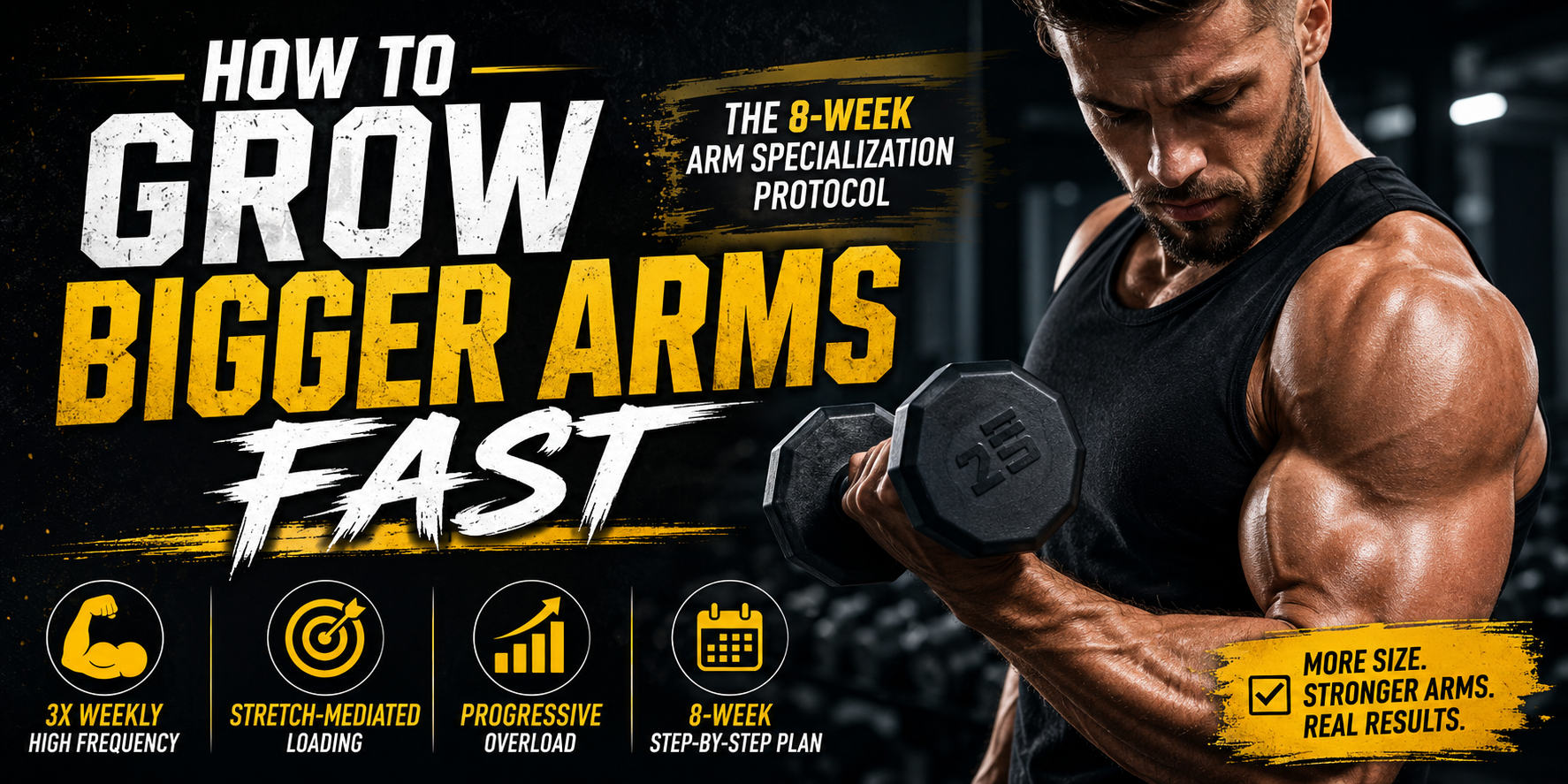
How to Get Bigger Arms Fast: The 8-Week Arm Specialization Protocol
If you want to know how to get bigger arms fast, the answer is not more random curls at the end of your chest day. Getting noticeably bigger arms in a short time frame requires a structured specialization protocol that applies the three fastest levers for arm hypertrophy — stretch-mediated loading, elevated frequency, and relentless progressive overload — simultaneously over a focused 8-week block.
This protocol is built around what the research on how to get bigger arms fast actually supports: incline dumbbell curls for maximum bicep stretch, overhead tricep extensions for long head loading, high weekly frequency, and a periodized progression model that prevents stagnation. If you follow this program, you will add measurable arm size in 8 weeks.
WHAT YOU’LL LEARN
- Why most arm programs fail to produce fast results (and what to fix first)
- The 3 fastest levers for arm hypertrophy according to current research
- The full 8-week arm specialization protocol with week-by-week progression
- Exercise tables for Weeks 1-4 and Weeks 5-8 with sets, reps, and technique notes
- How forearm development affects total arm size and what to do about it
- Nutrition protocol for fast arm growth including creatine timing
- Recovery and frequency rules for arm specialization
- Realistic size expectations for natural lifters over 8 weeks
THE SHORT ANSWER
The fastest path to bigger arms is an 8-week specialization block with 3x weekly arm training frequency, stretch-mediated loading for both biceps and triceps, and a caloric surplus with adequate protein. Most lifters make the mistake of under-frequenting and under-loading their arm training. This protocol fixes both. Expect 0.3 to 0.7 inches of arm growth in 8 weeks for natural lifters in a consistent caloric surplus.
Why Most Arm Programs Produce Slow Results
The vast majority of arm training programs are structured incorrectly in one or more of three critical ways: insufficient frequency, poor exercise selection for hypertrophic stimulus, and no coherent progressive overload strategy. Understanding where these programs fail is the fastest way to understand what this protocol does differently.
Problem 1: Training Arms Once Per Week
Most gym programs assign arms to one dedicated day per week, often Friday. The problem is that muscle protein synthesis (MPS) in response to a training session peaks within 24-48 hours and returns to baseline within 36-72 hours. Training a muscle only once per week means MPS returns to baseline for 4-5 days before the next stimulus arrives. This is a substantial missed opportunity.
Meta-analyses on training frequency consistently show that twice-weekly frequency produces greater hypertrophy than once-weekly frequency when total weekly volume is equated. Three times per week appears to offer an additional benefit for arms specifically, where muscle mass is relatively small and recovery is faster than for large muscle groups like the back or legs.
Problem 2: Wrong Exercise Selection
Most lifters do standing barbell curls, preacher curls, and pushdowns. None of these exercises maximizes the stretch loading that recent research identifies as a primary driver of hypertrophy. Barbell curls and preacher curls place the bicep in a shortened or mechanically disadvantaged position at the bottom of the movement. Overhead tricep extensions — which place the long head of the triceps at full stretch — are dramatically underused compared to pushdowns, which emphasize the shortened position.
Problem 3: No Progressive Overload Strategy
Arm training is frequently treated as finisher work with no tracking, no progression targets, and no periodization. The same 30-pound dumbbell curls get done every week for years. Without a systematic approach to adding load or reps over time — the same progressive overload principles that drive compound lift gains — arm development plateaus quickly regardless of how many sets are performed.
The 3 Fastest Levers for Arm Hypertrophy
Recent advances in hypertrophy research have clarified which training variables produce the fastest muscle growth. For arm training specifically, three levers stand above all others:
Lever 1: Stretch-Mediated Loading
A 2023 study published in the European Journal of Sport Science (Werkhausen et al.) found that exercises emphasizing the stretched position of a muscle produced greater hypertrophy than exercises emphasizing the shortened position — even when load and volume were equated. For the biceps, this means incline dumbbell curls (performed on a 45-60 degree incline bench with arms hanging behind the torso) consistently outperform standing curls for long-term mass gains.
For the triceps, the long head — the largest of the three tricep heads — is only fully stretched when the arm is elevated overhead. Cable overhead tricep extensions and dumbbell skull crushers performed with the arms overhead consistently produce greater long head hypertrophy than any pushdown variation. Since the long head makes up the majority of tricep mass, prioritizing overhead movements is non-negotiable in a fast-growth protocol.
WHAT THE RESEARCH SAYS
A landmark 2021 study by Maeo et al. in the Journal of Strength and Conditioning Research directly compared overhead tricep extension to tricep pushdowns in a matched-volume protocol. After 12 weeks, the overhead group showed significantly greater tricep long head hypertrophy — 40% more growth in the long head compared to the pushdown group. The short head showed no significant difference between groups. This single finding should change the exercise order in every arm program.
Lever 2: Elevated Frequency
Arms are small muscles that recover quickly. Training biceps and triceps three times per week — distributing total weekly volume across three sessions — allows you to hit each muscle group with 6-10 sets per session rather than cramming 20 sets into one fatigued session. Quality sets performed with a fresh nervous system generate significantly more muscle fiber recruitment than sets performed at the tail end of a long workout when fatigue accumulates.
This principle mirrors what we know about neuromuscular efficiency — the body’s ability to recruit motor units under load. As fatigue compounds within a session, motor unit recruitment drops and later sets become progressively less stimulating. Spreading volume across more sessions maintains per-set quality throughout the week.
Lever 3: Systematic Progressive Overload
Progressive overload means adding mechanical tension to the muscle over time. In arm training, this can take several forms: adding weight to the same rep scheme, adding reps at the same weight (double progression), reducing rest periods, or increasing ROM. For this 8-week protocol, double progression is the primary method in Weeks 1-4: each exercise has a rep range target (e.g., 3 sets of 8-12), and once you hit the top of the range across all sets, you add weight at the next session.
In Weeks 5-8, the protocol shifts to intensification techniques — rest-pause sets, mechanical drop sets, and myo-rep clusters — which increase per-set intensity without simply adding more sets. This prevents accommodation to the stimulus and drives continued growth through the back half of the specialization block.
The 8-Week Arm Specialization Protocol: Overview
This protocol runs for 8 weeks and structures arm training into three sessions per week. It is designed to be run alongside a reduced-volume maintenance program for the rest of the body — not added on top of a full training schedule. During a specialization block, the target muscles receive maximum stimulus while other body parts are maintained at minimum effective volume (roughly 60-70% of normal volume) to preserve recovery capacity.
| Week | Phase | Focus | Sets/Week Bicep | Sets/Week Tricep |
|---|---|---|---|---|
| 1 | Accumulation I | Volume introduction, technique refinement | 16 | 16 |
| 2 | Accumulation I | Volume adaptation, progressive loading | 18 | 18 |
| 3 | Accumulation I | Peak accumulation, maximum volume | 20 | 20 |
| 4 | Deload | Recovery, CNS reset, technique polish | 10 | 10 |
| 5 | Intensification I | Rest-pause sets, increased load | 16 | 16 |
| 6 | Intensification I | Mechanical drop sets, stretch emphasis | 18 | 18 |
| 7 | Intensification II | Myo-reps, peak mechanical tension | 20 | 20 |
| 8 | Peak Week | Heavy compound focus, maximum load | 14 | 14 |
The three weekly arm sessions are structured as follows: Session A is a bicep-priority session, Session B is a tricep-priority session, and Session C is a balanced superset session. This ensures each muscle group receives adequate stimulus from multiple angles while managing total training volume across the week.
Weeks 1-4: Accumulation Phase Program
The accumulation phase builds the volume foundation. The goal in these weeks is to establish progressive overload benchmarks on each exercise and adapt to the elevated frequency. Use double progression: stay in the prescribed rep range, and when you complete all sets at the top of the range, add 2.5-5 lbs at the next session.
Session A: Bicep Priority (Monday)
| Order | Exercise | Sets | Reps | Technique Notes |
|---|---|---|---|---|
| A1 | Incline Dumbbell Curl (45 degrees) | 4 | 8-12 | Arms hanging behind torso, full stretch at bottom, supinate at top |
| A2 | EZ Bar Curl | 3 | 8-10 | Strict form, no body swing, 2-second eccentric |
| A3 | Cable Curl (low pulley) | 3 | 12-15 | Squeeze at peak contraction for 1 second |
| B1 | Cable Overhead Tricep Extension | 4 | 10-12 | Arms fully overhead, feel long head stretch at bottom |
| B2 | Tricep Dips (bodyweight or weighted) | 3 | 10-15 | Upright torso for tricep focus; add weight when 15 reps easy |
Session B: Tricep Priority (Wednesday)
| Order | Exercise | Sets | Reps | Technique Notes |
|---|---|---|---|---|
| A1 | Overhead Dumbbell Tricep Extension (two-arm) | 4 | 8-12 | Full stretch overhead, elbows close to head, controlled descent |
| A2 | Close-Grip Bench Press | 3 | 6-8 | Shoulder-width grip, elbows 45 degrees from body, 3-sec eccentric |
| A3 | Cable Pushdown (rope) | 3 | 12-15 | Flare wrists at bottom for lateral head peak contraction |
| B1 | Hammer Curl | 3 | 10-12 | Neutral grip, targets brachialis and brachioradialis |
| B2 | Concentration Curl | 3 | 12-15 | Elbow braced on inner thigh, peak squeeze at top |
Session C: Balanced Superset (Friday)
| Superset | Exercise A | Exercise B | Sets | Reps Each | Rest |
|---|---|---|---|---|---|
| 1 | Incline Curl (stretch focus) | Overhead Extension (stretch focus) | 4 | 10-12 | 60 sec after pair |
| 2 | EZ Bar Curl | Close-Grip Pushup or Dip | 3 | 8-10 | 60 sec after pair |
| 3 | Cable Curl | Rope Pushdown | 3 | 15 | 45 sec after pair |
For Week 4 (deload), reduce all sets by 40% and cut weight by 15-20%. Maintain the same exercise selection and movement patterns but allow systemic recovery. A proper deload is not optional — it preconditions the body for the intensification phase and consistently produces a rebound effect where training performance and muscle anabolism are elevated for the first 1-2 weeks of the next training block.
GYM APPLICATION
On the incline dumbbell curl, set the bench to 45-50 degrees, lie back, and let the dumbbells hang with your arms fully extended and behind the plane of your body. This position places the bicep long head under significant stretch even before the curl begins. The first rep should feel like you are curling from a deep, slightly uncomfortable stretch. If you feel nothing at the bottom, drop the bench angle lower. This stretched starting position is the entire point of the exercise.
Weeks 5-8: Intensification Phase Program
The intensification phase shifts from accumulation to maximum mechanical tension per set. Volume stays roughly the same as the final weeks of accumulation, but the techniques change to amplify the stimulus. The three intensification tools used in this phase are rest-pause sets, mechanical drop sets, and myo-rep clusters.
Rest-pause: Perform a set to near failure, rack the weight, rest 15 seconds, then perform as many additional reps as possible. This dramatically increases effective reps per set — reps performed close to muscular failure — which is associated with superior motor unit recruitment.
Mechanical drop set: Switch from a harder variation to an easier variation of the same movement pattern without rest. Example: perform incline curls to near failure, then immediately switch to standing curls at the same weight. The easier mechanics allow the muscle to continue working past its failure point on the harder movement.
Myo-rep clusters: Perform an activation set of 12-15 reps, rest 3-5 deep breaths, then perform mini-sets of 3-5 reps with the same rest between each mini-set. Continue until you can no longer hit 3 clean reps. This technique keeps metabolic stress and mechanical tension simultaneously high and is particularly effective for the pump-oriented final weeks of a specialization block.
Session A: Bicep Priority with Intensification (Monday, Weeks 5-8)
| Order | Exercise | Sets | Reps / Method | Technique Notes |
|---|---|---|---|---|
| A1 | Incline Dumbbell Curl | 4 | 8 + rest-pause | Perform 8 reps, 15-sec pause, continue to failure. Count total reps. |
| A2 | EZ Bar Curl (mechanical drop set) | 3 | 8 incline / 6+ standing | Finish EZ bar incline curls, immediately perform standing curls same weight |
| A3 | Cable Curl Myo-reps | 1 cluster | 15 + 4×3-5 | Activation set of 15, then 4 mini-sets of 3-5 with 3-breath rest between |
| B1 | Overhead Cable Extension | 4 | 10 + rest-pause | 10 reps, 15-sec pause, continue. Focus on long head stretch throughout |
| B2 | Weighted Dips | 3 | 8-10 heavy | 5 lbs heavier than Weeks 1-3 target. Upright torso, controlled descent. |
Session B: Tricep Priority with Intensification (Wednesday, Weeks 5-8)
| Order | Exercise | Sets | Reps / Method | Technique Notes |
|---|---|---|---|---|
| A1 | Overhead Dumbbell Extension (mechanical drop) | 4 | 8 overhead / 6 behind-head | Start overhead, drop to single-arm behind-head when overhead fails |
| A2 | Close-Grip Bench Press | 4 | 5-6 heavy | Heavier than Weeks 1-3; 3-second eccentric remains; 3-minute rest |
| A3 | Rope Pushdown Myo-reps | 1 cluster | 15 + 4×3-5 | Same protocol as cable curl myo-reps; flair reps at end of cluster |
| B1 | Hammer Curl (rest-pause) | 3 | 10 + rest-pause | Brachialis emphasis; neutral grip throughout |
| B2 | Spider Curl | 3 | 12-15 | Chest against incline pad, peak contraction emphasis at top |
Session C: Heavy Compound Focus (Friday, Weeks 5-8)
| Order | Exercise | Sets | Reps | Notes |
|---|---|---|---|---|
| 1 | Barbell Curl | 4 | 5-6 | Heaviest curl of the week; strict form; 3-minute rest |
| 2 | Incline Dumbbell Curl | 3 | 10-12 | Standard execution, no intensification technique — quality reps only |
| 3 | Close-Grip Bench Press | 4 | 5-6 | Heaviest tricep compound of the week; full ROM, 3-min rest |
| 4 | EZ Bar Skull Crusher | 3 | 10-12 | Lower bar to forehead, arms overhead at bottom for long head stretch |
Week 8 is peak week: drop intensification techniques and focus on performing the heaviest clean sets of each compound exercise you have managed in the entire 8-week block. This final week confirms strength gains from the specialization and provides a psychological and neurological peak that makes arms look and feel at their best for measurement.
The Role of Forearms in Total Arm Size
Forearm development is frequently overlooked in arm specialization programs, but it significantly affects how arm size reads from every angle. Thick forearms create a visual continuity from the wrist to the elbow that makes the entire arm look bigger — even if bicep and tricep measurements have not changed. Conversely, large upper arms sitting on pencil-thin forearms create a disproportionate look that undermines the overall aesthetic.
The forearms contain two main muscle groups: the flexors (wrist curl movements, grip strength) and the extensors (reverse curl, reverse wrist curl). Direct forearm development training includes wrist curls, reverse wrist curls, reverse barbell or dumbbell curls, and farmer’s carries. Adding two sets of wrist curls and two sets of reverse curls at the end of each arm session adds minimal fatigue but produces substantial forearm growth over the 8-week block.
The brachialis muscle — which sits underneath the bicep — also contributes significantly to upper arm width when viewed from the front and side. Hammer curls and reverse curls directly target the brachialis. Including them in your protocol, as shown in the Session B tables above, ensures that growth occurs in the full arm cross-section, not just the bicep peak alone.
Nutrition for Fast Arm Growth
No training program produces maximum results without matching nutrition. For arms specifically, three nutritional variables directly influence the speed of hypertrophy: caloric surplus magnitude, protein intake, and creatine supplementation.
Caloric Surplus
Building muscle requires a caloric surplus — more calories consumed than expended. For an arm specialization block, a moderate surplus of 200-400 calories above maintenance is appropriate. Larger surpluses do not proportionally accelerate muscle growth beyond a certain point and primarily add fat mass. For those attempting body recomposition, it is possible to build arm muscle at maintenance or in a slight deficit, particularly for those with less than 2 years of training, but the rate of growth will be slower than in a true surplus.
Protein Intake
Current research supports protein intake of 0.7 to 1.0 grams per pound of bodyweight (1.6 to 2.2 g/kg) for maximizing hypertrophy. During an arm specialization block with three training sessions per week, sitting at the higher end of this range — 0.9 to 1.0 g/lb — is advisable given the elevated protein synthetic demand. Protein should be distributed across 3-5 meals per day with each meal containing at least 30-40g of high-quality protein (chicken, eggs, beef, whey, cottage cheese).
Creatine Timing and Dosing
Creatine monohydrate is the single most well-researched supplement for increasing lean muscle mass and training performance. For arm growth specifically, creatine increases phosphocreatine availability in fast-twitch muscle fibers — the exact fiber type that arm training predominantly recruits — which allows more reps at higher loads before fatigue, directly increasing the mechanical tension stimulus per session.
Dosing: 3-5 grams of creatine monohydrate daily. Timing does not significantly matter if taken consistently. Post-workout or with a meal is slightly favored by some research but the effect size is small. No loading phase is necessary — saturation is achieved within 3-4 weeks of daily dosing. Micronized creatine monohydrate is preferred for solubility and absorption.
WHAT THE RESEARCH SAYS
A 2022 meta-analysis in the Journal of the International Society of Sports Nutrition reviewing 22 randomized controlled trials found that creatine supplementation combined with resistance training produced an average of 1.37 kg more lean mass than training alone over 8-12 week periods. This is a meaningful absolute gain, equivalent to roughly 3 pounds of additional muscle — a significant contribution to an 8-week arm specialization block.
Recovery and Frequency Rules for Arm Specialization
Three-times-weekly arm training is manageable for most intermediate lifters because the biceps and triceps are small muscles that generate relatively low systemic fatigue compared to legs or back training. However, several recovery rules apply specifically to high-frequency arm work:
- Never train arms on consecutive days. The sessions above are scheduled Monday/Wednesday/Friday for a reason. 48 hours between sessions allows localized muscle protein synthesis to complete its primary phase before the next stimulus. Training arms two days in a row interrupts this cycle and increases injury risk at the bicep tendon and elbow.
- Reduce compound pressing and pulling volume during the specialization. Bench press, overhead press, rows, and chin-ups all involve the biceps and triceps as secondary movers. Excessive volume from these movements adds to arm training load. During this 8-week block, cut compound pulling sets by 30-40% and monitor for elbow fatigue.
- Monitor elbow joint health weekly. Lateral epicondylitis (tennis elbow) and bicep tendon irritation are the two most common injuries from high-frequency arm training. If either of these develops, drop frequency to twice weekly immediately and address form on the offending exercise.
- Sleep is non-negotiable. Growth hormone secretion during sleep is a primary driver of muscle protein synthesis. 7-9 hours per night during this block is not optional. Consistently sleeping less than 7 hours reduces testosterone, elevates cortisol, and cuts recovery capacity by an estimated 20-30%.
This protocol pairs well with a complete arm workout plan for the rest of the year — use the specialization block for 8 weeks, then return to a standard program where arms are trained directly twice per week with 12-16 sets total, maintaining the gains built during the specialization phase.
Common Arm Training Mistakes
| Mistake | Why It Happens | What It Costs You | The Fix | Priority |
|---|---|---|---|---|
| Skipping stretch-position exercises | Unfamiliarity with incline curls, overhead extensions | Significantly reduced hypertrophy vs. optimal potential | Replace at least 50% of your curls and extensions with stretch-dominant variations | High |
| Relying only on pushdowns for triceps | Equipment convenience, force of habit | Underdeveloped long head; flat-looking tricep from the side | Start every tricep session with an overhead movement; pushdowns come last | High |
| No progressive overload tracking | Arms treated as finisher work, no log kept | Years of stagnation at the same arm size | Log weight and reps for every exercise; apply double progression systematically | High |
| Excessive body swing on curls | Ego loading past the point of controlled form | Front delt does the work, bicep gets a partial stimulus | Drop to controlled weight; pin elbows to sides or use cable for feedback | Medium |
| Adding arm specialization on top of a full program | Not reducing other volume to compensate | Overreaching, elbow irritation, poor recovery, no growth | Cut pressing, pulling, and direct shoulder work by 30-40% during specialization weeks | High |
Expected Results: Realistic Timeline for Natural Lifters
Setting realistic expectations is a critical part of any specialization protocol. Unrealistic expectations lead to abandoning effective programs prematurely because results feel insufficient relative to effort.
For natural lifters in a caloric surplus following this protocol consistently, realistic arm growth over 8 weeks falls in the following ranges:
- Beginners (0-12 months training): 0.5 to 0.8 inches of arm circumference increase over 8 weeks. Beginners have the highest rate of muscle protein accretion due to untapped anabolic potential.
- Intermediate lifters (1-3 years): 0.3 to 0.5 inches of arm circumference. Intermediate lifters still have meaningful growth potential, particularly if their prior arm training was suboptimal.
- Advanced lifters (3+ years): 0.1 to 0.3 inches of arm circumference. Advanced lifters are closer to their genetic ceiling and will see smaller absolute gains, but these gains are disproportionately meaningful at this stage of development.
Arm circumference measurements should be taken first thing in the morning in a relaxed state (not pumped) to minimize measurement variability. Measure at the midpoint of the upper arm between the shoulder and elbow. A difference of 0.3 inches is clearly visible and represents a meaningful increase in arm mass.
Beyond 8 weeks, this specialization block should not be run continuously. Return to standard programming for 12-16 weeks to allow overall development to catch up and recovery capacity to reset. You can run another arm specialization block 2-3 times per year. Each successive block typically produces smaller absolute gains, which reflects natural progression toward your genetic ceiling.
Note that some individuals exploring enhanced protocols may investigate SARMs to accelerate muscle protein synthesis. The training principles and exercise selection in this protocol remain valid regardless of supplementation approach, and the stretch-mediated loading, frequency, and progressive overload principles described here represent the biomechanical foundation of any effective arm program.
For those whose upper arm development exceeds their chest and back development, increasing compound pressing volume after the specialization block ensures balanced upper body development and provides indirect but significant tricep stimulus that complements direct arm work.
Article Summary
- Most arm programs fail because of once-weekly frequency, poor exercise selection, and no systematic progressive overload
- Stretch-mediated loading — incline curls for biceps, overhead extensions for triceps — produces the fastest hypertrophy according to current research
- The tricep long head, which makes up most of tricep mass, is only fully stretched with the arm overhead; pushdowns alone are insufficient
- Three-times-weekly arm frequency during an 8-week specialization block consistently outperforms twice-weekly for arm-focused growth
- The protocol runs 4 weeks accumulation (weeks 1-3, deload week 4) then 4 weeks intensification with rest-pause, mechanical drop sets, and myo-reps
- Forearm training (wrist curls, reverse curls, hammer curls) is essential to total arm size and should be included in every session
- A 200-400 calorie surplus with 0.9-1.0g protein per pound bodyweight and 3-5g daily creatine monohydrate maximizes results
- Reduce other training volume by 30-40% during the specialization to preserve recovery capacity
- Realistic growth for intermediate natural lifters is 0.3 to 0.5 inches of arm circumference in 8 weeks
- Run this specialization block 2-3 times per year with standard programming between blocks
Frequently Asked Questions
How fast can you realistically add arm size?
For natural intermediate lifters in a caloric surplus following a structured protocol, 0.3 to 0.5 inches of arm circumference in 8 weeks is a realistic and achievable target. Beginners can gain slightly faster — up to 0.8 inches in 8 weeks. Advanced lifters will gain less in absolute terms but those gains are still meaningful. Any program promising an inch or more of arm growth in 8 weeks for natural lifters should be viewed skeptically.
Should I train biceps and triceps on the same day?
During an arm specialization block, yes — training both in the same session on three days per week is the most practical structure and allows for the high frequency that drives fast results. Each session has a primary focus (bicep-priority or tricep-priority) so neither muscle is under-trained. The superset session on Friday balances the volume and provides a pump-oriented finisher to the training week.
Is the incline dumbbell curl actually better than barbell curls?
For maximizing long-term bicep hypertrophy, yes. The incline curl positions the bicep in a fully stretched state before the first rep begins — no other curl variation achieves this. The long head of the biceps, which creates the peak, is only fully stretched with the arm behind the torso (shoulder extension). Barbell curls and preacher curls place the bicep in a shortened or neutral position at the bottom. This does not mean barbell curls are useless — they allow heavier loading — but incline curls should be the primary bicep exercise in a hypertrophy-focused program.
Can I run this arm specialization while cutting?
You can, but the results will be slower. Muscle protein synthesis is calorie-dependent — a caloric deficit reduces the anabolic environment. If you must run this during a cut, ensure protein is at the top of the recommended range (1.0g/lb), keep the deficit modest (300 calories or less), and accept that growth will be 40-60% slower than in a surplus. Creatine becomes even more important during a cut, as it helps maintain training performance when total caloric intake is restricted.
What about forearm training — how often should I train forearms?
Two to three times per week of direct forearm work is appropriate during an arm specialization block. Wrist curls (2 sets each: flexion and extension) added at the end of each session takes 10-15 minutes and produces significant forearm development over 8 weeks. For a complete breakdown of forearm-specific training, see the guide on forearm development.
Will SARMs or peptides significantly accelerate arm growth beyond this protocol?
SARMs and anabolic compounds can accelerate muscle protein synthesis and allow for faster recovery between sessions, which may support higher training volumes than are sustainable naturally. However, they do not change the optimal exercise selection or structural principles of effective arm training. The stretch-mediated loading, frequency, and progressive overload principles in this protocol represent the biomechanical foundation of any effective arm program regardless of pharmaceutical approach. The training structure should be mastered first.
What should I do after the 8-week block ends?
After completing the specialization block, transition back to a full-body or standard push-pull-legs program for 12-16 weeks. Maintain arm training at twice weekly with 12-16 total sets — enough to preserve and consolidate the gains. Focus on tricep training and bicep work at maintenance volume while ramping up compound work for overall muscular development. You can run a second arm specialization block after 12-16 weeks of standard programming.
DISCLAIMER
This article is for educational and informational purposes only. The training protocols, nutrition recommendations, and supplementation suggestions provided are general in nature. Individual responses to training vary significantly based on genetics, training history, recovery capacity, and other factors. Consult a qualified physician or registered dietitian before making significant changes to your exercise or nutrition program. The arm specialization protocol described here represents an increase in training frequency and volume that may not be appropriate for all individuals, particularly those with pre-existing elbow, shoulder, or wrist conditions.
Related Reading
- Complete Arm Workout Plan: Full Programs for Biceps, Triceps, and Forearms
- Tricep Training Guide: Best Exercises and Programs for Tricep Mass
- How to Get Bigger Forearms: Direct Training Methods and Exercise Selection
- Creatine Monohydrate Guide: Dosing, Timing, and Evidence for Muscle Growth
- 5/3/1 Program Guide: Progressive Overload for Long-Term Strength and Mass