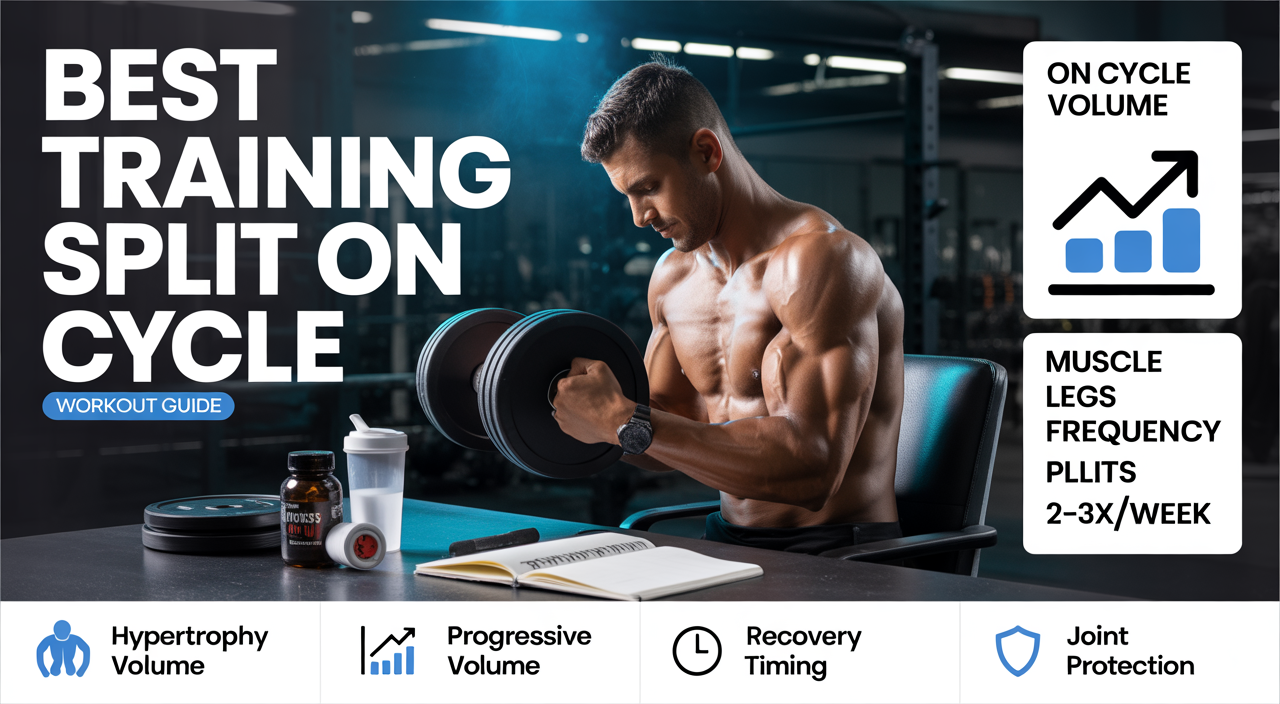
If you’re running a cycle and still training the same way you did natural, you’re leaving serious gains on the table. Training on cycle with steroids or SARMs isn’t just about showing up and lifting hard. The enhanced recovery, accelerated protein synthesis, and altered hormonal environment actually require you to rethink your volume, frequency, and intensity to fully capitalize on what your compounds are doing.
Get it wrong and you’ll either undertrain, wasting the anabolic window your cycle creates, or you’ll overtrain, accumulating joint stress and CNS fatigue that no amount of testosterone or RAD-140 can fix. This guide covers the complete on-cycle training program: what changes, what doesn’t, and exactly how to structure your workouts for maximum results.
- How steroids and SARMs change your recovery capacity and what that means for training volume
- The optimal training split for on-cycle lifters at beginner, intermediate, and advanced levels
- How to apply progressive overload correctly when enhanced recovery masks fatigue signals
- Joint and connective tissue risks on cycle and how to protect yourself
- The difference between training on SARMs vs. full anabolic steroids
- Sample 4-day and 6-day on-cycle programs with sets, reps, and intensity guidelines
- Common training mistakes that waste your cycle and how to avoid them
- How to adjust volume and frequency as the cycle progresses
The best training program on cycle for steroids or SARMs involves higher volume than natural training, increased frequency per muscle group (2–3x per week), and aggressive progressive overload because enhanced recovery supports it. A 4-to-6 day upper/lower or push-pull-legs split works best for most on-cycle lifters. The critical mistake most people make is keeping their natural training volume when their cycle-enhanced recovery can now handle significantly more. Compound movements still anchor every session, but on-cycle lifters can profitably add more volume per session and recover in time for the next.
[IMAGE SUGGESTION 1: Side-by-side comparison table showing Natural Training vs. On-Cycle Training with rows for weekly volume (sets per muscle), training frequency per muscle group, recovery time between sessions, progressive overload pace, and joint health considerations.]
1. How Steroids and SARMs Change Your Recovery Capacity
Understanding why training on cycle differs from natural training starts with the mechanism. Anabolic steroids and SARMs both increase nitrogen retention, accelerate protein synthesis, and speed up glycogen replenishment. The practical result: you can handle more training stress and recover from it faster.
Testosterone-based steroids achieve this by binding to androgen receptors throughout muscle tissue and upregulating satellite cell activity. IGF-1 production increases, which amplifies the anabolic signaling cascade. The net effect is that muscle protein synthesis stays elevated for longer after a training session and starts the repair process sooner.
SARMs like RAD-140 (Testolone) and LGD-4033 (Ligandrol) work through selective androgen receptor binding, producing meaningful but generally milder recovery improvements compared to full anabolic steroids. You’re not going to recover as fast on 10mg RAD-140 as you would on 500mg testosterone, but you’ll recover meaningfully faster than you would natural.
A 2001 study published in the New England Journal of Medicine (Bhasin et al.) demonstrated that subjects receiving 600mg testosterone enanthate weekly gained more lean mass even without training than natural subjects who trained. When testosterone-treated subjects trained, gains were substantially higher still, confirming that enhanced recovery directly translates to greater adaptations when training stimulus is applied.
This recovery advantage is not a reason to skip rest days entirely. Central nervous system fatigue, joint wear, and connective tissue stress do not respond to androgens the same way muscle tissue does. Tendons and ligaments adapt more slowly than muscle, which creates a mismatch on cycle: your strength can outpace your connective tissue durability. This is why joint injuries during cycles are common when training volume spikes too aggressively.
2. Optimal Volume: How Many Sets Per Muscle Per Week On Cycle
Training volume is the primary variable to adjust when you go on cycle. Natural lifters generally perform best with 10–20 working sets per muscle group per week, depending on training age. On cycle, that ceiling moves up meaningfully.
The enhanced recovery your training program on cycle provides means you can profitably handle 20–30 working sets per muscle per week, provided you’re distributing that volume across multiple sessions rather than cramming it into one day. High-frequency, moderate-volume-per-session training outperforms low-frequency, high-volume-per-session training for enhanced lifters for exactly this reason.
| Training Status | Natural (Sets/Muscle/Week) | On SARMs (Sets/Muscle/Week) | On Steroids (Sets/Muscle/Week) | Sessions Per Muscle |
|---|---|---|---|---|
| Beginner (0–2 yrs) | 10–14 | 14–18 | 16–20 | 2x/week |
| Intermediate (2–5 yrs) | 14–18 | 18–24 | 20–28 | 2–3x/week |
| Advanced (5+ yrs) | 16–22 | 22–28 | 26–35 | 3x/week |
Start your cycle at 15–20% above your natural training volume baseline. Add 2–3 sets per major muscle group per week for the first 3–4 weeks as your compounds fully kick in. Track performance (strength, pump, soreness levels) and increase volume further only when recovery indicators remain positive. Don’t blast full on-cycle volume from day one.
3. Best Training Split For On-Cycle Lifters
The training split you use on cycle should reflect your increased recovery capacity. A 3-day full-body routine, common among natural beginners, is almost certainly undertaxing your system when enhanced. The best training splits for on-cycle lifters are those that hit each muscle group 2–3 times per week with moderate-to-high volume per session.
Push-Pull-Legs (PPL) 6-Day Split
This is the most popular choice among advanced on-cycle lifters for good reason. Running a PPL twice per week means each muscle gets trained twice in 6 days. The structure is clean: push days (chest, shoulders, triceps), pull days (back, biceps, rear delts), leg days (quads, hamstrings, glutes, calves). With enhanced recovery, hitting each muscle group twice weekly with 12–16 sets per session becomes manageable.
Upper/Lower Split (4-Day)
The 4-day upper/lower split is ideal for intermediate on-cycle lifters or those who can’t train 6 days. You hit each muscle group twice per week across 4 sessions. Upper days handle chest, back, shoulders, and arms. Lower days handle quads, hamstrings, glutes, and calves. This split allows high per-session volume while keeping frequency elevated.
Body Part Split (5-Day “Bro Split”)
The traditional bro split — chest Monday, back Tuesday, shoulders Wednesday, arms Thursday, legs Friday — hits each muscle once weekly. This is suboptimal for natural lifters and similarly suboptimal on cycle. Once-weekly frequency doesn’t capitalize on your compound-enhanced protein synthesis window, which resets within 48–72 hours. The bro split can work if daily volume per session is very high (25–30 sets per muscle), but most people aren’t productive that long in a single session.
| Split | Days/Week | Muscle Freq | Best For | On-Cycle Rating |
|---|---|---|---|---|
| Push/Pull/Legs x2 | 6 | 2x/week | Advanced, high commitment | ⭐⭐⭐⭐⭐ |
| Upper/Lower x2 | 4 | 2x/week | Intermediate, balanced schedule | ⭐⭐⭐⭐⭐ |
| PPL x1 (3-day) | 3 | 1x/week | Beginners, recovery priority | ⭐⭐⭐ |
| Bro Split (5-day) | 5 | 1x/week | High volume specialists only | ⭐⭐ |
| Full Body (3x/week) | 3 | 3x/week | Beginners, SARMs-only cycles | ⭐⭐⭐⭐ |
4. Progressive Overload On Cycle: How Fast Should You Push It
Progressive overload is still the engine of muscle growth on cycle, but the rate at which you can progress accelerates. Natural lifters might add 2.5–5 lbs to a compound lift per week when things are going well. On a proper training program on cycle with testosterone, hitting 5–10 lb weekly strength jumps on main lifts is realistic, especially in weeks 3–10 of a cycle when compounds are fully active.
The trap many lifters fall into: chasing strength numbers too aggressively and loading the bar beyond what their tendons can handle. Your muscles adapt to androgens quickly. Your connective tissue doesn’t. A 50 lb increase in your squat over 8 weeks is attainable on cycle, but the patellar tendon that has to handle that load is not keeping pace.
Connective tissue injuries (patellar tendon, bicep tendon, rotator cuff) are significantly more common during anabolic cycles, not because steroids weaken tendons, but because rapid strength gains outpace tendon adaptation. Cap your main lift progression at 5 lbs per session on upper body pressing movements and 10 lbs on lower body compound lifts. Prioritize form over load as weight increases rapidly.
A smarter progressive overload model on cycle looks like this: increase load only when you’ve completed all target reps with good form across all sets. Don’t chase a new 1RM every week. Accumulate volume at your current training weight before adding load. This approach, known as double progression, protects your joints and still produces consistent strength gains over the cycle duration.
[IMAGE SUGGESTION 2: A progression timeline chart showing typical strength gains over a 12-week testosterone cycle. X-axis: weeks 1–16. Y-axis: relative strength increase (%). Annotations mark when compound blood levels peak (typically weeks 3–4), when gains accelerate, and when PCT begins.]
5. Training On SARMs vs. Training On Steroids: Key Differences
Not all enhanced training programs are equal. Training on SARMs and training on anabolic steroids both benefit from increased volume and frequency, but the magnitude of recovery enhancement differs significantly.
SARMs like RAD-140, LGD-4033, and Ostarine (MK-2866) produce measurable improvements in recovery and protein synthesis, but they’re operating at a fraction of the anabolic signal that full testosterone provides. A lifter on 500mg testosterone weekly has far more anabolic hormone circulating than someone on 10mg RAD-140. The training implications: on SARMs, aim for the lower end of on-cycle volume recommendations. On full steroids, especially with compounds like Trenbolone or Nandrolone in the mix, recovery capacity is substantially higher.
| Variable | On SARMs (e.g., RAD-140 10mg) | On Testosterone (400–600mg) | On Advanced Stack (Test + Tren/Deca) |
|---|---|---|---|
| Weekly volume increase vs. natural | 20–30% | 30–50% | 50–70% |
| Recommended sessions/muscle/week | 2x | 2–3x | 3x |
| Strength progression speed | Moderate | High | Very High |
| Joint/connective tissue risk | Low-Moderate | Moderate | High (especially dry compounds like Tren) |
| Recommended rest days/week | 1–2 | 1 | 1 (active recovery) |
6. Sample 4-Day On-Cycle Training Program (Upper/Lower Split)
This program is designed for intermediate lifters on a first or second cycle (SARMs or testosterone). It runs on the upper/lower framework, training each muscle group twice per week with progressive overload built in. Adjust sets upward by 2–3 per muscle group if running a more aggressive compound stack.
| DAY 1 — UPPER A (Strength Focus) | |||
|---|---|---|---|
| Exercise | Sets | Reps | Notes |
| Barbell Bench Press | 4 | 4–6 | Heavy. Rest 3 min. |
| Barbell Row | 4 | 4–6 | Heavy. Rest 3 min. |
| Overhead Press | 3 | 6–8 | Barbell or DB. Rest 2–3 min. |
| Weighted Pull-Ups | 3 | 6–8 | Add weight via belt. |
| Incline DB Press | 3 | 8–10 | Accessory chest volume. |
| Face Pulls | 3 | 12–15 | Shoulder health. Non-negotiable. |
| Barbell Curls + Tricep Pushdowns | 3 each | 10–12 | Superset to save time. |
| DAY 2 — LOWER A (Strength Focus) | |||
|---|---|---|---|
| Exercise | Sets | Reps | Notes |
| Barbell Back Squat | 4 | 4–6 | Heavy. Rest 3–4 min. Don’t ego lift. |
| Romanian Deadlift | 3 | 6–8 | Hamstring dominant. Full stretch. |
| Leg Press | 3 | 8–10 | Volume accumulation for quads. |
| Leg Curl (Lying or Seated) | 3 | 10–12 | Isolation hamstring work. |
| Calf Raises | 4 | 12–15 | Slow eccentric. Full range of motion. |
Days 3 and 4 repeat the upper/lower pattern with hypertrophy rep ranges (8–12 reps), slightly lower load, and 1–2 additional accessory exercises. Rest day on Day 5, then repeat the cycle.
7. Nutrition to Support Your On-Cycle Training Program
Training on cycle without the right nutritional foundation is like running a high-performance engine on low-grade fuel. Your compounds create the anabolic environment, but nutrition provides the substrate. Protein synthesis operates at an accelerated rate on cycle, which means your protein requirements increase.
Aim for 1.0–1.4 grams of protein per pound of bodyweight while on cycle. A 200 lb lifter should be hitting 200–280g of protein daily. Prioritize whole food sources: chicken, beef, eggs, Greek yogurt, cottage cheese, salmon. Protein shakes fill gaps but shouldn’t substitute for whole food meals.
Calorie targets depend on your cycle goal. Bulking cycles (testosterone, LGD-4033) work best with 300–500 calories above maintenance. Cutting cycles (Ostarine, Anavar, low-dose Primobolan) work better at maintenance or a modest 200–300 calorie deficit. Recomposition is most common on SARMs like RAD-140 at maintenance calories.
Research published in the Journal of Applied Physiology (Phillips et al., 2016) demonstrated that protein requirements for maximally stimulating muscle protein synthesis increase with training volume. When volume is higher, as it should be on an enhanced training program, protein demands scale proportionally. Cycling athletes using performance-enhancing compounds alongside high-volume training showed greater lean mass retention when consuming above 1.2g/kg versus lower intakes.
8. Recovery Strategies While Running an On-Cycle Training Program
Your training program on cycle only produces results if recovery is managed intelligently. Enhanced recovery from compounds doesn’t eliminate the need for rest strategies; it shifts where your limiting factors are. Muscle soreness resolves faster. CNS fatigue and joint accumulation don’t.
Sleep is the most important recovery tool on any cycle. Growth hormone pulses most significantly during deep sleep. Most of your tissue repair happens nocturnally. If you’re running 6 days per week on cycle and sleeping 5–6 hours per night, you’re leaving the most powerful free anabolic stimulus on the table. Target 7–9 hours consistently.
Creatine monohydrate is worth stacking during your training program on cycle. At 3–5g daily, creatine improves phosphocreatine resynthesis between sets and has a meaningful effect on set volume capacity. It pairs well with any compound and has an extensive safety record. Pair it with 5–10g of glycine at night to support collagen synthesis and joint health, both of which become more relevant as training loads increase on cycle.
Add a deload week every 6–8 weeks of your cycle even if you feel good. Drop volume by 40% and reduce load by 10–15%. This prevents cumulative joint stress from building into an injury and allows CNS recovery. Most experienced enhanced lifters who skip deloads find themselves dealing with a nagging elbow, shoulder, or hip issue by week 10 of a 12-week cycle.
9. Common Training Mistakes On Cycle
| Mistake | Why It Hurts | What To Do Instead |
|---|---|---|
| Keeping natural training volume | Wastes the anabolic window. You recover faster but don’t stress the muscle more. | Increase volume 20–30% above natural baseline by week 3. |
| Maxing out every session | Destroys joint integrity over time. Tendons don’t adapt as fast as muscles on cycle. | Use double progression: volume first, then add load. |
| Training once per muscle weekly (bro split) | Misses the protein synthesis window that resets every 48–72 hrs on cycle. | Hit each muscle 2–3x per week via Upper/Lower or PPL. |
| Skipping deload weeks | CNS and joint fatigue accumulates. Most cycle injuries happen in weeks 8–12 for this reason. | Plan a deload every 6–8 weeks regardless of how good you feel. |
| Under-eating protein | Limits muscle protein synthesis even when the anabolic environment is optimal. | Target 1.0–1.4g of protein per pound of bodyweight daily. |
| Ignoring joint health supplements | Dry compounds (Trenbolone, Winstrol, Anavar) can worsen joint lubrication. | Use fish oil (4–6g EPA/DHA), glycine (5–10g), collagen peptides on dry cycles. |
10. Article Summary: Key Takeaways
- Training on cycle with steroids or SARMs requires higher volume than natural training because recovery capacity increases significantly with enhanced hormone levels.
- The best training splits for on-cycle lifters are Push-Pull-Legs (6-day) and Upper/Lower (4-day), both of which train each muscle group 2–3x per week.
- Volume should increase 20–50% above natural training baselines, with the exact amount depending on the compound stack and its anabolic potency.
- SARMs provide a moderate recovery enhancement; full anabolic steroids (especially stacks with Trenbolone or Nandrolone) provide substantially greater recovery capacity.
- Progressive overload accelerates on cycle, but connective tissue adaptation lags behind muscle gains. Use double progression and cap load increases conservatively.
- Protein intake should increase to 1.0–1.4g per pound of bodyweight to match the elevated protein synthesis environment the cycle creates.
- Joint health becomes a priority on cycle. Dry compounds especially increase connective tissue risk. Use fish oil, glycine, and collagen peptides as standard support.
- Deload every 6–8 weeks regardless of how well you’re recovering. CNS fatigue and joint accumulation can silently build toward injury even when muscle soreness is absent.
- Sleep remains the most powerful recovery tool on or off cycle. Seven to nine hours allows maximum growth hormone pulsing and tissue repair.
- Training on SARMs follows the same principles as training on steroids but at the lower end of volume and progression recommendations.
Frequently Asked Questions
How many days per week should I train on cycle?
Most on-cycle lifters train 4–6 days per week. Four-day upper/lower splits work well for intermediate lifters on their first cycle. Six-day push-pull-legs programs work best for advanced lifters on more potent compound stacks. The key is hitting each muscle group at least twice per week to capitalize on the enhanced protein synthesis window that anabolic compounds create. Training only 3 days per week while on cycle wastes a significant portion of your recovery advantage.
Should I train differently on SARMs vs. steroids?
The principles are the same — more volume, more frequency, progressive overload, joint protection — but the magnitude differs. SARMs like RAD-140 and LGD-4033 produce meaningful but moderate recovery improvements. Full anabolic steroids, especially testosterone at 400–600mg per week, produce substantially greater recovery capacity. On SARMs, aim for 15–25% above your natural volume baseline. On full steroid cycles, 30–50% above baseline is appropriate. Avoid matching steroid-cycle volume when running SARMs; you’ll accumulate fatigue without the recovery horsepower to match it.
Can I do more cardio while on cycle to stay lean?
Yes, and your cardiovascular system can handle more on cycle due to improved red blood cell production and recovery. However, excessive cardio on a bulking cycle competes with muscle growth by creating additional caloric and cortisol demands. If staying lean is the goal during a bulk, 3–4 sessions of moderate-intensity cardio (20–30 minutes) per week is a reasonable addition without significantly compromising gains. On cutting cycles, cardio can be increased to 4–5 sessions weekly. LISS (low-intensity steady state) is preferred over daily HIIT to protect recovery capacity for your lifting sessions.
What rep ranges work best for training on cycle?
A mix of rep ranges produces the best results. For compound movements like squat, bench, and deadlift, sets of 4–6 reps at high load take advantage of enhanced strength capacity. For secondary compound and accessory work, 8–12 reps in the hypertrophy range drives muscle size. Include some higher-rep sets (15–20 reps) for isolation work and shoulder health movements. Don’t fixate on a single rep range; training across a spectrum taxes both mechanical tension and metabolic stress pathways and produces superior hypertrophy outcomes.
Do I need to change my training during PCT?
Yes. During post-cycle therapy, circulating androgens drop significantly. Recovery capacity declines toward natural levels. If you keep on-cycle training volume during PCT, you’ll accumulate fatigue you can’t recover from and likely see accelerated strength and muscle loss. During PCT, reduce training volume by 20–30%, reduce training frequency to 3–4 days per week, keep intensity moderate, and prioritize sleep and nutrition. The goal during PCT is maintaining the muscle you built, not adding new tissue. Volume reduction during PCT is not failure; it’s smart periodization.
How do I protect my joints when training on cycle?
Joint protection on cycle comes down to three areas: supplementation, load management, and movement selection. For supplementation, fish oil (4–6g EPA/DHA daily), glycine (5–10g nightly), and collagen peptides with vitamin C support connective tissue health. For load management, use double progression, cap weekly load increases on upper body at 5 lbs per session, and include a deload every 6–8 weeks. For movement selection, prioritize controlled ranges of motion, include shoulder health work (face pulls, band pull-aparts) in every upper body session, and be cautious with heavy overhead pressing if you run dry compounds like Trenbolone or Winstrol.
Disclaimer: This article is for informational and educational purposes only. It is not medical advice. The compounds and protocols discussed may carry serious health risks. Always consult a qualified healthcare provider before starting any new supplement, peptide, hormone, or training protocol. FitScience does not encourage or endorse the use of any illegal substances.
Related Reading on FitScience
- Cardio on Cycle: The Science-Backed Protocol for Fat Loss Without Muscle Damage
- Best SARMs For Bulking 2025: Expert Guide and Real Results
- Top 5 SARMs For Recomp Based On The FitScience Methodology
- Creatine For Maximum Muscle Growth: Dosage, Timing, and New Research
- Estrogen Management For Bodybuilders: The Complete Aromatase Inhibitor Guide