Sleep Optimization for Bodybuilders: How to Maximize Growth Hormone and Testosterone Every Night
WHAT YOU’LL LEARN IN THIS GUIDE
- Why sleep is the most underutilized anabolic tool in bodybuilding — backed by 2025–2026 research
- Exactly when and how growth hormone is released during sleep — and how to maximize each pulse
- The dose-response relationship between sleep duration and testosterone production
- How poor sleep sabotages muscle protein synthesis by up to 18% even with optimal nutrition
- Specific, actionable sleep optimization protocols: environment, timing, supplementation, and behavior
- The supplement stack that meaningfully improves sleep quality for lifters without sedative dependency
- How sleep interacts with peptides, SARMs, and steroid cycles — and what to do differently on cycle
- The five most common sleep mistakes bodybuilders make that silently kill their gains
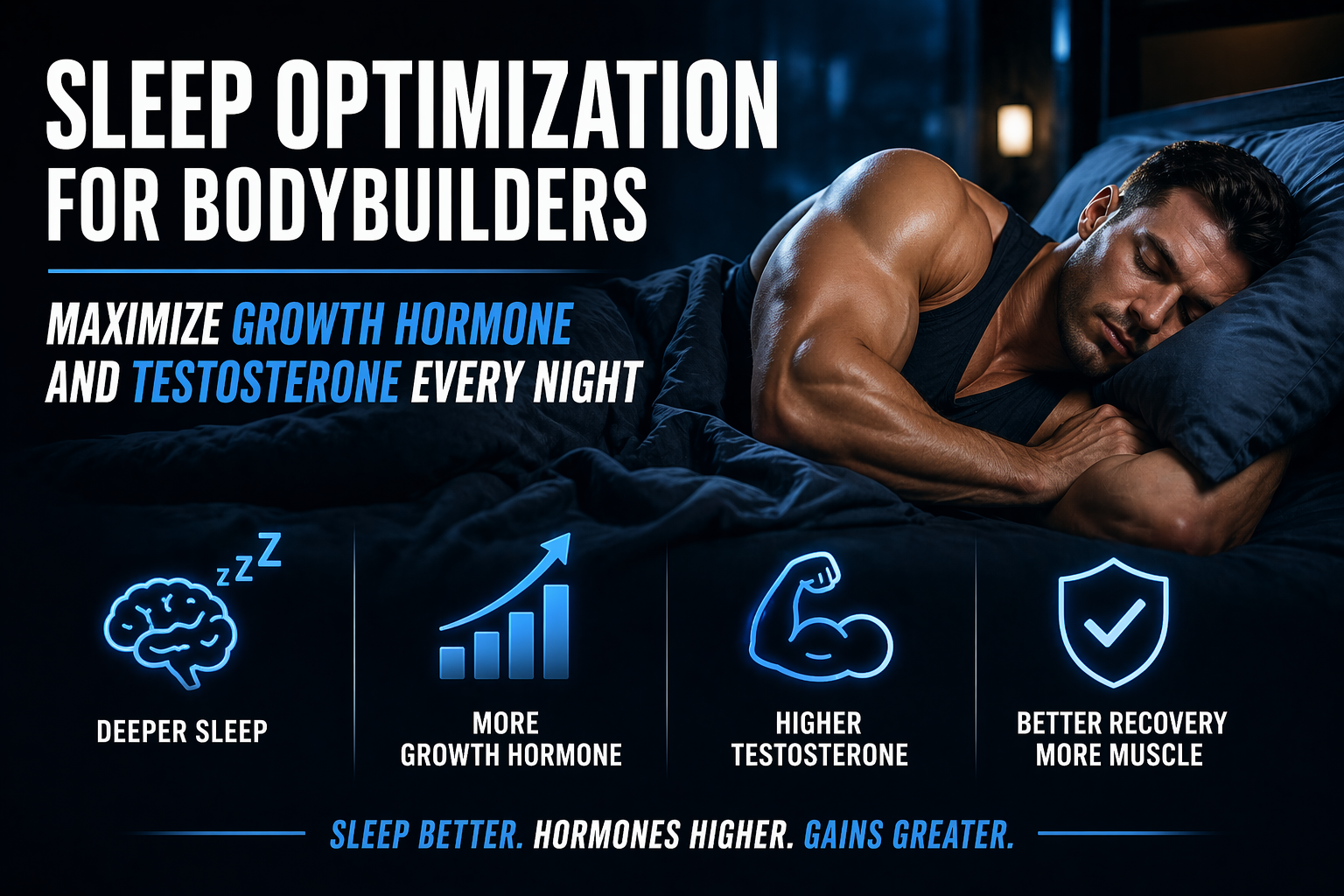
Sleep optimization for bodybuilders is not about feeling rested. It is about controlling the single largest natural growth hormone pulse your body produces in any 24-hour period, maintaining the testosterone levels that drive training adaptation, and ensuring that the protein synthesis machinery your training session activates actually runs at full capacity overnight. Most lifters track their macros to the gram and their training volume by the set — then sleep six hours on a cheap mattress in a room full of artificial light and wonder why gains are slower than expected.
Sleep is not passive recovery. It is the most anabolically active period of your day, and optimizing it produces measurable improvements in body composition, strength, and hormonal health that no supplement can replicate.
THE SHORT ANSWER
Sleep optimization for bodybuilders centers on maximizing slow-wave (deep) sleep, when 70–75% of your daily growth hormone is released, and protecting late-cycle REM sleep, when testosterone production peaks. Sleeping 7–9 hours per night in a cool, dark room with consistent sleep/wake timing produces measurably higher GH output, better testosterone levels, stronger muscle protein synthesis rates, and lower cortisol compared to sleeping 5–6 hours. One week of 5-hour nights can reduce testosterone by 10–15%. One night of complete sleep deprivation reduces muscle protein synthesis by 18%. Sleep is not optional — it is a primary anabolic lever.
[IMAGE SUGGESTION 1: Infographic showing the sleep cycle stages (N1, N2, N3/slow-wave, REM) with callouts showing when GH and testosterone are released. Dark blue/black background, bold text, hormonal event markers on a timeline.]
1. The Anabolic Physiology of Sleep: Why Your Body Builds Muscle at Night
Sleep optimization for bodybuilders starts with understanding what’s actually happening hormonally during the night. Sleep is not a single uniform state — it cycles through distinct phases, each with specific hormonal signatures that matter enormously for muscle growth and recovery.
The sleep cycle runs in approximately 90-minute blocks, repeating four to six times per night. Each block contains non-REM stages (N1, N2, and N3 slow-wave sleep) and REM sleep. The ratio of these stages shifts across the night: early sleep cycles are dominated by slow-wave deep sleep (N3), while later cycles contain progressively more REM. This architecture matters because different anabolic hormones are tied to different stages.
| Sleep Stage | When It Dominates | Key Anabolic Event | Bodybuilding Impact |
|---|---|---|---|
| N3 Slow-Wave (Deep Sleep) | First half of night | Largest GH pulse of the day (70–75% of daily GH) | Tissue repair, protein synthesis, fat oxidation |
| REM Sleep | Second half of night | Peak testosterone secretion, GHRH + somatostatin surge | Androgens, neural consolidation, mood regulation |
| N2 Light Sleep | Throughout night | Sleep spindles, memory consolidation | Motor learning, technique consolidation |
WHAT THE RESEARCH SAYS
A September 2025 study from the University of California, Berkeley published findings on the neural mechanisms behind GH release during sleep. The research identified that hypothalamic neurons controlling growth hormone releasing hormone (GHRH) and somatostatin operate in a coordinated pattern during slow-wave sleep — GHRH surges to trigger GH release while somatostatin (GH’s inhibitor) temporarily withdraws. This creates the large GH pulse that drives overnight tissue repair and protein synthesis. Disrupting slow-wave sleep by sleeping fewer than 7 hours truncates this pulse significantly.
What this means in practical terms: going to bed at 2am and waking up at 7am gives you five hours that heavily skew toward early-night stages (since you’re starting late), missing a disproportionate amount of late-cycle REM and its testosterone-associated benefits. Timing matters — not just duration.
2. Growth Hormone and Sleep: The Numbers You Need to Know
Growth hormone is released in pulses throughout the day, but the sleep-associated pulse during slow-wave sleep is by far the largest of any 24-hour period — accounting for 70–75% of total daily GH secretion in healthy adults. For bodybuilders, this is not a footnote. This is the primary mechanism by which your body repairs training-damaged tissue, synthesizes new protein structures, and oxidizes fat while you’re not eating.
The GH pulse during deep sleep works in concert with IGF-1 — insulin-like growth factor 1 — which is produced primarily in the liver in response to GH signaling. IGF-1 is the downstream effector that directly stimulates muscle cell proliferation and satellite cell activation. You do not get maximum IGF-1 output without maximum GH secretion. You do not get maximum GH secretion without adequate slow-wave sleep.
If you’re running peptides like CJC-1295 or ipamorelin to amplify GH secretion, optimal sleep timing is even more critical. GHRH-based peptides work by potentiating the natural GH pulse — they amplify the existing physiological rhythm rather than creating a new one. Taking a GHRH peptide before bed and then sleeping 5 hours cuts the pulse short. You’re wasting half the compound’s effect window.
3. Testosterone and Sleep: The Dose-Response Relationship
The relationship between sleep duration and testosterone is documented clearly in the clinical literature, and the numbers are alarming for lifters who chronically under-sleep. Peak testosterone secretion occurs during the REM-rich later sleep cycles — the ones you lose first when you cut sleep short.
| Sleep Duration | Testosterone Impact | Study Reference |
|---|---|---|
| 8.5 hours/night | Baseline (optimal) | Baseline comparator |
| 5 hours/night for 1 week | 10–15% testosterone reduction | Leproult & Van Cauter, JAMA 2011 |
| Total sleep deprivation (1 night) | 24% testosterone drop; 21% cortisol increase | Multiple studies, consistent finding |
| 5.5 hours/night in caloric deficit | 60% more lean mass lost vs 8.5 hours at same calories | Nedeltcheva et al., Annals Internal Medicine, 2010 |
The Nedeltcheva et al. finding is the most alarming for bodybuilders. Two groups ate the same calories in a deficit. The group sleeping 5.5 hours lost 60% more muscle mass than the group sleeping 8.5 hours. Not body weight — lean mass. Sleep duration directly controlled how much muscle was sacrificed during the cut. No amount of protein intake or training can compensate for that hormonal environment.
For athletes on TRT or testosterone-based cycles, exogenous testosterone bypasses the endogenous sleep-testosterone link — but GH is not replaced by most TRT protocols. Optimizing sleep remains essential for the GH-IGF-1 axis even in fully exogenous androgen users.
4. Sleep and Muscle Protein Synthesis: The Direct Connection
Muscle protein synthesis — the rate at which your body builds new muscle protein — doesn’t stop when you sleep. In fact, overnight protein synthesis is responsible for a significant portion of the total MPS response to a training session. A single workout session elevates protein synthesis for 24–48 hours; during the sleep periods within that window, the synthesis machinery runs at full capacity if the hormonal environment supports it.
WHAT THE RESEARCH SAYS
A study published in The Journal of Physiology found that a single night of total sleep deprivation reduced postprandial muscle protein synthesis by 18% in healthy young adults compared to a normal sleep night, despite identical food intake. The researchers noted that the reduction in GH and testosterone — not protein availability — was the primary driver. The implication is clear: you can eat perfect protein and still get substantially less anabolic mileage from it when sleep is compromised.
The optimization target here is maximizing slow-wave sleep quality, not just duration. Research on creatine, glycine, and magnesium supplementation shows that these compounds can improve sleep architecture — specifically increasing the proportion of slow-wave sleep in each cycle — which directly amplifies the GH pulse and overnight MPS.
5. Sleep Optimization Protocol: Environment
Sleep optimization for bodybuilders requires controlling four environmental variables: temperature, light, sound, and timing. Each one has measurable effects on sleep architecture.
Temperature
Core body temperature drops 1–2°F to initiate and maintain sleep. A bedroom temperature of 65–68°F (18–20°C) is the research-supported sweet spot. Higher temperatures disrupt slow-wave sleep specifically. Cooling mattress pads or a simple programmable thermostat set to cool 30–60 minutes before bed are effective interventions for lifters who run warm.
Light
Melatonin production begins when light exposure decreases and is suppressed by blue-spectrum light (the type emitted by phones, tablets, and LED screens). For bodybuilders, this has a direct consequence: melatonin initiates the hormonal cascade that precedes the deep sleep GH pulse. Delaying melatonin onset by staying on a phone until 1am pushes the deep sleep onset later, compressing the GH window if you have a fixed wake time.
Practical target: dim lights and eliminate screen exposure 60–90 minutes before bed. If this isn’t feasible, blue-light blocking glasses worn for the 90 minutes before sleep reduce melatonin suppression by approximately 50–58% in controlled studies. This is not a high-effort change and the effect is substantial.
Timing Consistency
Circadian rhythm consistency is more important than most lifters realize. Going to bed and waking at the same time every day — including weekends — synchronizes your cortisol awakening response, testosterone peaks, and GH release to predictable windows. Variable sleep timing (sleeping at 10pm Monday, 1am Friday, 8am Saturday) fragments the hormonal rhythm that your training adaptation depends on.
6. Sleep Supplementation for Bodybuilders: What Actually Works
[IMAGE SUGGESTION 2: Clean supplement stack graphic showing 4 compounds (magnesium glycinate, glycine, ashwagandha, low-dose melatonin) with dosages, timing, and mechanism callouts. Dark background, clinical infographic style.]
Most sleep supplements sold to athletes are either sedatives (which suppress REM sleep) or have minimal evidence behind them. The compounds below have documented mechanisms relevant to sleep quality for bodybuilders — not just general insomnia, but specifically the anabolic-relevant aspects of sleep architecture.
| Compound | Dose | Timing | Mechanism | Evidence Level |
|---|---|---|---|---|
| Magnesium Glycinate | 300–400mg elemental Mg | 30–60 min before bed | NMDA receptor modulation; increases slow-wave sleep duration | Strong — multiple RCTs |
| Glycine | 3g | 30 min before bed | Reduces core temperature, improves sleep quality; increases REM proportion | Strong — human trials |
| Ashwagandha (KSM-66) | 300–600mg | 30–60 min before bed | Cortisol reduction; GABA-ergic activity; improves sleep onset and quality | Moderate-Strong |
| Melatonin (low dose) | 0.3–1mg | 60–90 min before bed | Circadian rhythm synchronization; does NOT increase GH — only advances timing | Strong — use lowest effective dose |
| L-Theanine | 200mg | 30 min before bed | Alpha-wave promotion; reduces sleep latency without sedation | Moderate |
| Phosphatidylserine | 400mg | Before bed or post-workout | Blunts exercise-induced cortisol spike that delays sleep onset | Moderate |
⚠️ SAFETY NOTE
Avoid high-dose melatonin (3–10mg capsules common in US supplements). Melatonin does not increase GH release — it only influences sleep timing. High doses have been shown to suppress the natural melatonin rhythm over time and may negatively affect morning testosterone levels when used chronically at pharmacological doses. 0.3–1mg is all you need. The US supplement market sells 3–10mg as standard; this is 3–10x higher than the physiologically meaningful dose.
7. Sleep and PED Cycles: How SARMs, Steroids, and Peptides Affect Sleep Quality
Bodybuilders using performance-enhancing compounds face specific sleep quality challenges that natural athletes don’t encounter. Understanding these interactions is critical for anyone running a SARMs cycle, steroid cycle, or peptide protocol.
SARMs and Sleep
Testosterone suppression caused by SARMs reduces natural overnight testosterone production — specifically the REM-associated testosterone peaks. This is one reason sleep quality often declines mid-cycle for SARMs users: the hormonal architecture of sleep is disrupted by suppressed LH/FSH signaling. Prioritizing sleep optimization habits (environment, timing, magnesium) becomes more important during a suppressive SARM cycle, not less.
Anabolic Steroids and Sleep Apnea
High-dose androgens are a documented risk factor for obstructive sleep apnea in susceptible individuals. Upper airway muscle tone is affected by androgen exposure, and sleep apnea fragments slow-wave sleep severely — directly suppressing the GH pulse. Users experiencing excessive daytime drowsiness, waking unrefreshed, or partner-reported snoring during a cycle should consider a sleep study. Untreated sleep apnea in an enhanced athlete is a significant barrier to maximal gains regardless of compound choice.
GHRH Peptides and Sleep Timing
Growth hormone secretagogues like CJC-1295 with DAC, ipamorelin, or GHRP-6 amplify the natural GH pulse during deep sleep. Administering these compounds 30–45 minutes before sleep places the active window directly over the slow-wave sleep phase where GH pulsing occurs. This is why the pre-bed dose is considered the most anabolically productive injection of any GHRH protocol. See the peptide muscle growth guide on FitScience for complete dosing protocols.
8. Nutrition Timing Around Sleep for Maximum Anabolic Output
Two nutritional decisions around sleep have specific evidence behind them for bodybuilders: pre-sleep protein and carbohydrate timing relative to bedtime.
Pre-Sleep Protein (Casein Protocol)
The research on pre-sleep protein is mature and consistently positive. 40g of micellar casein protein consumed 30 minutes before sleep increases overnight muscle protein synthesis compared to no pre-sleep protein, without meaningfully disrupting GH secretion when consumed at appropriate timing. The slow-digesting nature of casein provides a sustained amino acid release across the overnight fasting period — the period when your muscle protein synthesis machinery is running on the GH pulse.
GYM APPLICATION
40g of micellar casein 30–45 minutes before bed is one of the highest return-on-investment nutritional habits for a natural or enhanced lifter. This is not a supplement company recommendation — it is what the human trials consistently show for overnight muscle protein synthesis. If you tolerate dairy, prioritize this above most other supplements in your stack.
Carbohydrates and Sleep Quality
A moderate carbohydrate meal 2–3 hours before bed elevates tryptophan availability (via its transport ratio against competing amino acids) and can improve sleep onset latency. This does not mean eating a large carbohydrate meal immediately before bed — that blunts GH secretion by elevating insulin, which suppresses the GH-stimulating effect of GHRH. Time carbohydrates at dinner rather than at the immediate pre-bed meal if GH optimization is a priority. Meal timing here matters: see the full breakdown in the meal timing guide.
9. Common Sleep Mistakes Bodybuilders Make
| Mistake | Why It Hurts | What to Do Instead |
|---|---|---|
| Sleeping 5–6 hours and compensating with caffeine | Caffeine masks fatigue but does not restore hormonal output; GH and testosterone remain suppressed | Prioritize sleep duration before adding stimulants; use caffeine to enhance performance, not to substitute for sleep |
| Using alcohol as a sleep aid | Alcohol severely suppresses REM sleep and disrupts slow-wave sleep architecture; GH pulse and testosterone peak are both blunted | If you drink, do so at least 3–4 hours before bed; never use alcohol as a sleep aid |
| Training late at night (after 9pm) | Intense evening training raises cortisol and core temperature, delaying sleep onset by 60–90 minutes; the GH window is pushed later or shortened | Train before 7pm when possible; if evening training is unavoidable, use a cooling shower and L-theanine post-workout to accelerate recovery toward sleep readiness |
| Inconsistent sleep timing (different bedtimes each night) | Circadian rhythm disruption fragments hormonal cycles; testosterone and GH cannot peak at optimal times when the body’s clock is unsynchronized | Set a consistent sleep/wake schedule and hold it 7 days a week — the weekend is not exempt |
| Taking high-dose melatonin (5–10mg) | Does not increase GH; may suppress natural melatonin rhythm over time and depress morning testosterone at pharmacological doses | Use 0.3–1mg melatonin for circadian timing only; do not use it as a sedative at high doses |
10. Article Summary
- Sleep optimization for bodybuilders is a primary anabolic lever — not a lifestyle bonus; 70–75% of daily growth hormone is released during slow-wave sleep
- Peak testosterone production occurs during REM sleep in the later part of the night; shortening sleep duration disproportionately removes these late-cycle anabolic events
- One week of 5-hour nights reduces testosterone by 10–15%; one sleep-deprived night reduces muscle protein synthesis by 18% despite identical food intake
- Bedroom temperature of 65–68°F, complete darkness, and screen elimination 60–90 minutes before bed are the highest-impact environmental changes for sleep quality
- Magnesium glycinate (300–400mg), glycine (3g), and low-dose melatonin (0.3–1mg) are the most evidence-supported supplements for improving sleep architecture in athletes
- GHRH peptides like CJC-1295 and ipamorelin work by amplifying the natural GH sleep pulse — taking them 30–45 minutes pre-bed places the active window directly over slow-wave sleep
- SARMs suppress the natural testosterone rhythm overnight; this makes sleep optimization more critical during suppressive cycles, not less
- 40g of casein protein 30–45 minutes before bed increases overnight muscle protein synthesis without suppressing GH when timed correctly
- High-dose androgens carry a documented risk for sleep apnea — a condition that destroys slow-wave sleep and directly suppresses GH output
- Consistent sleep/wake timing 7 days a week synchronizes circadian hormone rhythms and maximizes the predictability of the anabolic overnight window
Frequently Asked Questions
How many hours of sleep do bodybuilders need?
Seven to nine hours is the research-supported range for most adults, and for bodybuilders under significant training load, erring toward 8–9 hours is warranted. Below 7 hours, testosterone decreases measurably and muscle protein synthesis is impaired even with adequate protein intake. Elite athletes in high-load training blocks sometimes target 9–10 hours specifically to maximize recovery capacity. The relationship is dose-responsive — more sleep (up to about 9 hours) generally means better hormonal output.
Does napping help with muscle recovery?
A 20–30 minute nap (a “power nap” staying in N2 sleep) reduces subjective fatigue and improves afternoon performance without disrupting nighttime sleep. Naps over 60 minutes risk entering slow-wave sleep and causing sleep inertia, and can reduce nighttime sleep drive. For athletes who train twice per day or operate in high-stress environments, a 20-minute nap after a morning session is a net positive. It won’t replicate the GH pulse of nighttime slow-wave sleep, but it meaningfully reduces cortisol and improves cognitive function for the afternoon session.
Does creatine affect sleep quality?
Emerging research suggests creatine may improve sleep quality when sleep is restricted, possibly by supporting cerebral phosphocreatine stores that buffer the neurological cost of sleep debt. Creatine does not cause insomnia in most people when taken at standard doses. There is no strong evidence that taking creatine before bed specifically is superior to other timing for sleep quality. For the full breakdown on creatine timing and muscle growth, see the creatine guide.
What is the best time to go to sleep for maximum muscle growth?
The specific time matters less than consistency and duration. That said, going to bed between 10pm and midnight allows most people to get 7–9 hours while waking at a practical morning time. The first deep sleep cycle (and its GH pulse) occurs approximately 60–90 minutes after sleep onset regardless of clock time. What destroys this architecture is going to bed very late (2–3am) with a fixed early wake time — this cuts off the later REM cycles where testosterone peaks.
Should I eat before bed for muscle growth?
Yes — with specificity. 40g of casein protein 30–45 minutes before bed is supported by multiple human trials for increasing overnight muscle protein synthesis. Avoid large carbohydrate or calorie-dense meals immediately before bed, as elevated insulin suppresses the GH pulse during slow-wave sleep. A casein shake or cottage cheese (which contains micellar casein naturally) is the standard pre-sleep nutrition strategy for hypertrophy-focused athletes.
Can poor sleep make me lose muscle while cutting?
Yes — and the magnitude is significant. The Nedeltcheva et al. study (2010, Annals of Internal Medicine) found that subjects sleeping 5.5 hours per night in a caloric deficit lost 60% more lean mass than subjects sleeping 8.5 hours, despite identical calorie intake. During a cut, sleep optimization becomes more important, not less, because low calories already signal a catabolic environment. Adequate sleep is one of the primary mechanisms for maintaining a muscle-preserving hormonal profile during a deficit. See the body recomposition guide for how to structure a cut without losing muscle.
Do peptides help with sleep quality?
Certain peptides have documented sleep-related effects. Epithalon (a pineal peptide) has been studied for circadian rhythm restoration and sleep quality in older populations. DSIP (Delta Sleep-Inducing Peptide) is named for its sleep-promoting effects, though human evidence is less robust. BPC-157 reduces anxiety in animal models, which may indirectly improve sleep quality. GHRH-type peptides improve sleep architecture as a secondary effect of their GH-releasing action. None of these replace the foundational behaviors (timing, environment, duration) but they can provide an additional edge for those already optimizing the basics. See the full Bodybuilder’s Encyclopedia of Peptides for mechanism details.
Disclaimer: This article is for informational and educational purposes only. It is not medical advice. The compounds and protocols discussed may carry serious health risks. Always consult a qualified healthcare provider before starting any new supplement, peptide, hormone, or training protocol. FitScience does not encourage or endorse the use of any illegal substances.