
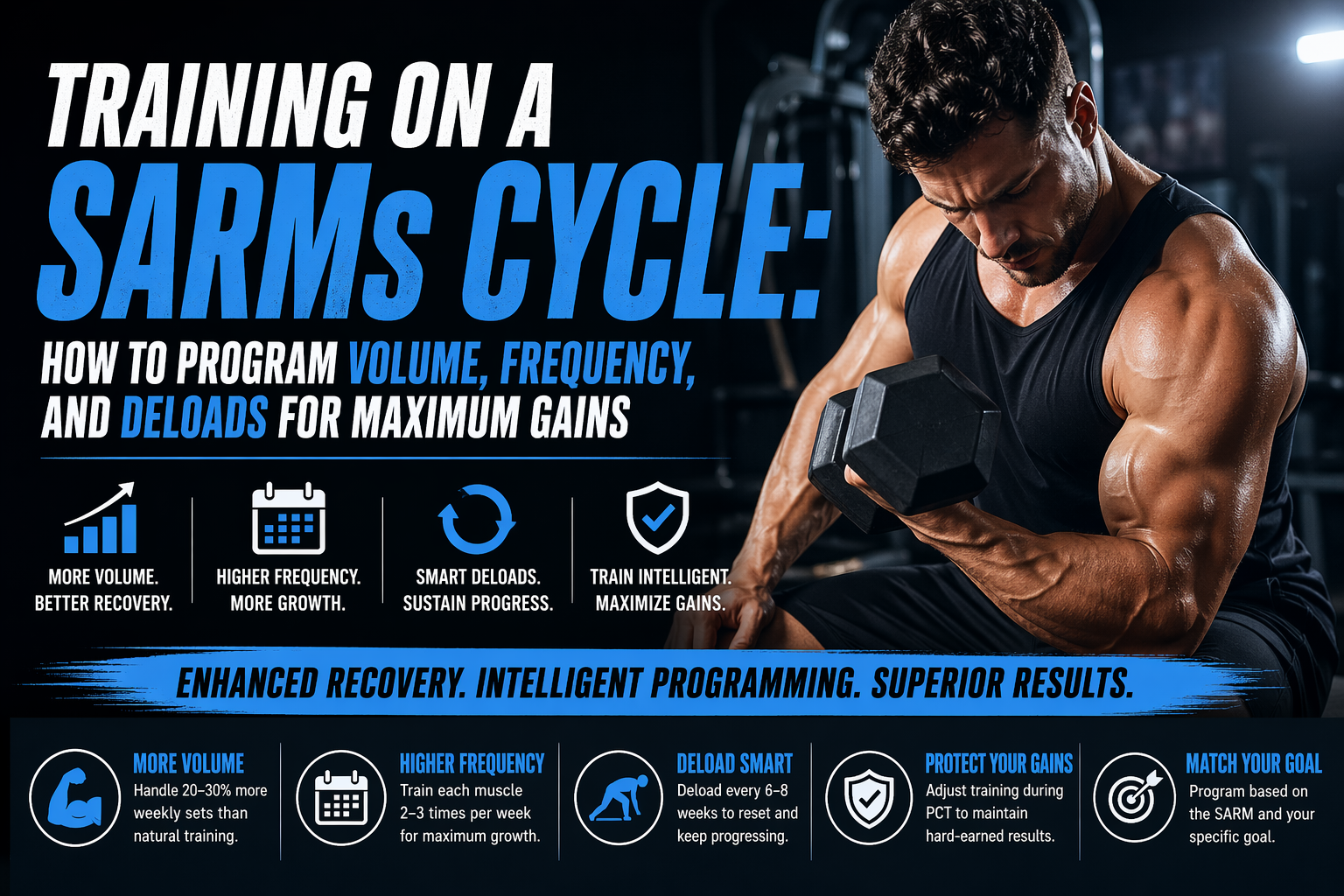
Training on a SARMs Cycle: How to Program Volume, Frequency, and Deloads for Maximum Gains
WHAT YOU’LL LEARN IN THIS GUIDE
- Why training on a SARMs cycle is fundamentally different from natural training — and how to take advantage of it
- How much volume your muscles can actually handle on cycle (the research-backed ceiling)
- Optimal training frequency per muscle group when SARMs accelerate recovery
- How to adjust programming based on which SARM you’re running (RAD-140 vs LGD-4033 vs Ostarine)
- When to deload on a SARMs cycle — and what a proper on-cycle deload looks like
- How to structure your training through PCT without losing the gains you built
- The five most common programming mistakes enhanced athletes make that kill their results
- A sample weekly training template for two different SARMs goals (size vs strength)
Training on a SARMs cycle without adjusting your programming is like putting premium fuel in a car and still driving 40 mph in fifth gear. The compound is doing its job — accelerating muscle protein synthesis, improving nitrogen retention, and sharpening androgen receptor sensitivity — but if your training stimulus doesn’t match the enhanced recovery capacity SARMs provide, you’re leaving serious gains on the table. How you train while on a SARMs cycle is just as important as which SARM you choose.
Most guides tell you which SARMs to run for your goal. This one tells you what to do in the gym while you’re running them.
THE SHORT ANSWER
Training on a SARMs cycle should involve 20–30% more total weekly volume than your natural baseline, with muscle groups trained 2–3 times per week rather than once. SARMs accelerate recovery by upregulating androgen receptors in muscle tissue and increasing nitrogen retention, which means your muscles are ready to be hit again sooner. Deloads should still happen every 6–8 weeks — they’re more about central nervous system recovery than muscle soreness. During PCT, drop volume by 40% and focus on maintaining intensity to protect your gains.
1. Why SARMs Change Your Recovery Math
Before you can program intelligently for a SARMs cycle, you need to understand what SARMs actually do to your recovery machinery. Selective androgen receptor modulators bind to androgen receptors in skeletal muscle and bone with high tissue selectivity. The downstream effects on training recovery are real and measurable — not bro-science.
When androgen receptor activation increases in muscle tissue, three things happen that directly affect how fast you recover between sessions. First, muscle protein synthesis rates rise. Second, nitrogen retention improves, meaning your muscles hold more of the raw material needed for repair. Third, satellite cell activation accelerates — these are the progenitor cells that fuse into existing muscle fibers to add new nuclei, which is a prerequisite for hypertrophy.
WHAT THE RESEARCH SAYS
A 2019 review in Current Opinion in Endocrinology, Diabetes and Obesity found that androgen signaling directly upregulates follistatin (a myostatin inhibitor) and IGF-1 expression in skeletal muscle. This dual effect — reducing the brake on muscle growth while increasing the accelerant — shortens the physiological window between productive training sessions. In practical terms: your muscles recover faster when androgen receptor signaling is elevated.
What this means for programming: the minimum effective volume threshold rises on a SARMs cycle, and the maximum recoverable volume ceiling also rises. You can do more, recover from it, and grow from it — but only if your program accounts for both shifts.
2. Volume: How Many Sets Per Muscle Group Per Week on Cycle
Natural lifters at an intermediate-to-advanced level typically train each muscle group with 10–20 hard sets per week before recovery becomes the limiting factor. That range shifts significantly when training on a SARMs cycle.
The practical window for enhanced athletes on a standard SARMs cycle is 18–28 sets per muscle group per week, depending on the compound, the dosage, training history, and whether you’re in a caloric surplus or deficit. Below that range and you’re under-stimulating — the SARM is accelerating recovery, but there’s nothing to recover from. Above that range without adequate protein and sleep, even enhanced recovery can’t keep pace.
| Muscle Group | Natural Lifter (sets/week) | On SARMs Cycle (sets/week) | Notes |
|---|---|---|---|
| Chest | 10–16 | 16–24 | Respond well to frequency increase |
| Back (lats + traps) | 12–20 | 20–28 | Large muscle group — higher ceiling |
| Quadriceps | 10–16 | 16–22 | High systemic fatigue cost — be conservative |
| Hamstrings | 8–14 | 12–20 | Injury-prone — prioritize quality over quantity |
| Shoulders (delts) | 12–18 | 18–26 | Often the most responsive to volume increases |
| Biceps | 8–14 | 14–20 | Small muscle — add volume gradually |
| Triceps | 8–14 | 14–20 | Shares volume with pressing movements |
| Glutes | 8–14 | 14–20 | Underrated for male physique athletes |
Do not add all this volume in week one. Increase by 2–3 sets per muscle group per week for the first two to three weeks of the cycle. This gives your connective tissue — which does not recover as fast as muscle — time to adapt to the new stimulus. SARMs accelerate muscle recovery, not tendon and ligament recovery. This distinction is responsible for a large portion of overuse injuries in enhanced athletes.
GYM APPLICATION
Track your weekly sets per muscle group in a training log. If you finish a session with minimal soreness 48 hours later AND your performance is trending up in subsequent sessions, your volume is calibrated well. If you’re chronically sore or your strength is stalling, you’ve exceeded your maximum recoverable volume — pull back two sets per group and reassess the following week.
3. Training Frequency: How Often to Hit Each Muscle on a SARMs Cycle
Frequency is the most under-optimized variable for enhanced lifters. Natural athletes can see good results training each muscle group once or twice per week because protein synthesis stays elevated for 48–72 hours post-training before returning to baseline. On a SARMs cycle, that window may compress slightly, but more importantly, the magnitude of the protein synthesis spike per session can be amplified — meaning you can benefit from hitting the same muscle more frequently without accumulating excessive fatigue.
The recommended frequency for most muscle groups while training on a SARMs cycle is twice per week minimum, with three times per week possible for smaller muscles like shoulders, biceps, and triceps. Large, high-demand groups like legs can be pushed to two to three times per week for intermediate lifters who have adapted to high frequency work.
The practical implication is a shift away from traditional bro-splits (chest Monday, back Tuesday, etc.) toward push/pull/legs or upper/lower structures that naturally hit each muscle group two to three times weekly. A sample structure that works well with a SARM cycle:
- Upper/Lower 4-day split: Upper A, Lower A, rest, Upper B, Lower B, rest, rest — two exposures per muscle group per week
- Push/Pull/Legs 6-day split: PPL, rest, PPL — two full exposures per muscle group at high total volume
- PPL 5-day: Push, Pull, Legs, Push, Pull — two push and pull sessions, one leg session per week; add a second leg session in week two
4. Programming by Compound: Matching Training Style to Your SARM
Not all SARMs create the same physiological environment, and your training approach should reflect the specific effects of the compound you’re running. This is where most people fail — they run a SARM, pick a random program, and wonder why results are mediocre. The programming needs to match the compound’s mechanism.
| SARM | Primary Effect | Optimal Training Style | Rep Range Focus | Volume Note |
|---|---|---|---|---|
| RAD-140 (Testolone) | Strength and aggression, high AR binding | Strength-focused — heavier loads, shorter rest | 3–6 reps for main lifts, 6–12 for accessories | Moderate volume, high intensity |
| LGD-4033 (Ligandrol) | Mass accumulation, high anabolic effect | Hypertrophy focus — higher volume, moderate intensity | 8–15 reps primary | High volume tolerated well |
| Ostarine (MK-2866) | Muscle preservation, joint healing | Recomp or lean bulk — balanced volume/intensity | 10–15 reps, controlled tempo | Moderate volume, excellent for deficit training |
| YK-11 | Myostatin inhibition, rapid strength gains | Power and strength focus | 3–8 reps primary | High intensity, moderate volume — joints need attention |
| S23 | Hardening effect, fat loss + muscle retention | Dense training — shorter rest, higher reps | 10–20 reps | High frequency, moderate volume |
| ACP-105 | Moderate anabolic, CNS stimulation | Balanced hypertrophy | 8–12 reps | Standard enhanced volume |
If you’re running a stack — for example, RAD-140 paired with LGD-4033 for a bulk — bias your programming toward hypertrophy (higher reps, more volume) since the stack is providing the strength stimulus systemically. Running RAD-140 alone favors strength block programming with accessory hypertrophy work.
5. Progressive Overload on Cycle: Don’t Waste the Window
SARMs create an anabolic environment, but they don’t manufacture strength gains from nothing. Progressive overload — systematically increasing the training stimulus over time — remains the non-negotiable mechanism that drives muscle growth. The SARM accelerates adaptation to that stimulus; it doesn’t replace it.
On a typical 8–12 week SARMs cycle, you have a finite window of enhanced adaptation. Every week you fail to add load, increase volume, or improve rep quality is a week of that window wasted. Structure your cycle with a specific progression model:
- Weeks 1–3 (Ramp Phase): Establish baseline weights for each movement at the target rep range. Focus on form and technique. Add volume conservatively. This is not the time to go to failure every set.
- Weeks 4–7 (Overload Phase): Add weight or reps to every working set each week. This is where the SARM’s effects are most pronounced. Hit near-failure (1–2 reps in reserve) on your working sets. Volume should be at its weekly peak.
- Week 7–8 (Deload — see section 6): Reduce volume by 40–50%. Maintain intensity. Allow CNS and connective tissue to catch up.
- Weeks 9–12 (Second Overload Wave): Return to high volume with the new baseline strength established. Many lifters see their best gains in the second half of a cycle after the deload.
GYM APPLICATION
Use a double progression model: pick a rep range (e.g., 8–12). Once you can complete the top of that range for all sets with good form, add 5 lbs (upper body) or 10 lbs (lower body) next session. This is the cleanest way to ensure every week of a SARMs cycle is delivering a new growth stimulus.
6. Deloading on a SARMs Cycle: When, Why, and How
A common mistake among enhanced lifters is skipping deloads because they feel recovered. SARMs do improve muscular recovery, but they don’t meaningfully accelerate CNS recovery, tendon adaptation, or joint loading tolerance. After 6–8 weeks of progressive overload training on a SARMs cycle, a deload is necessary — not optional.
The purpose of a deload while training on a SARMs cycle is different from a natural lifter’s deload. You’re not primarily reducing muscular fatigue — you’re giving your nervous system, connective tissue, and joints a recovery window while your muscles continue their enhanced protein synthesis. The SARM keeps working during the deload; the deload doesn’t pause your gains.
An effective on-cycle deload looks like this:
- Duration: 5–7 days
- Volume reduction: Drop to 50–60% of your peak weekly sets per muscle group
- Load: Keep weights at 70–80% of your working loads (do not drop to empty bars)
- Rep range: Stay in your normal range — don’t go to failure
- Frequency: Can maintain normal frequency or drop one session per week
⚠️ SAFETY NOTE
Tendon injury is a real risk for enhanced athletes who skip deloads. SARMs accelerate muscle recovery so significantly that muscle strength can temporarily outpace the structural capacity of tendons and ligaments — which adapt more slowly regardless of hormonal environment. If you feel joint pain (not muscle soreness) during a cycle, treat it as a mandatory deload trigger regardless of where you are in your programming schedule.
7. Training Through PCT: Protecting Your Gains When Hormones Drop
Post-cycle therapy (PCT) is the phase where gains disappear for most people — not because of the SARM stopping, but because training volume stays high while hormonal support drops. This mismatch is a guaranteed path to lost muscle, excess fatigue, and poor recovery.
During PCT after SARMs, your natural testosterone production is suppressed and hasn’t fully recovered yet. The SERMs (clomiphene, enclomiphene, tamoxifen) used in PCT are stimulating HPTA recovery, not providing direct anabolic support. Your recoverable volume is now closer to — or below — your natural baseline.
PCT training guidelines:
- Cut total volume by 35–45% compared to your peak on-cycle volume
- Maintain intensity on main lifts — keep the weight on the bar, just do fewer working sets
- Prioritize compound movements over isolation work — more bang for fewer sets
- Reduce frequency if soreness persists — drop to each muscle group twice per week if needed
- Increase protein intake — aim for 1.1–1.2g per pound of bodyweight to offset the reduced anabolic environment
- Prioritize sleep — natural GH and testosterone pulses are most active during deep sleep, and this is your primary anabolic driver during PCT
Most athletes who manage PCT training intelligently retain 85–95% of on-cycle gains. Those who train with the same volume as on-cycle often see significant regression as fatigue accumulates without adequate hormonal support.
8. Sample Training Programs for SARMs Cycles
Here are two complete weekly templates matched to common SARMs goals. Both use a 4-day upper/lower structure — a reliable format for enhanced athletes because it provides sufficient frequency and volume without excessive session length.
Template A: Size-Focused (LGD-4033 / Bulking Cycle)
| Day | Session | Key Movements | Sets x Reps |
|---|---|---|---|
| Monday | Upper A (Push Focus) | Incline Bench, OHP, Cable Fly, Lateral Raise | 4 x 8–12 |
| Tuesday | Lower A (Quad Focus) | Squat, Leg Press, Hack Squat, Leg Extension | 4 x 8–12 |
| Wednesday | Rest / Active Recovery | Walking, mobility work | — |
| Thursday | Upper B (Pull Focus) | Barbell Row, Pull-Up, Cable Row, Rear Delt Fly, Curl | 4 x 8–12 |
| Friday | Lower B (Posterior Chain) | Romanian Deadlift, Walking Lunge, Leg Curl, Hip Thrust | 4 x 8–12 |
| Sat/Sun | Rest or 1 optional cardio session | Moderate incline treadmill — 30 min | — |
Template B: Strength-Focused (RAD-140 Cycle)
| Day | Session | Key Movements | Sets x Reps |
|---|---|---|---|
| Monday | Upper A (Strength) | Flat Bench 5×3, OHP 4×5, DB Row 4×6, Tricep Pushdown 3×10 | As shown |
| Tuesday | Lower A (Strength) | Squat 5×3, Romanian DL 4×5, Leg Press 3×8, Calf Raise 4×10 | As shown |
| Wednesday | Rest | — | — |
| Thursday | Upper B (Volume) | Incline DB Press 4×8, Pull-Up 4×8, Lateral Raise 4×12, Curl 3×12 | As shown |
| Friday | Lower B (Volume) | Hack Squat 4×10, Walking Lunge 3×12, Leg Curl 4×12, Hip Thrust 3×12 | As shown |
| Saturday | Optional: Arms / Weak Points | Bicep, Tricep, Rear Delt isolation | 3–4 sets each |
9. Common Training Mistakes on a SARMs Cycle
| Mistake | Why It Hurts | What to Do Instead |
|---|---|---|
| Running the same natural program without adding volume | Under-stimulates enhanced recovery capacity; compounds the gains you could be making | Add 2–4 sets per muscle group per week for the first 3 weeks of the cycle |
| Skipping deloads because “I feel fine” | Tendons and CNS accumulate fatigue that isn’t felt until an injury occurs | Schedule a deload at weeks 6–8 regardless of how you feel |
| Maintaining on-cycle volume during PCT | Hormonal support is gone; training stress now outpaces recovery capacity | Cut volume 40% during PCT, maintain intensity on main lifts |
| Training to absolute failure on every set | High-frequency enhanced training generates CNS fatigue faster than daily failure training can be sustained | Keep 1–2 reps in reserve on most sets; reserve true failure for final sets of isolation work |
| Ignoring cardio entirely during a bulk cycle | Poor cardiovascular conditioning blunts recovery between sets, limiting volume capacity | Add 2–3 low-intensity cardio sessions per week; incline treadmill at 3.5 mph for 30 minutes is sufficient |
10. Article Summary
- Training on a SARMs cycle requires 20–30% more weekly volume than natural training because SARMs accelerate muscular recovery through androgen receptor upregulation and increased nitrogen retention
- Increase volume gradually over the first 2–3 weeks of the cycle; do not dump all additional volume in week one
- Target 18–28 sets per muscle group per week depending on the muscle and compound used
- Hit each muscle group 2–3 times per week; push/pull/legs and upper/lower splits are optimal structures for enhanced frequency
- Match your training style to your SARM: RAD-140 favors strength-focused programming; LGD-4033 supports high-volume hypertrophy work; Ostarine is ideal for recomp training in a caloric deficit
- Progressive overload is still mandatory — the SARM accelerates adaptation, it doesn’t create it from nothing
- Deload for 5–7 days at weeks 6–8, cutting volume 40–50% while maintaining load; connective tissue and CNS need this even when muscles feel ready
- During PCT, reduce volume by 35–45%, maintain intensity on main compound lifts, and prioritize sleep and protein intake to protect gains
- Tendons adapt slower than muscles regardless of SARM use; joint pain is always a mandatory deload trigger
Frequently Asked Questions
Should I train differently on different SARMs?
Yes. The anabolic mechanism differs between compounds. RAD-140 produces strong aggression and strength increases, making it well-suited to lower-rep strength programming. LGD-4033 creates a fuller, more anabolic environment suited to higher-volume hypertrophy work. Ostarine is mild and well-suited to recomp programming where you’re training in a deficit. When stacking compounds, bias toward the goal of the dominant compound.
How many days a week should I train on a SARMs cycle?
Four to five days per week is the sweet spot for most enhanced athletes. Five days allows higher total volume and frequency than four, but gives you two full rest days for CNS recovery. Six-day PPL splits work for advanced lifters with strong recovery foundations, but most intermediate athletes benefit more from the extra rest day than from the extra session.
Can I run cardio while on a SARMs cycle?
Yes — and you should. Low-intensity steady-state cardio two to three times per week improves cardiovascular health (which SARMs can stress by affecting cholesterol levels), boosts work capacity between sets, and aids nutrient partitioning. Keep cardio sessions under 40 minutes and away from your leg training days to avoid interfering with recovery. Check the cardio comparison guide on FitScience for modality recommendations.
Do I need to deload on a short 6-week SARMs cycle?
On a 6-week cycle, a full deload week would consume a significant portion of your cycle time. Instead, run a mini-deload at week 4 — drop volume by 25–30% for 4–5 days rather than a full week. Then push hard for weeks 5–6. This approach maintains CNS health without sacrificing too much productive training time. For cycles of 8 weeks or longer, a full deload at the halfway point is recommended.
How much protein do I need while training on a SARMs cycle?
At minimum, 0.9–1.0g of protein per pound of bodyweight during a SARMs cycle. Some experienced enhanced athletes push to 1.1–1.2g. With elevated protein synthesis rates, adequate substrate availability is critical — if protein intake is low, the SARM’s enhanced anabolic signaling has nothing to work with. See the protein intake guide on FitScience for complete dosing recommendations.
What happens to my training gains after the SARMs cycle ends?
Strength and muscle gains are largely maintained if PCT is managed correctly and training volume is reduced appropriately during the hormonal recovery phase. Myonuclei added during the cycle are permanent — they don’t disappear when the SARM clears. Water weight and some glycogen-related fullness will decrease as androgen levels normalize, which can look like muscle loss but isn’t. Stay consistent with training and nutrition through PCT and you should retain the majority of lean tissue gained.
Should I use blood tests to guide my training adjustments on cycle?
Bloodwork is essential for monitoring health markers — not directly for programming. That said, lipid panel results matter: if your HDL is significantly depressed, it signals elevated cardiovascular stress, which means keeping cardio in the program is more important than ever. Do pre-cycle and mid-cycle bloodwork as a baseline and use the results to make informed PCT decisions, not to second-guess your training structure.
Disclaimer: This article is for informational and educational purposes only. It is not medical advice. The compounds and protocols discussed may carry serious health risks. Always consult a qualified healthcare provider before starting any new supplement, peptide, hormone, or training protocol. FitScience does not encourage or endorse the use of any illegal substances.