WHAT YOU’LL LEARN IN THIS GUIDE
- The exact mechanism that links SARMs and hair loss — it is not aromatization, and blocking estrogen makes zero difference
- A full compound-by-compound virilization and hair loss risk ranking for every major SARM
- Why some SARMs accelerate androgenic alopecia while others have essentially zero hair risk
- The role of 5-alpha reductase, dihydrotestosterone (DHT), and androgenic receptor density in hair follicles
- Which hair loss interventions actually work on SARMs (and which popular ones do not)
- How genetic predisposition changes the risk calculation for every compound on this list
- Practical cycle design decisions that minimize hair loss risk without sacrificing results
SARMs and hair loss is one of the most searched topics in the enhanced bodybuilding community, and also one of the most misunderstood. The confusion starts because most hair loss prevention advice in the steroid world centers on DHT conversion and aromatization — but SARMs do not convert to DHT in the same way testosterone does, and they do not aromatize. That means the conventional “take finasteride and crash your DHT” strategy used on testosterone cycles is largely irrelevant when discussing SARMs and hair loss, and may actually make some situations worse. This guide explains why the mechanism is different, which SARMs pose the greatest risk to your hairline, and what interventions actually work.
THE SHORT ANSWER
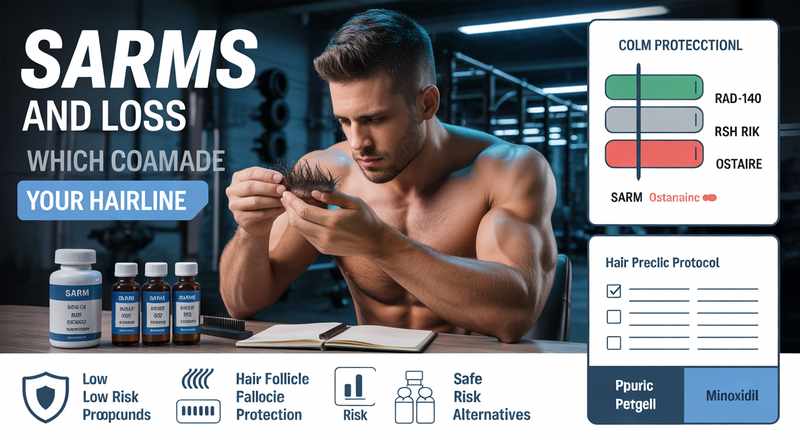
SARMs and hair loss are linked through direct androgenic receptor binding in hair follicles, not through DHT conversion. SARMs that are highly anabolic often retain significant androgenic activity in scalp tissue, causing follicle miniaturization in genetically predisposed individuals. RAD-140 (Testolone), LGD-4033 (Ligandrol), and YK-11 carry the highest hair loss risk of the major SARMs. Ostarine (MK-2866) and Cardarine (GW-501516) carry essentially zero hair loss risk at standard doses. Finasteride has limited efficacy on SARMs-related hair loss because SARM activity at scalp receptors is direct — blocking the 5-alpha reductase enzyme that converts testosterone to DHT does not block a compound that already binds the receptor directly.
[IMAGE SUGGESTION 1: visual]
1. How SARMs Actually Cause Hair Loss: The Mechanism Most Guides Get Wrong
To understand the link between SARMs and hair loss, you need to understand androgenic alopecia at the follicle level. Hair follicles on the scalp express androgen receptors. When those receptors are activated by androgenic compounds, a process called follicle miniaturization begins: the hair growth cycle shortens, each new hair grows thinner and shorter, and eventually the follicle becomes dormant.
In natural male physiology, the main androgen that drives this process is dihydrotestosterone (DHT). DHT is converted from testosterone by the enzyme 5-alpha reductase (5-AR). It binds androgen receptors in scalp follicles with approximately 3 to 5 times the affinity of testosterone itself. This is the basis of finasteride’s mechanism: block 5-AR, reduce DHT, protect follicles.
Why SARMs Bypass This Pathway
SARMs bind androgen receptors directly. They do not rely on conversion to DHT to activate scalp follicle receptors. The degree to which they do this depends on the compound’s selectivity profile. The actual anabolic-to-androgenic ratios for available SARMs range from roughly 3:1 to 10:1, with DHT itself at approximately 1:1 for reference.
WHAT THE RESEARCH SAYS
Research on SARM selectivity profiles (Narayanan et al., 2008, Endocrinology; Zilbermint and Dobs, 2009) confirms that tissue-selective androgenic activity is compound and receptor-density dependent. Scalp follicle androgen receptor expression varies significantly between individuals based on genetic programming at the AR gene on the X chromosome.
eference.
The practical implication: any SARM with meaningful androgenic activity will produce some degree of follicle stimulation in genetically predisposed individuals, regardless of whether DHT is involved. Finasteride does not block this effect because finasteride only reduces DHT production â it has no effect on SARMs binding directly to scalp androgen receptors.
WHAT THE RESEARCH SAYS
Research on SARM selectivity profiles (Narayanan et al., 2008, Endocrinology; Zilbermint and Dobs, 2009, Expert Opinion on Investigational Drugs) confirms that tissue-selective androgenic activity is compound and receptor-density dependent. Scalp follicle androgen receptor expression varies significantly between individuals based on genetic programming at the AR gene on the X chromosome â which is why two people can run an identical SARM cycle with completely different hair outcomes.
2. SARMs Hair Loss Risk Rankings: Every Major Compound Rated
The following table ranks every commonly used SARM by hair loss risk. Risk is assessed based on the compound’s anabolic-to-androgenic selectivity ratio, reported androgenic side effects in clinical trial data and user populations, and the degree to which the compound retains androgen receptor agonist activity in non-muscle tissues.
| SARM | Hair Loss Risk | Androgenic Activity | Reason |
|---|---|---|---|
| RAD-140 (Testolone) | HIGH | High potency, partial androgenic selectivity | Strong AR agonist activity; highest hair shedding reports of any SARM |
| YK-11 | HIGH | Steroidal backbone, partial DHT derivative | Structurally closest to a steroid; DHT-like androgenic activity at scalp |
| S-23 | HIGH | Very high androgenic potency | One of the most androgenic SARMs; serious scalp androgenic activity |
| LGD-4033 (Ligandrol) | MODERATE | High anabolic, moderate androgenic | Hair loss reported, especially at 10mg+; dose-dependent |
| Andarine (S4) | MODERATE | Moderate, partial agonist at scalp AR | Lower selectivity than Ostarine; hair effects dose-dependent |
| Ostarine (MK-2866) | LOW | High tissue selectivity, minimal scalp AR activity | Best selectivity profile of any classic SARM; lowest androgenic side effects |
| ACP-105 | VERY LOW | Designed for high CNS selectivity, low androgenic peripheral activity | Minimal androgenic side effects; data limited but favorable |
| Cardarine (GW-501516) | NONE | Not a SARM â PPAR-delta agonist, no androgenic activity | Zero androgenic receptor activity; cannot cause androgenic alopecia |
| MK-677 (Ibutamoren) | NONE | GH secretagogue, no androgenic activity | Not androgenic; some users report hair thickening via GH/IGF-1 pathway |
Important Note on RAD-140: RAD-140’s position as the highest-risk SARM for hair loss is consistent across clinical trial adverse event data and user-reported outcomes. The SARMs community consistently identifies RAD-140 as the compound most associated with accelerated hairline recession, even at conservative doses. Individuals with significant family history of male pattern baldness (particularly maternal grandfather and father patterns) face a disproportionately higher risk.
3. The Genetic Factor: Why Two People React Completely Differently
SARMs and hair loss outcomes depend more on your genetics than on almost any other variable. Two people can run identical RAD-140 cycles at identical doses for identical durations and have completely different hair outcomes â one experiences obvious shedding, the other notices nothing. The explanation is in the androgen receptor gene.
The androgen receptor (AR) gene is located on the X chromosome. A specific CAG repeat polymorphism in this gene influences how sensitive the receptor is to androgenic stimulation: fewer CAG repeats correlates with higher receptor sensitivity to androgens. Individuals with highly sensitive androgen receptors (fewer repeats) experience more aggressive androgenic side effects â including hair loss â from the same dose of the same compound compared to individuals with less sensitive receptors.
The practical test for this is your own hair history and family pattern. Indicators of high androgenic receptor sensitivity relevant to SARMs and hair loss risk:
- Personal early hair loss (starting before age 30 or at a young age)
- Father showing significant androgenic alopecia
- Maternal grandfather showing significant androgenic alopecia (X-chromosome inheritance makes this the stronger predictor)
- History of aggressive hair shedding in response to even mild androgenic compounds (creatine, pre-workouts with hormonal herbs)
- Thick, fast-growing body and facial hair (high androgenic receptor density systemically)
If you have three or more of these indicators, you are in a higher-risk category for SARMs and hair loss. Choosing compounds from the low-risk tier of the table above is the most effective primary protective strategy.
SAFETY NOTE
Androgenic alopecia caused by SARMs can be permanent if cycles are run long enough for follicle miniaturization to become irreversible. The early shedding phase (telogen effluvium) is often reversible if the compound is stopped immediately. Progressive thinning over multiple cycles is not reliably reversible without medical intervention such as minoxidil, Dutasteride, or hair transplantation. Early warning signs are more important than post-cycle intervention.
4. RAD-140 and Hair Loss: The Most Common High-Risk SARM
RAD-140 deserves specific attention in any discussion of SARMs and hair loss because it is simultaneously one of the most popular and most hair-toxic compounds in the class. RAD-140 is the strongest selective androgen receptor modulator by anabolic potency, but its selectivity profile is imperfect: it retains meaningful androgenic activity at scalp follicle receptors despite its overall selectivity.
In clinical trial data for RAD-140 (Testolone), androgenic side effects including hair thinning were among the reported adverse events at doses as low as 0.1mg/kg. In the performance-enhancement community where doses range from 10 to 30mg per day, the hair loss risk is substantially higher and dose-dependent.
The RAD-140 Hair Loss Timeline
Most users who experience hair shedding on RAD-140 report the following pattern:
- Weeks 1 to 3: No noticeable change
- Weeks 4 to 6: Increased shedding (telogen effluvium phase) â more hair coming out in shower, on pillow, when running hands through hair
- Weeks 7 to 12: Shedding may stabilize or intensify depending on genetics and dose
- Post-cycle: Shedding often continues for 4 to 8 weeks after stopping before reversing, because the affected hairs entered the shedding phase during the cycle
The shedding seen in weeks 4 to 6 is often telogen effluvium â a sudden shift of hair follicles from the growth phase (anagen) to the resting and shedding phase (telogen). This phase is usually reversible if caught early. Continued use that leads to follicle miniaturization is a different, more serious progression.
For lifters committed to RAD-140 who have hair loss concerns, the SARMs microdosing approach may be worth evaluating: lower doses of 5 to 7.5mg reduce androgenic scalp exposure while maintaining partial anabolic benefit, though this trades off significantly against the compound’s primary use case.
[IMAGE SUGGESTION 2: A visual infographic showing the hair growth cycle (anagen, catagen, telogen phases) with annotations showing where androgenic stimulation triggers premature entry into the telogen phase. Alongside, a RAD-140 dose-response curve for hair loss risk. Dark gym background, scientific diagram style, white and blue annotations.]
5. LGD-4033 and Hair Loss: The Moderate-Risk Comparison
LGD-4033 (Ligandrol) sits in the moderate-risk tier for SARMs and hair loss, which means it causes hair thinning in a subset of genetically predisposed users at typical doses, but with less frequency and severity than RAD-140. At doses of 2.5 to 5mg per day, hair effects are uncommon. At 10mg per day â a common bodybuilding dose â the risk increases meaningfully.
LGD-4033’s clinical trial data (Basaria et al., 2010, Journal of Gerontology) showed hair-related adverse events at higher doses in some participants. The compound’s androgenic activity at scalp follicles is present but less potent than RAD-140, which places it in the moderate rather than high risk category.
Stacking LGD-4033 with RAD-140, which is a common bulking protocol, creates compounding androgenic scalp exposure and significantly elevates the combined hair loss risk beyond either compound alone. Stack design matters for hair preservation.
6. Does Finasteride Work for SARMs Hair Loss? The Honest Answer
Finasteride (Propecia) is the most widely prescribed medication for male pattern baldness, and it works by inhibiting 5-alpha reductase, the enzyme that converts testosterone into dihydrotestosterone (DHT). It is highly effective for testosterone-driven hair loss. Its efficacy for SARMs-driven hair loss is limited, and in some cases counterproductive.
Here is why finasteride has limited utility for SARMs and hair loss:
SARMs Bind Directly â Finasteride Cannot Block This
Finasteride works upstream of the problem: it blocks the conversion of testosterone to DHT. SARMs do not require this conversion â they bind the androgen receptor directly. Finasteride cannot block a compound from binding a receptor it has direct affinity for. Using finasteride on a RAD-140 cycle may reduce DHT levels (which finasteride always does), but RAD-140’s direct androgenic activity at scalp receptors proceeds independently.
The DHT Compensation Problem
Finasteride reduces systemic DHT by 70 to 90%, which is normally beneficial for hair in a testosterone context. However, DHT plays a role in sexual function, mood, and libido. On a SARM cycle where testosterone is already suppressed, adding finasteride further reduces an androgen that the body needs for non-hair functions. The net result for many users is worsened hormonal side effects without meaningful hair protection.
When Finasteride Might Still Help
If you are using a SARM on top of an exogenous testosterone base (such as a testosterone replacement therapy dose for cycle support), finasteride can reduce the DHT component of hair loss while the SARM’s direct activity runs in parallel. In this specific scenario, finasteride offers partial protection. On a standalone SARM cycle without exogenous testosterone, its utility is substantially reduced.
7. What Actually Works for Hair Protection on SARMs
Given that finasteride’s mechanism is mismatched for most SARMs, what interventions do have evidence for protecting hair during a SARM cycle?
1. Compound Selection (Most Effective)
Choosing lower-risk compounds is far more effective than any mitigation strategy applied to high-risk compounds. If hair preservation is a priority, building a protocol around Ostarine rather than RAD-140 produces meaningfully different hair outcomes for the same cycle goal. Check the risk table above before designing your cycle if hair matters to you.
2. Minoxidil (Topical)
Minoxidil works by a completely different mechanism than anti-androgens: it extends the anagen (growth) phase of the hair cycle and improves follicle blood flow. Because its mechanism is androgen-independent, it is effective against both DHT-driven and SARM-driven hair loss. Topical minoxidil applied to the scalp during a SARM cycle can meaningfully offset follicle miniaturization in progress. 5% foam daily application is standard; some enhanced athletes use it throughout cycles and continue for 3 to 6 months post-cycle.
3. Dutasteride (More Effective Than Finasteride for Hair)
Dutasteride inhibits both type 1 and type 2 5-alpha reductase isoforms compared to finasteride’s type 2 inhibition only. This produces greater DHT reduction (90 to 99% versus 70 to 90%). For SARM users who also use testosterone as a cycle base, dutasteride offers superior DHT reduction. Its limitations for standalone SARM use are the same as finasteride’s: it cannot block direct SARM binding at scalp receptors.
4. Ketoconazole Shampoo (Topical Anti-Androgen)
2% ketoconazole shampoo has modest evidence for reducing scalp androgen activity topically. It does not match the efficacy of oral medications, but its mechanism is relevant: it reduces local androgen receptor binding at the follicle level through a direct topical anti-androgenic effect. Used 3 to 4 times per week, it is a useful adjunct with no systemic hormonal consequences.
5. RU-58841 (Topical Anti-Androgen)
RU-58841 is a non-FDA-approved topical anti-androgen used extensively in the hairloss community. Applied directly to the scalp, it competitively blocks androgen receptor binding at the follicle level. Because it works at the receptor itself (rather than upstream via 5-AR), it is the only topical agent with a mechanism capable of blocking the direct androgenic activity of SARMs at scalp receptors. Research quality is limited (preclinical and open-label only), but mechanistically it is the most logically matched intervention for SARMs-driven hair loss. Risk: there is some concern about systemic absorption, though studies suggest absorption is low at standard topical concentrations.
6. Cycle Length and Dose Management
The severity of SARMs and hair loss is dose and duration dependent. Shorter cycles (6 to 8 weeks), lower doses (closer to the minimum effective dose), and longer off periods give genetically predisposed follicles recovery time between cycles. Running a 16-week RAD-140 cycle at 20mg per day creates substantially higher cumulative androgenic scalp exposure than two 8-week cycles at 10mg separated by 8 weeks off.
GYM APPLICATION
If you are in the early stages of male pattern baldness and committed to running SARMs, the most effective hair-protective stack is: Ostarine at 20 to 25mg (low hair risk compound) + Cardarine at 10mg (zero androgenic activity) + 5% topical minoxidil applied daily. This protocol gives you meaningful body recomposition support and endurance enhancement without the follicle stress of RAD-140 or LGD. Add a hair-focused cycle structure using the SARM cycle calculator for timing guidance.
8. SARMs That Can Actually Improve Hair: MK-677 and the GH Connection
The flip side of SARMs and hair loss is worth covering: some compounds in the broader performance enhancement category may actually improve hair quality rather than degrade it. MK-677 (Ibutamoren) is the most notable example.
MK-677 is a growth hormone secretagogue â it increases pulsatile GH release and raises IGF-1 levels chronically. Hair follicle cells have IGF-1 receptors, and IGF-1 signaling is associated with the promotion of the anagen (growth) phase and follicle cell proliferation. Several clinical studies on GH-related compounds and hair have shown increased hair density and growth rate with IGF-1 elevation.
In practice, some MK-677 users report noticeably thicker hair and faster hair growth, particularly in the early months of use when GH and IGF-1 are rising. This does not reverse androgenic alopecia â MK-677 has no anti-androgenic activity and will not reverse follicle miniaturization already in progress. But for hair follicles not yet in the miniaturization pathway, the GH-IGF-1 axis stimulation can produce visible improvements in density and texture.
This is why MK-677 is sometimes included in hair-protective SARMs cycles: it has zero androgenic activity, no hair loss risk, and a mechanistic basis for potential hair improvement. Used alongside low-risk androgenic compounds like Ostarine, it offers positive net hair effects for most users.
9. Post-Cycle Hair Recovery: What to Expect and How to Accelerate It
Post-cycle therapy after SARMs or steroids is designed primarily for hormonal recovery, but the post-cycle period is also when hair shedding often peaks before reversing. Understanding this timeline helps avoid premature panic about post-cycle hair loss.
The telogen effluvium triggered by androgenic SARM use causes follicles to enter the shedding phase during the cycle. Those hairs do not shed immediately â they remain attached through the telogen phase (roughly 2 to 3 months) before shedding and being replaced. This creates a pattern where hair shedding accelerates 4 to 12 weeks post-cycle even though the androgenic stimulus has stopped. The shedding is lagged behind the cycle’s endpoint.
For most genetically-typical users who experienced mild shedding on SARMs, hair density returns to baseline within 3 to 6 months of stopping. Continuing minoxidil through this period significantly accelerates recovery by keeping the follicles in active anagen phase during the regrowth window. Stopping minoxidil abruptly post-cycle allows the follicles to rest and may extend the recovery timeline.
For users with significant genetic predisposition who experienced progressive thinning across multiple cycles, recovery may be incomplete without medical intervention. The window for reversal is before follicle miniaturization becomes complete â once the follicle has permanently miniaturized, regrowth without intervention (medical or transplant) is unlikely.
After completing any high-androgenic SARM cycle, reviewing the full PCT protocol guide is important not just for testosterone recovery but because a properly managed PCT reduces the duration of androgenic exposure and gives follicles the best recovery environment.
10. SARMs Hair Loss Risk by Cycle Goal: Choosing the Right Compound
Practical cycle design for hair-conscious users means matching compound choice to training goal while minimizing hair risk. Here is how the major cycle goals map to hair-safe compound options:
| Cycle Goal | Hair-Safe Option | Higher-Risk Option | Compromise |
|---|---|---|---|
| Lean bulk / muscle gain | Ostarine 20mg + MK-677 15mg | RAD-140 10mg + LGD-4033 5mg | LGD-4033 5mg (moderate risk, monitor) |
| Cutting / fat loss | Ostarine 20mg + Cardarine 10mg | RAD-140 10mg + Cardarine 10mg | Ostarine alone is sufficient for most cutting cycles |
| Recomposition | Ostarine 20mg + Cardarine 10mg + MK-677 12.5mg | RAD-140 + LGD-4033 stack | Check the top SARMs for recomp guide for rankings |
| Endurance / performance | Cardarine 10mg (zero hair risk) | S-23 (high risk) | Cardarine alone is highly effective for endurance |
| Strength gains | Ostarine 25mg + ACP-105 15mg | YK-11 + RAD-140 stack | YK-11 reserved for those with low hair loss risk genetically |
11. Common Mistakes When Managing SARMs and Hair Loss
| Mistake | Why It Hurts | What to Do Instead |
|---|---|---|
| Taking finasteride thinking it blocks SARMs | Finasteride has no effect on direct SARM binding at scalp receptors | Use topical minoxidil or RU-58841 instead; reserve finasteride for testosterone-only use |
| Ignoring early shedding signals | Telogen effluvium that continues into miniaturization is much harder to reverse | Start minoxidil at first sign of increased shedding; consider stopping or switching compounds |
| Running high-risk compounds at high doses because “I’m not bald yet” | The follicle miniaturization process can run for years before visible hair loss appears | Check family history and consider scalp health monitoring throughout the cycle |
| Stacking multiple androgenic SARMs | Compound androgenic scalp exposure multiplies hair risk beyond either single compound | If stacking, pair high androgenic compounds with zero-risk compounds (Cardarine, MK-677) |
| Stopping minoxidil abruptly post-cycle | Sudden minoxidil withdrawal causes a shedding episode on top of post-cycle shedding | Continue minoxidil through PCT and for 3 to 6 months post-cycle; taper rather than stop abruptly |
Article Summary
- SARMs and hair loss are linked through direct androgenic receptor binding at scalp follicles â not through DHT conversion, which is why finasteride’s standard mechanism is largely ineffective for SARM-driven hair loss
- RAD-140, YK-11, and S-23 carry high hair loss risk; LGD-4033 and Andarine carry moderate risk; Ostarine and ACP-105 carry low risk; Cardarine and MK-677 carry zero hair loss risk
- Genetic predisposition (androgen receptor CAG repeat length, family history) is the primary determinant of how severely any individual responds to SARMs’ androgenic activity at the scalp
- Finasteride cannot block a SARM from binding directly to a scalp follicle’s androgen receptor â its mechanism does not address the SARM hair loss pathway
- Topical minoxidil (5% foam daily) is the most practical and effective hair protection strategy during and after SARM cycles because it works independently of androgen receptor activity
- RU-58841 (topical anti-androgen) is the only topically applied compound that mechanistically addresses direct SARM binding at scalp receptors, though it lacks FDA approval and has limited clinical data
- Hair shedding often peaks 4 to 12 weeks post-cycle due to the telogen effluvium lag â this is normal and often reverses within 3 to 6 months if cycles are not excessively long
- MK-677 may improve hair quality through GH-IGF-1 pathway stimulation and carries zero androgenic hair loss risk, making it a useful addition to hair-conscious cycles
- Compound selection is the single most effective preventive measure: building cycles around Ostarine, Cardarine, and MK-677 provides meaningful body composition benefits with minimal hair risk
- Post-cycle recovery is faster with continued topical minoxidil application â stop it gradually rather than abruptly to avoid adding a drug-withdrawal shedding episode on top of post-cycle shedding
Frequently Asked Questions
Do all SARMs cause hair loss?
No. Not all SARMs cause hair loss, and the risk varies enormously by compound. Cardarine (GW-501516) and MK-677 (Ibutamoren) carry zero hair loss risk because they have no androgenic receptor activity. Ostarine (MK-2866) and ACP-105 carry very low risk due to high tissue selectivity. RAD-140, YK-11, and S-23 carry the highest risk. Choosing compounds from the lower-risk end of the spectrum is the most effective prevention strategy for hair-conscious lifters.
Does finasteride protect your hair on a SARMs cycle?
Finasteride has limited efficacy specifically for SARMs and hair loss. Finasteride works by blocking the conversion of testosterone to DHT. SARMs do not require this conversion â they bind androgen receptors in scalp follicles directly. Finasteride cannot block direct receptor binding, so it offers little protection against the primary mechanism of SARMs-driven hair loss. It can provide partial benefit if you are also using exogenous testosterone alongside SARMs, as it will reduce the DHT component of the combined androgenic exposure.
Will my hair grow back after stopping SARMs?
For most users who experienced increased shedding (telogen effluvium) during a SARM cycle, hair density returns to baseline within 3 to 6 months after stopping. The shedding often peaks 4 to 12 weeks post-cycle due to the lag between follicle programming and visible shedding. Hair that has not undergone permanent follicle miniaturization will regrow. Progressive thinning across multiple long cycles may produce changes that are only partially reversible without medical intervention (minoxidil, dutasteride, or transplant). This is why early shedding signals during a cycle should be taken seriously.
Which SARMs are best for people with a genetic predisposition to hair loss?
Individuals with strong family history of male pattern baldness should build cycles from the low-risk tier: Ostarine (MK-2866) at 15 to 25mg per day, Cardarine (GW-501516) at 10mg for endurance and fat loss support, and MK-677 (Ibutamoren) for GH-driven muscle and recovery benefits. This combination delivers meaningful body composition and performance benefits with essentially no androgenic hair exposure. High-risk compounds like RAD-140, YK-11, and LGD-4033 at high doses should be avoided entirely in individuals with active genetic hair loss progression.
Can SARMs make hair loss permanent?
Yes, if used at high androgenic doses over extended periods in genetically predisposed individuals. The mechanism is follicle miniaturization: the hair growth cycle progressively shortens until the follicle produces only vellus (colorless, thin) hair and eventually becomes dormant. Once a follicle has fully miniaturized, regrowth without medical intervention is unlikely. The timeline for this progression varies by genetic sensitivity and compound choice. This is why monitoring hair health throughout a cycle and stopping or switching compounds at early warning signs is important, not optional.
Is RAD-140 or LGD-4033 worse for hair loss?
RAD-140 is consistently worse for hair loss than LGD-4033. RAD-140 is more potent as an androgenic receptor agonist and shows higher rates of hair shedding in both clinical trial adverse event data and user reports. LGD-4033 causes hair thinning in a subset of genetically predisposed users, particularly at doses of 10mg or higher, but with lower frequency and severity than RAD-140 at equivalent doses. For lifters between the two compounds who are concerned about hair, LGD-4033 at conservative doses (5mg) represents meaningfully lower hair risk than RAD-140 at any standard dose.
Does stacking SARMs increase the hair loss risk?
Yes. Stacking multiple androgenic SARMs creates compound androgenic scalp exposure. A RAD-140 plus LGD-4033 stack does not simply add the two compounds’ individual risks â the combined androgenic receptor activation at scalp follicles is greater than either compound alone. For hair-conscious lifters, pairing any androgenic SARM with a non-androgenic compound (Cardarine, MK-677) rather than stacking two androgenic SARMs is the hair-protective approach. Always use the SARM cycle calculator to plan cycle duration and doses in ways that minimize cumulative exposure.
Disclaimer: This article is for informational and educational purposes only. It is not medical advice. The compounds and protocols discussed may carry serious health risks. Always consult a qualified healthcare provider before starting any new supplement, peptide, hormone, or training protocol. FitScience does not encourage or endorse the use of any illegal substances.
Related Reading on FitScience
- Best SARMs for Cutting: Compounds That Preserve Muscle in a Deficit
- Top 5 SARMs for Recomp Based on the FitScience Methodology
- The Science of SARMs Microdosing: Is Less Actually More?
- <a href="https://fitscience.co/peptides/how-to-run-a-safe-pct-after-sarms-or-peptides-2025-protocols/”>How to Run a Safe PCT After SARMs or Peptides (2025 Protocols)
- SARM Cycle Calculator: Free Advanced Planning Tool